Ask ten engineers which 3D printing technology they prefer, and you’ll get ten different answers — each one correct for their specific situation. FDM is cheap and fast. SLA is precise and smooth. SLS is the choice when geometry gets genuinely complex. But pick the wrong one for your project and you’ll either overspend on capability you don’t need or underspend on a machine that can’t do the job.
This guide is for Indian buyers — product designers, manufacturing managers, R&D teams, and entrepreneurs — who need a clear framework for making that decision. We compare FDM, SLA, and SLS across the variables that actually matter: cost, material range, accuracy, surface finish, and real-world applications. Browse professional 3D printers to see current options available in India.
1. What Are 3D Printing Technologies?
3D printing — formally known as additive manufacturing — is the process of building a physical object from a digital file by adding material layer by layer. Unlike subtractive manufacturing (where you cut away from a block) or formative manufacturing (where you press or cast material into a mould), additive processes build from nothing.
The term ‘3D printing technology’ refers to the specific process used to solidify each layer. Different technologies use different energy sources, different feedstock types, and different solidification mechanisms. The result: each technology has a distinct profile of achievable accuracy, material options, build speed, and cost — which is why choosing correctly matters before you buy or commission a print.
In India, three technologies dominate the practical market for professional buyers: FDM, SLA, and SLS. Below, we break each one down from first principles.
2. How Different 3D Printing Technologies Work
Every 3D printing process starts the same way: a 3D model is sliced into thin horizontal layers by software. From there, the paths diverge:
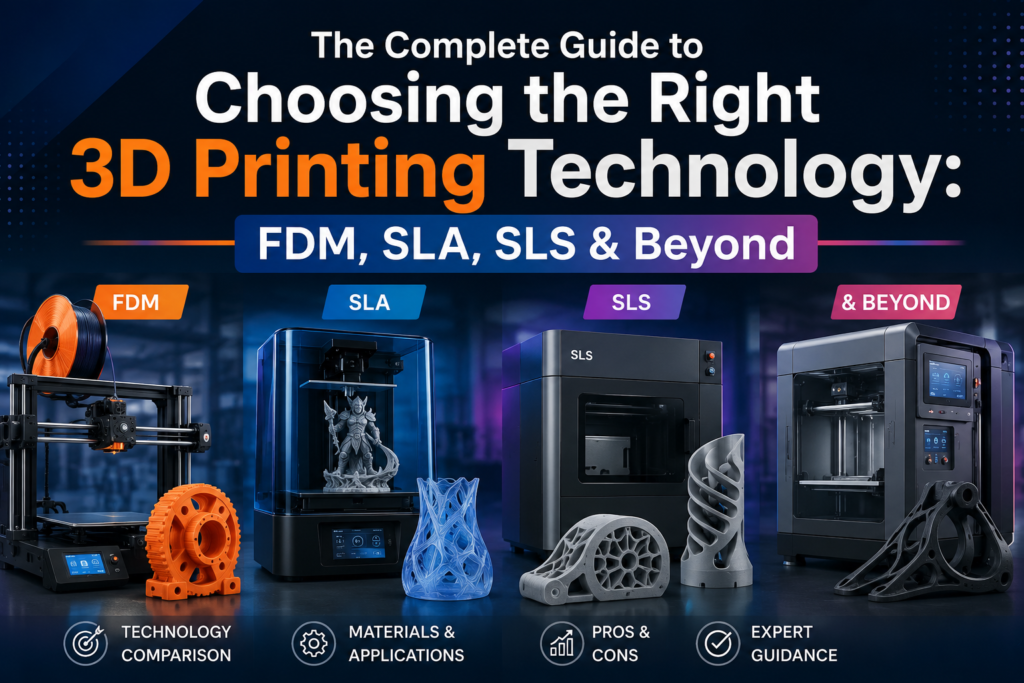
- FDM: A spool of thermoplastic filament is fed through a heated nozzle. The nozzle melts the filament and deposits it in precise paths on a build plate, layer by layer. Each layer fuses to the one below as it cools.
- SLA: A tank of liquid photopolymer resin is selectively cured by a UV laser or light source. The build plate lifts out of the resin as each layer solidifies, producing a highly detailed solid part.
- SLS: A thin layer of nylon powder is spread across a build chamber. A CO2 laser traces the cross-section of the part, fusing powder particles together. The platform drops, a new powder layer is spread, and the process repeats. Unsintered powder acts as natural support material.
The differences in mechanism drive everything else: material compatibility, minimum feature size, surface finish, support structure requirements, and cost per part.
3. FDM Technology Explained
FDM — Fused Deposition Modelling — is the most widely used 3D printing technology in India and globally. Machines from Bambu Lab, Creality, and Raise3D dominate the desktop and semi-industrial FDM segment, offering build volumes from 200 mm cubes all the way past 600 mm for large format industrial machines.
Materials: PLA, ABS, PETG, ASA, nylon, TPU, and composite filaments including carbon fiber and glass fiber reinforced variants. Material selection is the broadest of any 3D printing technology.
Strengths: Low machine cost, low material cost, large build volumes, wide material availability, and strong community support. FDM machines are accessible to small studios, SMEs, and individual engineers without a large capital outlay.
Limitations: Layer lines are visible on the surface. Parts are anisotropic — stronger along the XY plane than in the Z direction. Fine features below 1 mm are unreliable. Support structures leave marks and require post-processing.
Best for: Structural prototypes, tooling jigs and fixtures, large-scale models, educational use, and functional parts where cosmetics are secondary.
For buyers needing large single-piece parts, see our guide to best large format 3D printers for detailed machine comparisons.
4. SLA Technology Explained
SLA — Stereolithography — was the first commercial 3D printing technology, developed in the 1980s, and remains the benchmark for surface quality and dimensional accuracy. Formlabs leads the professional desktop SLA segment globally; Anycubic and Elegoo offer more accessible MSLA (masked SLA) alternatives popular in India.
Materials: Photopolymer resins — standard, engineering-grade, flexible, castable, dental, and high-temperature variants. Material selection is narrower than FDM but is expanding rapidly as resin chemistry matures.
Strengths: Exceptional surface finish comparable to injection-moulded parts. Dimensional accuracy of ±0.1 mm or better on quality machines. Ideal for capturing fine surface details, thin walls, and complex geometry.
Limitations: Resin is expensive per kilogram versus filament. Build volumes are smaller than FDM. Parts require UV post-curing and often isopropyl alcohol washing. Resins can be brittle in standard formulations; engineering resins address this at higher cost.
Best for: Presentation prototypes, product design models, jewellery masters, dental appliances, medical device casings, and any application where surface quality drives the decision.
5. SLS Technology Explained
SLS — Selective Laser Sintering — is the professional’s choice for functional parts that need both geometric complexity and material performance. EOS is the dominant industrial SLS manufacturer globally; the technology is used by aerospace OEMs, automotive Tier-1 suppliers, and medical device companies where output quality justifies the cost.
Materials: Nylon (PA11, PA12), glass-filled nylon, alumide (nylon-aluminium blend), and specialty engineering polymers. Parts are fully dense, isotropic, and mechanically strong in all orientations.
Strengths: No support structures required — the surrounding powder supports overhangs and internal cavities naturally. Parts are strong and functional as printed, with isotropic mechanical properties. Batch production of multiple complex parts in one build is economical.
Limitations: High machine cost — industrial SLS systems start at Rs. 15 lakh and scale into crores for production-grade equipment. Surface finish is grainy compared to SLA. Powder handling requires controlled environment and safety protocols.
Best for: End-use functional parts, complex assemblies with moving components, batch production of engineering-grade components, and applications where part performance matters more than cosmetics.
For manufacturing companies evaluating SLS for production use, the industrial 3D printer buying guide provides a detailed decision framework.
6. FDM vs SLA vs SLS Comparison
Here is a direct comparison across the variables that matter most for Indian buyers:
- Machine cost: FDM is lowest (Rs. 15,000 to Rs. 5,00,000+). SLA is mid-range (Rs. 20,000 for entry MSLA to Rs. 3,00,000+ for professional Formlabs systems). SLS is highest (Rs. 15,00,000 and above for industrial systems).
- Material cost: FDM filament runs Rs. 700–Rs. 3,000 per kg for standard materials. SLA resin costs Rs. 2,000–Rs. 8,000 per litre. SLS nylon powder is Rs. 5,000–Rs. 12,000 per kg.
- Accuracy: SLA leads at ±0.1 mm or better. SLS follows at ±0.2–0.3 mm. FDM is ±0.2–0.5 mm depending on machine calibration and layer height.
- Surface finish: SLA produces the smoothest finish. SLS produces a matte, slightly grainy texture. FDM shows visible layer lines requiring sanding or chemical smoothing for presentation use.
- Build volume: FDM offers the largest build volumes — up to 600 mm+ per axis on industrial machines. SLA tops out around 300 mm for professional desktop systems. SLS industrial machines support 300–700 mm build volumes.
- Support structures: SLS requires none — the unsintered powder provides support naturally. FDM and SLA both require support material for overhangs, which adds print time and post-processing work.
For a deeper spec-by-spec breakdown with India-specific pricing, see our FDM vs SLA vs SLS comparison.
7. Choosing the Right Technology for Your Application
The right technology is determined by four questions:
What does the part need to do? If it’s a structural functional part, FDM or SLS. If it’s a presentation model where clients will examine surface quality closely, SLA. If it’s a complex assembly with moving parts or internal channels, SLS.
How accurate does it need to be? For tolerance-critical parts — mating surfaces, snap fits, precision assemblies — SLA’s accuracy is the benchmark. For general structural prototypes, FDM is sufficient.
What size is it? Large single-piece parts (over 400 mm) push you toward FDM. Most SLA machines cap out under 300 mm per axis. SLS can handle large parts but at significant cost.
What is your budget? FDM is the right entry point for most Indian buyers. SLA makes sense once surface quality becomes a commercial requirement. SLS is a production investment — viable when volume and part complexity justify the cost.
8. Industries Using Different 3D Printing Technologies in India
- Automotive (FDM + SLS): Prototype bumpers, intake manifolds, and bracket assemblies in FDM. Functional end-use clips, ducts, and cable management components in SLS.
- Medical devices (SLA + SLS): Surgical guides and device housings in SLA for accuracy. Prosthetic components and complex body-conforming parts in SLS for strength and geometry freedom.
- Jewellery and consumer goods (SLA): Investment casting masters and presentation prototypes where surface finish is commercially non-negotiable.
- Architecture (FDM + SLA): Large building models and urban planning layouts in FDM. Fine-detail architectural elements and scale façade models in SLA.
- Education and R&D (FDM): IITs, NITs, and private engineering colleges use FDM as the primary technology for student project work, lab fabrication, and design centre operations.
For more industry-specific applications and case studies, visit the 3D printing blog at 3D ProtoFarm.
9. Why Choose 3D ProtoFarm?
3D ProtoFarm is one of India’s dedicated sources for professional 3D printing equipment and materials, serving buyers from its base in Rajkot, Gujarat. The catalogue spans Bambu Lab’s professional FDM range, Creality’s wide desktop and semi-industrial lineup, and a growing selection of filaments — all evaluated for Indian operating conditions.
For Indian buyers, what matters most is not just machine specification on paper but reliable access to spare parts, pre-sales technical guidance, and post-sales support when a machine goes down in a production environment. 3D ProtoFarm provides all three, with India-specific pricing and shipping to major cities across the country.
Whether you’re purchasing your first SLA printer for a design studio or specifying a large format FDM system for an automotive jig room, 3D ProtoFarm is the right starting point for buyers who want expert guidance, not just a transaction.
10. Frequently Asked Questions
What is the best 3D printing technology?
There is no single best technology. FDM is best for large structural parts and low budgets. SLA is best for high surface quality and accuracy. SLS is best for functional end-use parts with complex geometry. The right technology depends on your specific application, required accuracy, and budget.
What is the difference between FDM, SLA and SLS?
FDM melts plastic filament and deposits it layer by layer. SLA uses UV light to cure liquid resin. SLS uses a laser to fuse nylon powder. Each produces different surface quality, accuracy, and material properties.
Which 3D printing technology is best for prototyping?
FDM for fast structural prototypes. SLA for presentation-quality models. SLS for functional prototypes that need to perform under stress or in complex assemblies.
Which technology provides the highest accuracy?
SLA delivers the highest dimensional accuracy — typically ±0.1 mm or better on professional systems. Formlabs machines are the industry standard for high-accuracy desktop SLA work.
Which materials are compatible with FDM, SLA and SLS?
FDM: PLA, ABS, PETG, nylon, TPU, carbon fiber composites. SLA: Standard, engineering, flexible, castable, and dental resins. SLS: Nylon PA11/PA12, glass-filled nylon, alumide.
Which 3D printing technology is most affordable?
FDM is the most affordable across both machine and material costs. Entry-level FDM machines in India start under Rs. 15,000. Professional desktop SLA starts around Rs. 20,000 but resin costs are higher per part.
How do I choose the right 3D printing technology?
Define what the part needs to do, what accuracy and surface finish is required, how large it is, and what your budget is. Match these four variables to the technology profile that fits best.
Where can I buy professional 3D printers in India?3D ProtoFarm offers a curated range of professional FDM and resin printers with India-specific pricing, local shipping, and pre-sales technical support.