
Manufacturing in India is changing faster than most production managers anticipated three years ago. The arrival of industrial 3D printers at the factory floor has moved additive technology from the design studio into direct production workflows — and companies that have made the shift are seeing measurable gains in lead time, tooling cost, and product iteration speed. This guide is written for manufacturing companies, factory owners, engineering teams, and industrial buyers evaluating whether these systems belong in their operations.
Unlike desktop or entry-level machines, industrial systems are engineered for volume, consistency, and material range that desktop units simply cannot match. If you are responsible for procurement, production planning, or engineering direction, the decisions covered here will have a direct impact on your cost per part and your speed to market.
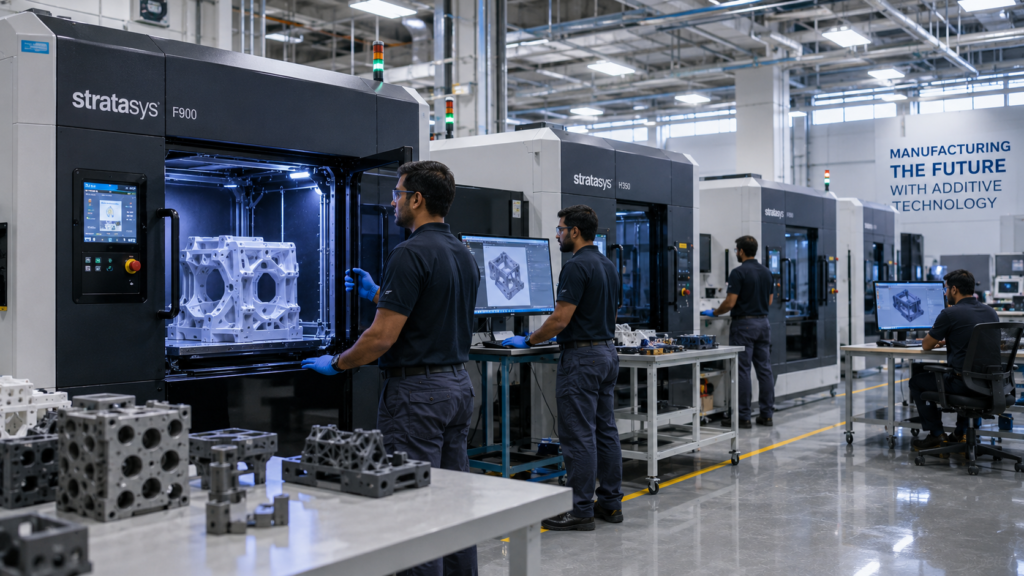
Why Industrial 3D Printers Are Transforming Modern Manufacturing
Traditional manufacturing depends on subtractive processes and fixed tooling. Every new component geometry means a new mold, a new jig, or weeks of machining time. Industrial 3D printers eliminate that constraint. A geometry that would take six weeks to tool conventionally can be printed and verified within days.
The shift is not just about speed. Industrial additive manufacturing has made it practical to produce functional prototypes that behave like the final part, not just look like it. Teams are now running structural tests, fit checks, and regulatory submissions using printed components that match production material properties.
For Indian manufacturers competing on both domestic and export markets, that compressed development cycle is a direct competitive advantage. Companies in automotive ancillary, consumer durables, and precision engineering have already begun integrating additive lines alongside conventional CNC and injection moulding operations.
The economics have also shifted. Entry costs for credible industrial systems have dropped significantly over the last five years, while reliability and throughput have improved. Manufacturing companies that postpone this evaluation are not being prudent — they are ceding ground to peers who are already using these systems to iterate faster and respond to customer changes in near real time.
Key Benefits of Industrial 3D Printing for Manufacturing Companies
Faster Product Development
Engineering teams no longer need to wait on external suppliers for first-article parts. With production-grade 3D printing in-house, the loop between design and physical verification closes in hours. That compression lets teams identify fitment and assembly issues before committing to tooling, which is where most prototype cost overruns originate.
Reduced Production Costs
Tooling is one of the most significant cost drivers in product manufacturing. Industrial additive manufacturing reduces or eliminates tooling requirements for short runs, custom fixtures, and end-of-life spare parts. Companies producing low-volume specialty components — a common profile in Indian industrial equipment manufacturing — are particularly well-positioned to realise these savings.
Improved Design Flexibility
Conventional machining imposes hard constraints on geometry. Industrial 3D printers remove most of those constraints. Internal channels, lattice structures, and consolidated part assemblies that would require multiple machined components to assemble can be printed as a single piece. That design freedom enables both weight reduction and part-count reduction.
Faster Time-to-Market
For product companies, the ability to produce certified functional prototypes quickly and iterate through design cycles without external delays shortens the total timeline from concept to launch. In competitive categories, getting to market four to six weeks earlier has a measurable impact on revenue and customer acquisition.
Industrial 3D Printers vs Professional 3D Printers
The distinction between industrial and professional systems is frequently misunderstood in procurement conversations. Professional 3D printers are well-suited to design offices and prototyping labs where output volume is moderate and material requirements are standard. Industrial systems are engineered for production environments where consistency across long runs, material performance, and system uptime are the deciding factors.
The table below outlines the key differences that matter most to manufacturing buyers:
| Feature | Industrial 3D Printers | Professional 3D Printers |
| Build Volume | Large format (500mm+ per axis) | Medium format (typically under 400mm) |
| Material Range | High-temp polymers, metal composites, specialty resins | Standard PLA, ABS, PETG, TPU |
| Print Accuracy | ±0.05mm or better | ±0.1–0.2mm typical |
| Duty Cycle | 24/7 continuous production | Intermittent or daily use |
| Software Ecosystem | MES/ERP integration, closed-loop monitoring | Standalone slicing software |
| Investment Range | ₹5 Lakh – ₹1 Crore+ | ₹50,000 – ₹5 Lakh |
| Best For | End-use part production, serial manufacturing | Design teams, prototyping labs, engineering offices |
The right choice depends on output volume, material specification, and production context. Many manufacturing companies operate both — professional 3D printers for early design iteration, and industrial systems for production validation and end-use parts.
Applications of Industrial Additive Manufacturing Across Industries
Manufacturing automation through additive technology is now practical across a wider range of sectors than most buyers recognise. Below are the primary application areas relevant to Indian manufacturing companies.
Automotive: Jigs, fixtures, end-of-arm tooling, functional prototypes, and custom interior components are the highest-volume additive applications in automotive manufacturing. Several Tier 1 and Tier 2 suppliers in Pune and Chennai are already running additive alongside conventional lines to handle low-volume variant production.
Aerospace and Defence: Engineering applications here demand tight tolerances and certified materials. Industrial additive manufacturing has become viable for duct assemblies, brackets, and structural components in non-critical airframe positions. Composites-compatible systems are expanding the addressable part range further.
Healthcare: Custom orthotics, surgical guides, anatomical models, and medical device housings represent a growing segment. The ability to produce patient-specific geometry affordably makes industrial printing a practical choice for medical device manufacturers and hospital procurement teams alike.
Consumer Products: Rapid prototyping of packaging, consumer electronics housings, and lifestyle product components gives product teams the ability to run user testing with production-representative parts before committing to injection moulding tooling.
Industrial Equipment: Spare parts on demand is one of the highest-ROI applications for industrial equipment manufacturers. Producing low-volume legacy spare parts additively eliminates minimum order quantity constraints and long lead times from external suppliers.
Features Manufacturing Companies Should Evaluate Before Buying
Procurement decisions for industrial systems involve more variables than a standard equipment purchase. The following six criteria should anchor every evaluation:
- Build Volume: Larger build envelopes increase per-run output and reduce the need to split parts. Evaluate this against your largest expected part geometry, not your average job size.
- Material Compatibility: Verify that the system supports the engineering materials your application requires — whether that is high-temperature polymers, flame-retardant compounds, flexible elastomers, or fibre-reinforced composites.
- Print Accuracy: For functional prototypes and production parts, dimensional accuracy directly determines whether the part passes inspection. Confirm stated accuracy against your tightest tolerance requirements.
- Production Speed: Throughput matters when the machine needs to support a manufacturing line rather than a design team. Evaluate build speed in the context of your expected weekly output volume.
- Software Ecosystem: Industrial systems should integrate with your existing MES, ERP, or CAD infrastructure. A closed or poorly-documented software stack creates long-term operational risk.
- Scalability: Consider whether the platform supports a fleet approach as your volumes grow. Some industrial systems are designed to scale horizontally across multiple units managed from a central queue.
How to Select the Right Industrial 3D Printer
Selection should begin with a clear application profile, not a shortlist of machines. Define the part types you intend to produce, the materials those parts require, the volume you expect in the first 12 months, and the level of surface finish or dimensional accuracy the application demands.
Once the application profile is clear, evaluate machines against it rather than against general benchmark specifications. A system with an impressive maximum print speed means little if it cannot maintain dimensional accuracy at that speed for your specific geometry.
Engage with a supplier that can provide production samples in your target material. 3DProtoFarm offers access to a range of industrial 3D printer solutions suited to Indian manufacturing environments, along with application-level guidance to help teams match the right technology to their production context.
For teams that want to validate production-grade 3D printing before committing to capital equipment, evaluating 3D printing services is a practical first step. It allows your engineering team to run real application tests with production-representative parts and build an internal business case grounded in actual output data.
Request total cost of ownership figures, not just machine price. Factor in material cost per part, maintenance contracts, consumables, and operator training. For most manufacturing companies, the cost-per-part calculation over a three-year horizon changes the relative ranking of machines significantly.
Future Trends in Industrial Additive Manufacturing
Several developments will meaningfully expand what industrial additive manufacturing can do for production companies over the next three to five years.
Multi-material printing is moving from laboratory capability to production readiness. Systems capable of depositing two or more materials in a single build are enabling components with integrated electrical pathways, overmoulded flexible zones, and graduated material properties — none of which are achievable through conventional manufacturing without assembly.
High-speed platforms such as Bambu Lab 3D printers are demonstrating that significantly faster print speeds are achievable without sacrificing dimensional accuracy. As these platforms extend into engineering material ranges, they will become viable for higher-volume production runs that currently sit above the practical threshold for additive.
Closed-loop process control — where the printer uses in-process sensors to detect and correct deposition errors in real time — is reducing the inspection burden associated with additive output and bringing part consistency closer to conventional manufacturing standards.
AI-driven process optimisation is also gaining traction. Systems that learn from historical print data to automatically adjust parameters for each new geometry will reduce setup time and material waste, making industrial additive manufacturing more accessible to smaller production teams without dedicated additive engineering specialists.
Conclusion: The Business Case for Industrial 3D Printers Is Established
Industrial 3D printers are no longer a speculative investment. For manufacturing companies operating in competitive categories — whether that is automotive components, industrial equipment, healthcare devices, or consumer products — these systems deliver measurable returns across development speed, tooling cost, and production flexibility.
Professional 3D printers continue to serve design and prototyping functions well, but the companies gaining the most from additive technology have moved beyond the design office and are using industrial systems as part of their core production capability.
The question for most manufacturing companies is no longer whether industrial additive manufacturing belongs in their operations. It is which system, at what scale, and how to integrate it into existing workflows with minimal disruption.
If your team is ready to evaluate options or move forward with implementation, explore the full range of industrial 3D printer solutions available for Indian manufacturing environments. The technology is here. The returns are documented. The next step is yours.




3 thoughts on “Commercial Guide to Industrial 3D Printers for Manufacturing Companies”
Pingback: Multi-Color 3D Printing: Best Printers, Technologies & Buying Guide (2026)
Pingback: Aerospace-Grade 3D Printing Materials Guide for Aerospace Parts
Pingback: Aerospace Tooling: 3D Printed Jigs, Fixtures & Gauges