Aerospace-Grade 3D Printing Materials Overview
Aerospace manufacturing runs on tolerances most industries never have to think about. A bracket on a satellite or a turbine component in a regional jet doesn’t get a second chance once it’s flying, so the material it’s printed from has to perform under heat, fatigue, and vibration loads that would shrug off a typical industrial part. That’s exactly why additive manufacturing has moved from prototyping curiosity to production reality across the aerospace supply chain: the right metal or polymer, printed with the right process control, now meets specifications that used to demand forged or machined billet stock.
For manufacturers and design teams working in India’s growing aerospace and defense ecosystem, sourcing and qualifying these materials locally is no longer a bottleneck. From titanium alloys for structural brackets to PEEK and ULTEM for cabin interiors and ducting, this guide breaks down the materials that matter, how they stack up against each other, and where each one earns its place on an aircraft, satellite, or UAV.
Best Metal & Polymer Materials for Aerospace
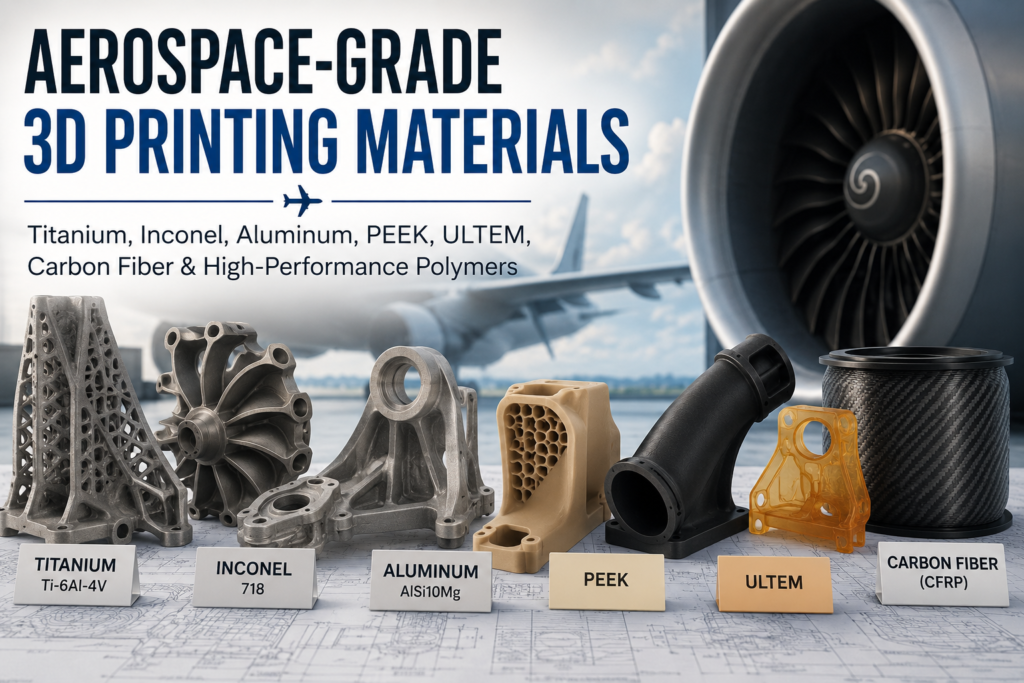
Titanium (Ti-6Al-4V)
Titanium alloy Ti-6Al-4V remains the workhorse of metal additive manufacturing for aerospace. It delivers an exceptional strength-to-weight ratio, resists corrosion in extreme environments, and holds up well under cyclic fatigue, which makes it a natural fit for structural brackets, engine mounts, and landing gear components. Indian manufacturers producing UAV airframes and satellite structures increasingly specify Ti-6Al-4V for parts that need to shed weight without giving up load-bearing capacity.
Inconel (625 and 718)
When a component sits close to a combustion chamber or exhaust path, Inconel takes over. This nickel-chromium superalloy keeps its mechanical properties at temperatures north of 650°C, which is why it shows up in turbine blades, combustor liners, and exhaust manifolds. Inconel 718 in particular is prized for its weldability and resistance to creep under sustained thermal load, making it the default choice for hot-section engine hardware that’s too complex or too low-volume to justify traditional casting.
Aluminum Alloys (AlSi10Mg, Scalmalloy)
Not every aerospace part needs titanium-level performance, and that’s where aluminum earns its keep. AlSi10Mg offers a good balance of strength and printability at a fraction of titanium’s cost, suiting brackets, housings, and ducting where weight savings matter but service temperatures stay moderate. Scalmalloy, a newer scandium-aluminum alloy, pushes strength closer to titanium territory while staying significantly lighter, which is why it’s gaining traction in drone frames and satellite components where every gram counts.
PEEK (Polyether Ether Ketone)
PEEK is the polymer aerospace engineers reach for when they need metal-like performance without the weight. It resists chemicals, holds dimensional stability under sustained heat near 250°C, and meets the flame, smoke, and toxicity standards required for cabin interiors. Connector housings, insulation components, and structural clips in non-load-bearing zones are common PEEK applications, especially where weight reduction directly improves fuel efficiency.
ULTEM 9085
ULTEM 9085 is practically synonymous with FAA-compliant aircraft interiors at this point. Its inherent flame retardancy, low smoke generation, and high strength-to-weight ratio make it the standard for ducting, air vents, cabin brackets, and interior panels. It’s also a favorite for low-volume production runs where tooling costs for traditional manufacturing wouldn’t make sense.
Carbon Fiber Reinforced Polymers
Carbon fiber reinforced nylon and PEEK composites bring added stiffness and dimensional stability to parts that need to resist warping under thermal cycling. Jigs, fixtures, and ground support equipment used in aircraft assembly lines benefit from this combination of rigidity and reduced weight, even if the parts themselves never leave the ground.
Material Comparison: Titanium vs Inconel vs PEEK vs ULTEM
Choosing between these materials comes down to matching service environment to material capability. The table below summarizes the core mechanical and thermal differences, along with typical sourcing costs for Indian manufacturers and design teams.
| Material | Tensile Strength | Max Service Temp | Density | Typical Cost (India) |
| Titanium Ti-6Al-4V | ~950 MPa | ~400°C | 4.43 g/cm³ | ₹8,000–₹14,000/cc |
| Inconel 718 | ~1,240 MPa | ~650°C | 8.19 g/cm³ | ₹12,000–₹20,000/cc |
| PEEK | ~100 MPa | ~250°C | 1.30 g/cm³ | ₹15,000–₹25,000/kg |
| ULTEM 9085 | ~70 MPa | ~186°C | 1.34 g/cm³ | ₹9,000–₹14,000/kg |
| Carbon Fiber Nylon | ~60 MPa | ~150°C | 1.10 g/cm³ | ₹3,500–₹6,000/kg |
A few patterns stand out here. Inconel pulls ahead on temperature resistance, which is why it owns the hot end of the engine. Titanium balances strength and weight better than any metal on this list, and it remains the default for structural aerospace parts. PEEK and ULTEM dominate the polymer side, with PEEK leaning toward chemical resistance and ULTEM toward flame-retardant interior compliance. Carbon fiber composites round out the lineup as the budget-conscious option for tooling and fixtures rather than flight-critical hardware.
Aerospace Applications & Material Selection
Material selection in aerospace additive manufacturing isn’t a single decision; it’s a series of trade-offs across weight, temperature, certification requirements, and cost. Here’s how the choice typically breaks down by application area.
- Engine and hot-section components: Inconel 625/718 for turbine blades, combustor liners, and exhaust hardware exposed to sustained high temperatures.
- Structural airframe parts: Titanium Ti-6Al-4V for brackets, mounts, and load-bearing fittings where strength-to-weight ratio is the deciding factor.
- Lightweight structural alternatives: Scalmalloy or AlSi10Mg for UAV frames and satellite panels where cost and printability matter alongside weight.
- Cabin interiors and ducting: ULTEM 9085 for FAA-compliant panels, vents, and brackets that need flame, smoke, and toxicity certification.
- Connectors and chemical-exposure parts: PEEK for housings and components that need to resist fuel, hydraulic fluid, or sustained heat.
- Tooling, jigs, and fixtures: Carbon fiber reinforced polymers for ground support equipment and assembly aids that need rigidity without metal costs.
Indian aerospace and defense manufacturers working on UAV programs, satellite subsystems, or MRO (maintenance, repair, overhaul) parts increasingly rely on this material matrix to cut both lead time and tooling cost compared to traditional casting or CNC machining from billet.
For a broader look at which printing technology pairs best with which material class, see our FDM vs SLA vs SLS Comparison, and if you’re evaluating equipment for in-house aerospace production, our Commercial Guide to Industrial 3D Printers covers what to look for in a machine built for these materials.
Why Choose 3D Proto Farm for Aerospace Projects
Working with aerospace-grade materials isn’t just about having the right machine; it’s about process discipline. Powder handling for titanium and Inconel needs controlled atmospheres to avoid contamination, polymer printing for ULTEM and PEEK needs chamber temperatures held within tight bands, and every part needs traceability back to its material batch.
3D Proto Farm’s 3D Printing Services are built around exactly this kind of process control, covering everything from metal powder bed fusion to high-temperature polymer extrusion for aerospace, defense, and industrial clients across India.
Beyond contract printing, the team also supports manufacturers setting up in-house capability, with a curated range of Industrial 3D Printers suited to metal and high-performance polymer production, along with sourcing for qualified Engineering Materials including titanium, Inconel, PEEK, and ULTEM stock.
Whether the requirement is a single Inconel prototype for a turbine test rig or a production run of ULTEM cabin brackets, the combination of verified material sourcing, India-based logistics, and process expertise keeps lead times and costs predictable for engineering teams that can’t afford a failed batch.
Frequently Asked Questions
Which material is best for aerospace structural parts?
Titanium Ti-6Al-4V is generally the first choice for structural aerospace components because of its strength-to-weight ratio and fatigue resistance, though aluminum alloys like Scalmalloy are gaining ground for applications where extra weight savings outweigh the need for titanium’s higher strength.
Can PEEK and ULTEM replace metal parts in aircraft?
For non-load-bearing components such as ducting, brackets, connector housings, and interior panels, yes. Both polymers meet relevant flame, smoke, and toxicity standards, but they aren’t substitutes for metal in primary structural or hot-section applications.
Why is Inconel used instead of titanium for engine parts?
Inconel retains its mechanical strength at temperatures well beyond what titanium can handle, which makes it the necessary choice for turbine blades and other hot-section hardware exposed to sustained heat near or above 650°C.
Is metal 3D printing certified for flight-critical aerospace parts in India?
Certification depends on the specific application, the part’s criticality, and the governing aviation authority’s requirements. Indian manufacturers typically combine additive manufacturing with rigorous material testing, batch traceability, and non-destructive inspection to meet the qualification standards required for flight-critical use.
What’s the cost difference between titanium and aluminum 3D printing in India?
Titanium powder and processing typically cost two to three times more than aluminum alloys in the Indian market, reflecting both raw material price and the more demanding process controls titanium printing requires.