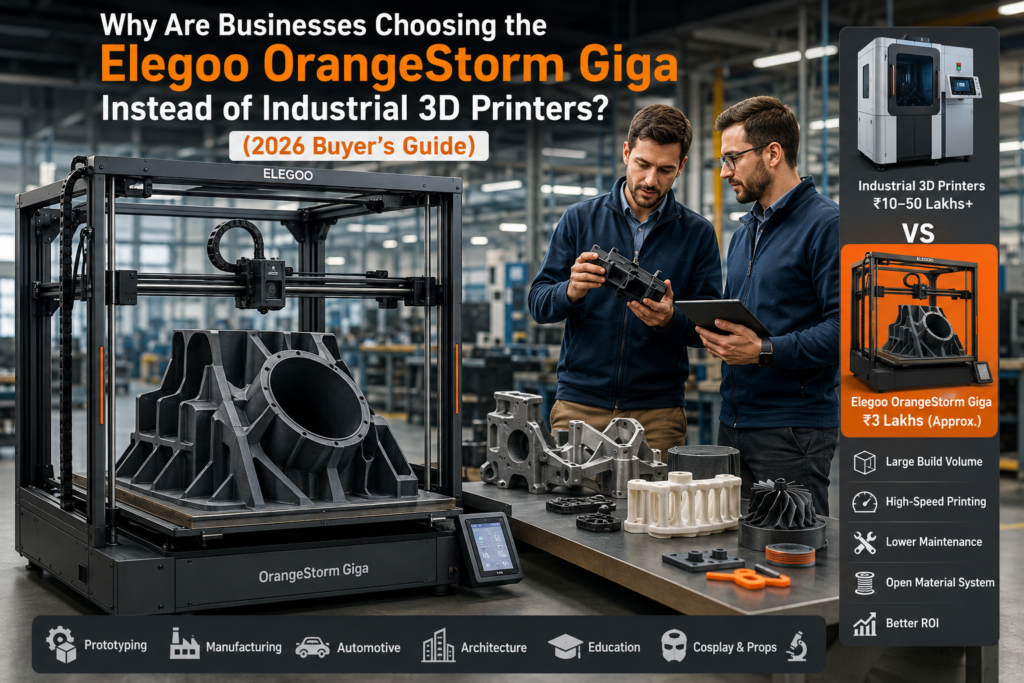
2026 is turning into the year large-format printing stopped being a luxury reserved for factory floors with seven-figure equipment budgets. Manufacturing teams, design studios, and R&D departments across India are increasingly weighing a roughly ₹3 lakh desktop-class large-format printer against industrial systems that routinely cost ₹10-50 lakh once tooling, service contracts, and training are factored in. That comparison is exactly what’s driving interest in the Elegoo OrangeStorm Giga.
The OrangeStorm Giga has become a talking point in manufacturing circles because it doesn’t ask a business to choose between build volume and budget. It offers genuinely industrial-scale printing without the capital outlay, the closed material ecosystems, or the long onboarding cycles that typically come with production-grade machines. For companies that need large parts but don’t need every certification an aerospace supplier requires, it’s changed the calculation entirely.
What is the Elegoo OrangeStorm Giga?
The Elegoo OrangeStorm Giga is a large-format FDM 3D printer built for teams that regularly hit the size limits of consumer-grade machines. With a build volume large enough to print furniture-scale components, full-size cosplay armor, or automotive interior mockups in one piece, it sits in a category that used to belong almost exclusively to industrial 3D printer manufacturers.
What makes it stand out isn’t just the size. The Elegoo OrangeStorm Giga runs on an open material ecosystem, meaning businesses aren’t locked into proprietary, marked-up filament the way they would be with many closed industrial systems. It supports high-speed printing profiles, a rigid CoreXY-style motion system for consistent large-scale accuracy, and enough thermal control to handle everything from PLA prototypes to more demanding engineering filaments.
Typical buyers include product design studios, engineering consultancies, architecture practices, automotive prototyping teams, exhibition and props fabricators, and print farms that need to scale output without scaling capital expenditure. For a broader look at how this category has evolved, our guide to Large Format 3D Printers breaks down the wider market landscape.
Why Businesses Are Replacing Industrial Printers
The shift toward machines like the OrangeStorm Giga isn’t happening because industrial 3D printers got worse. It’s happening because businesses are getting sharper about total cost, deployment speed, and what actually needs to happen on the shop floor versus what a sales brochure promises.
- Lower upfront investment — a large-format desktop printer costs a fraction of a comparable industrial system, freeing capital for tooling, staffing, or additional units.
- Faster ROI — with entry costs this much lower, break-even on a first production run arrives in weeks rather than years.
- Open filament compatibility — businesses can shop across brands instead of paying a premium for proprietary spools.
- Lower operating expenses — no service contracts, no per-print licensing, and simpler consumables.
- Easier maintenance — standard FDM components mean local technicians can service the machine without a manufacturer engineer flying in.
- Faster deployment — a large-format desktop printer can be unboxed and printing within a day, not weeks of installation and calibration.
- Reduced training requirements — most FDM-experienced operators are productive within hours, not the weeks industrial systems often demand.
It’s important to be direct about where this doesn’t apply. The Elegoo OrangeStorm Giga replaces industrial 3D printers well in prototyping, tooling, jigs and fixtures, architectural modeling, and large functional parts that don’t require certified engineering-grade materials. It is not a substitute where aerospace or medical certification, ultra-tight tolerances, or exotic high-temperature polymers are non-negotiable — more on that later in this guide.
Elegoo OrangeStorm Giga vs Industrial 3D Printers
Here’s a neutral, side-by-side look at how the two categories typically compare on the factors that matter most to a buying decision.
| Feature | OrangeStorm Giga | Industrial 3D Printer (₹10-50L) |
| Purchase Price | Approx. ₹3 lakh | ₹10-50 lakh+ |
| Build Volume | Very large (furniture/automotive scale) | Large, often comparable or larger |
| Print Speed | High-speed FDM profiles | Varies; often optimized for accuracy over speed |
| Material Cost | Open-market filament pricing | Often proprietary, premium-priced material |
| Software | Open-source slicers, broad compatibility | Often closed, licensed software |
| Maintenance | Standard FDM parts, locally serviceable | Manufacturer-dependent, specialized |
| Service Costs | Low, mostly self-managed | Annual contracts common |
| Closed vs Open Materials | Open ecosystem | Frequently closed/proprietary |
| Ease of Operation | Accessible to trained FDM operators | Steeper learning curve |
| Typical ROI | Weeks to a few months | Often 1-3 years |
| Best Applications | Prototyping, tooling, large functional parts | Certified, high-tolerance production |
Total Cost of Ownership (TCO)
Purchase price is only the opening line of the real cost conversation. A complete Total Cost of Ownership picture includes the initial investment, ongoing filament costs, spare parts, electricity, maintenance, service contracts, and — often the most underestimated factor — downtime.
With the Elegoo OrangeStorm Giga, most of these line items stay low because the machine uses standard, widely available components and an open material ecosystem. Filament costs stay competitive since businesses aren’t locked into a single proprietary supplier. Spare parts are inexpensive and easy to source. Electricity draw is modest compared to enclosed industrial systems with heated chambers running continuously.
Industrial printers can look justified on a spec sheet, but service contracts, certified material costs, and specialized technician callouts add up quickly — and unplanned downtime on a ₹30 lakh machine is a far more expensive problem than downtime on a large-format desktop unit. That’s why TCO, not sticker price, should anchor any serious purchasing decision.
Applications Where the OrangeStorm Giga Excels
Automotive Prototypes
Interior trim mockups, dashboard sections, and full-scale bumper prototypes can be printed in a single build, cutting the assembly and finishing time that smaller-format printers require.
Manufacturing Jigs & Fixtures
Factories use the OrangeStorm Giga to print custom jigs and fixtures on demand rather than waiting weeks for machined tooling, especially useful for low-volume or frequently changing production lines.
Architectural Models
Large-scale building models that once required segmented printing and gluing can now be produced closer to true scale in fewer pieces, saving both time and visible seam lines.
Product Development
Design teams iterate faster when full-size housings, enclosures, and ergonomic mockups can be printed overnight instead of scaled down or split across multiple machines.
Cosplay & Props
Cosplay production studios and prop houses rely on large-format printing for armor pieces, helmets, and set props that would otherwise need extensive multi-part assembly.
Education & Research
Universities and research labs use the machine’s scale and open material support to run engineering, robotics, and design coursework without per-print licensing costs.
Robotics
Robotics teams prototype chassis components and enclosures at full scale, testing fit and structural behavior before committing to final materials.
Furniture Prototyping
Furniture designers can prototype chair frames, panel sections, and modular components at near-final size, dramatically shortening design review cycles.
Exhibition Models
Trade show displays and exhibition pieces benefit from large single-piece prints that look more polished than visibly segmented alternatives.
Large Functional Parts
From ductwork sections to equipment housings, functional parts that don’t require certified engineering resins print reliably at production-relevant scale.
Material Compatibility
The OrangeStorm Giga’s open ecosystem supports a wide range of materials, giving businesses flexibility to match material choice to application rather than being limited to a manufacturer’s approved list.
| Material | Compatibility | Typical Applications |
| PLA | Full | Concept models, low-stress prototypes |
| PLA+ | Full | General prototyping, display models |
| PETG | Full | Functional parts, outdoor-tolerant components |
| ABS | Full (enclosure recommended for large parts) | Automotive trim, durable housings |
| ASA | Full (enclosure recommended) | UV-exposed outdoor parts, automotive |
| TPU | Supported at moderate speeds | Flexible components, gaskets, props |
| PLA-CF | Supported | Rigid, lightweight structural prototypes |
| PETG-CF | Supported | Higher-stiffness functional parts |
For demanding engineering polymers — high-temperature PEEK, ULTEM, or certified aerospace-grade materials — enclosed industrial printers with tightly controlled chamber environments remain the more reliable choice. Businesses working in those material categories should treat the OrangeStorm Giga as a prototyping companion rather than a production replacement.
Print Quality & Productivity
Layer consistency across large prints depends heavily on frame rigidity, and the OrangeStorm Giga’s structural design is built specifically to reduce the wobble and ringing that typically plague oversized FDM printers. Accuracy holds up well across large single-piece prints, which matters most for assemblies where multiple parts need to fit together.
For batch production, the machine’s reliability over long print runs makes it a practical fit for print farms and businesses running overnight production cycles. The trade-off between speed and quality is manageable — high-speed profiles work well for draft prototypes, while dialed-back settings deliver cleaner surface finishes for client-facing models. Most production workflows end up using a mix of both depending on the part’s purpose.
When an Industrial 3D Printer Still Makes Sense
A balanced buyer’s guide has to be honest about limits. There are scenarios where an industrial 3D printer remains the right call, regardless of cost:
- Aerospace components requiring certified materials and traceable manufacturing records
- Medical devices subject to regulatory compliance and validated production processes
- Parts requiring high-temperature engineering polymers like PEEK or ULTEM
- Applications with tight dimensional tolerances beyond typical FDM capability
- Production requiring specific industry certifications
- Fully automated manufacturing environments integrated into broader production lines
If your business operates in any of these categories, the OrangeStorm Giga is better positioned as a prototyping and tooling tool that runs alongside an industrial system, not a replacement for it. To understand where certified industrial systems remain essential, see our breakdown of Industrial 3D Printing requirements across regulated sectors.
Who Should Buy the Elegoo OrangeStorm Giga?
The Elegoo OrangeStorm Giga is a strong fit for:
- Startups that need large-format capability without industrial-scale capital
- SMEs scaling prototyping or light production in-house
- Product designers and design studios iterating on full-size mockups
- Architecture firms producing scale models
- Engineering companies building jigs, fixtures, and functional prototypes
- Educational institutes teaching design, engineering, or robotics
- Print farms looking to add large-format capacity affordably
- Manufacturing businesses needing on-demand tooling
Businesses should look at true industrial systems instead if they operate in certified, regulated, or high-tolerance production environments where the limitations outlined above would be a dealbreaker.
Pros & Cons
Advantages
- Massive build volume at a fraction of industrial pricing
- Open material ecosystem with no proprietary lock-in
- Fast deployment and short learning curve
- Low total cost of ownership
- Strong fit for prototyping, tooling, and large functional parts
Limitations
- Not suited for certified aerospace or medical production
- Limited support for extreme high-temperature engineering polymers
- Open-frame design needs an enclosure add-on for consistent ABS/ASA printing at scale
- Tolerances, while good for FDM, won’t match industrial-grade precision systems
Frequently Asked Questions
Is the Elegoo OrangeStorm Giga suitable for commercial use?
Yes. It’s widely used commercially for prototyping, tooling, and large functional parts across manufacturing, design, and education sectors.
Can it replace an industrial 3D printer?
It can replace industrial printers for many prototyping, tooling, and large-format applications, but not for certified, high-tolerance, or regulated production.
What industries benefit most from it?
Automotive, product design, architecture, education, robotics, furniture prototyping, and exhibition fabrication all benefit significantly.
What materials does it support?
PLA, PLA+, PETG, ABS, ASA, TPU, PLA-CF, and PETG-CF are all supported, thanks to its open material ecosystem.
How much can businesses save?
Compared to a ₹10-50 lakh industrial system, businesses can save the vast majority of upfront capital while still accessing large-format printing capability.
Is it suitable for print farms?
Yes. Its reliability over long print runs and low per-unit operating cost make it a practical addition to print farm operations.
What maintenance does it require?
Routine FDM maintenance — nozzle checks, belt tension, and bed leveling — using standard, widely available components.
Can it print large engineering parts?
Yes, within the limits of FDM materials like PETG-CF and PLA-CF. Parts requiring certified engineering polymers still need industrial equipment.
Is it worth buying in India?
For businesses needing large-format capability without industrial capital costs, it offers strong value in the Indian market, particularly for prototyping and tooling use cases.
Where can I buy a genuine Elegoo OrangeStorm Giga in India?
Genuine units, along with compatible filaments and spare parts, are available through 3DProtoFarm’s verified product listings.
Conclusion
The Elegoo OrangeStorm Giga isn’t trying to be everything an industrial 3D printer is. What it offers instead is exceptional value for the large share of business workflows that don’t require aerospace-grade certification or micron-level tolerances — prototyping, tooling, architectural modeling, and large functional parts where speed and cost matter more than closed-system precision.
For businesses evaluating a ₹10-50 lakh industrial purchase, it’s worth asking a simple question first: does the work actually require that level of certification and tolerance, or does it need large-format capability at a sustainable cost? For a growing number of Indian manufacturers, designers, and engineering teams, the answer is pointing toward machines like the OrangeStorm Giga.
Ready to explore genuine Elegoo printers, filaments, spare parts, and expert buying guidance? Visit 3D Printer Store India to browse verified products, or start with the Elegoo OrangeStorm Giga product page for full specifications and pricing.