What Is Aerospace Tooling?
Aerospace tooling refers to the entire category of supporting hardware that makes precision aircraft and spacecraft manufacturing possible without ever ending up on the finished vehicle itself. Drill jigs, assembly fixtures, inspection gauges, layup mandrels, and end-of-arm robotic tooling all fall under this umbrella. None of these parts fly, but every one of them determines whether the part that does fly meets tolerance.
Traditionally, this tooling has been machined from aluminum or tool steel, a process that’s accurate but slow and expensive, especially for the low-volume, frequently revised tooling aerospace programs depend on. A single design change to an aircraft bracket can mean reworking the jig that holds it during drilling, and waiting six weeks for a new aluminum fixture isn’t realistic when a production line is already running. That gap is exactly where additive manufacturing has changed the equation for aerospace manufacturers, MRO shops, and tier-1 suppliers across India.
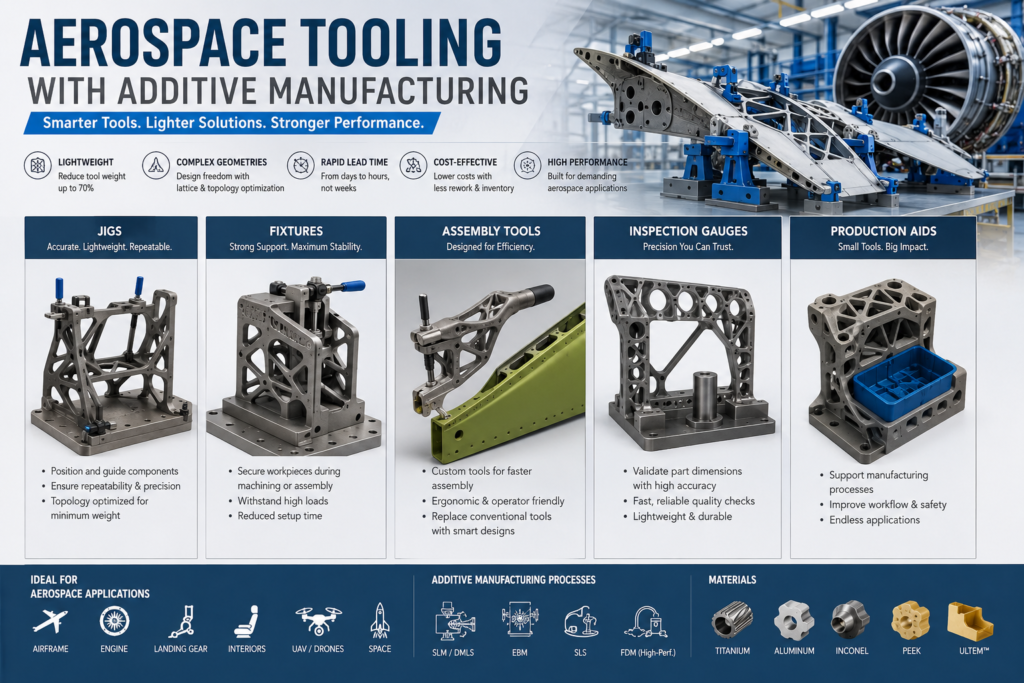
Types of 3D Printed Aerospace Tooling
Drill Jigs and Templates
Drill jigs guide cutting tools to exact hole locations on airframe panels, brackets, and structural members. Printed in carbon fiber reinforced nylon, these jigs hold tight positional tolerances while weighing a fraction of their metal equivalents, which matters when technicians are repositioning tooling across large fuselage sections multiple times a shift.
Assembly Fixtures
Assembly fixtures hold components in place during bonding, riveting, or welding operations, and they need to maintain geometric accuracy across hundreds or thousands of cycles. Printed fixtures built from engineering-grade thermoplastics or aluminum-filled composites give assembly teams custom-fit tooling for each part variant without the cost of machining a new block of aluminum for every revision.
Inspection Gauges and Go/No-Go Tools
Quality control on aerospace lines relies heavily on go/no-go gauges and contour-checking fixtures that verify a part meets dimensional spec before it moves downstream. PEEK and reinforced composites print these gauges with the rigidity and wear resistance needed for repeated handling, while still arriving in days instead of weeks.
Layup Mandrels and Composite Tooling
Composite fuselage and wing sections are built up over mandrels and layup tools that need to survive autoclave curing temperatures without warping. High-temperature resins and ULTEM-class materials hold their shape through these thermal cycles, making them viable substitutes for the machined or composite-laminate mandrels traditionally used in this step.
End-of-Arm Tooling and Soft Jaws
Robotic assembly cells on modern aerospace lines need grippers and end-of-arm tooling shaped to each specific part. Carbon fiber nylon prints give robotics teams lightweight, custom grippers that can be redesigned and reprinted as part geometry changes, instead of being locked into a single tooling configuration for the life of a program.
Benefits of Additive Manufacturing for Aerospace Tooling
The case for 3D printed tooling in aerospace comes down to a handful of measurable advantages over traditional machining and casting.
- Faster turnaround: jigs and fixtures that took weeks to machine can print in days, which matters enormously when a tooling change is holding up a production line.
- Lower cost per unit: low-volume, custom tooling avoids the setup and material waste of CNC machining a one-off aluminum block.
- Design freedom: complex internal geometries, lattice structures, and organic shapes that would be difficult or impossible to machine are straightforward to print.
- Weight reduction: lighter tooling is easier for technicians to handle repeatedly across a shift, reducing fatigue and improving ergonomics on the line.
- Rapid iteration: when a part design changes, the matching jig or fixture can be redesigned and reprinted within the same week rather than waiting on a new machining cycle.
- On-demand replacement: damaged or worn tooling can be reprinted from the same digital file without re-cutting a new master pattern.
This combination of speed and flexibility is exactly why tooling has become one of the most mature and widely adopted use cases for additive manufacturing in aerospace, often serving as the entry point for manufacturers who are still evaluating whether to extend 3D printing to flight-critical parts.
Typical Tooling Lead Time Comparison
The table below illustrates how dramatically lead times shift when tooling moves from traditional machining to additive manufacturing, based on common aerospace tooling categories.
| Tooling Type | Typical Material | Lead Time (Traditional) | Lead Time (3D Printed) |
| Drill Jigs | Nylon / Carbon Fiber Nylon | 3–6 weeks | 2–5 days |
| Assembly Fixtures | ABS / PC / Aluminum-filled | 4–8 weeks | 3–7 days |
| Inspection Gauges | PEEK / Tool Steel (hybrid) | 5–7 weeks | 4–6 days |
| Layup Mandrels | High-temp resin / ULTEM | 6–10 weeks | 5–8 days |
| End-of-Arm Tooling | Carbon Fiber Nylon | 3–5 weeks | 2–4 days |
Aerospace Tooling Applications
Across India’s aerospace and defense manufacturing base, 3D printed tooling shows up at nearly every stage of production.
- Airframe assembly lines use printed drill jigs and positioning fixtures to maintain hole-pattern accuracy across large structural panels.
- Composite manufacturing facilities rely on printed layup tools and mandrels for fuselage skins, wing sections, and interior composite panels.
- MRO facilities use on-demand printed fixtures and gauges to service legacy aircraft where original tooling has been lost or damaged over the years.
- UAV and satellite component manufacturers use lightweight printed fixtures to hold small, intricate parts during bonding and inspection.
- Quality assurance teams use printed go/no-go gauges and contour checks to verify dimensional accuracy without tying up CMM machine time for routine checks.
Many of these workflows start with a 3D scan of an existing part or legacy tool that needs to be replicated or reverse engineered; 3D Proto Farm’s range of 3D Scanners makes that capture step straightforward before the tooling design even begins.
Why Choose 3D Proto Farm
Aerospace tooling has a narrow margin for error: a fixture that’s off by half a millimeter can throw off an entire assembly sequence. Getting tooling right requires both manufacturing precision and a workflow that can absorb frequent design changes without blowing up the schedule.
3D Proto Farm’s Rapid Prototyping Services are built around exactly this kind of fast-turnaround, design-to-part workflow, with engineers who understand the tolerance and material requirements specific to aerospace tooling rather than generic industrial parts.
For programs that need ongoing tooling support rather than a one-off job, the broader 3D Printing Services portfolio covers everything from drill jigs to composite layup mandrels, backed by material expertise across nylon, carbon fiber composites, PEEK, and ULTEM.
Manufacturers building in-house tooling capability instead of outsourcing can also explore 3D Proto Farm’s range of Industrial 3D Printers, and our Commercial Guide to Industrial 3D Printers is a good starting point for comparing machines suited to tooling production at scale.
Whether the need is a single inspection gauge for a one-off MRO job or a full set of assembly fixtures for a new production line, the right tooling partner turns what used to be a six-week bottleneck into a same-week turnaround, without compromising on the accuracy aerospace work demands.
Frequently Asked Questions
Is 3D printed tooling accurate enough for aerospace use?
Yes, when printed on industrial-grade systems with proper calibration and post-processing. Most tooling applications, including drill jigs and assembly fixtures, don’t require the same tolerance bands as flight-critical parts, which is part of why tooling was one of the earliest aerospace use cases for additive manufacturing.
What materials are used for 3D printed aerospace tooling?
Carbon fiber reinforced nylon, ABS, polycarbonate, PEEK, and ULTEM are the most common choices, selected based on whether the tool needs to withstand repeated handling, chemical exposure, or elevated curing temperatures.
How much does 3D printed tooling cost compared to machined tooling?
Costs vary by complexity and size, but printed tooling typically runs significantly lower than CNC-machined equivalents for low-volume or frequently revised tools, since there’s no setup cost, no master pattern, and minimal material waste.
Can 3D printed fixtures survive composite curing temperatures?
High-temperature resins and ULTEM-class materials are specifically formulated to hold dimensional stability through autoclave curing cycles, making them suitable for composite layup tooling that experiences sustained heat.
How quickly can a damaged jig or fixture be replaced?
If the original design file exists, a replacement can typically be reprinted within a few days, compared to weeks for re-machining a new tool from a master pattern.