India’s 3D printing market is growing faster than ever. From engineering colleges and design studios to manufacturing startups and large-scale production units, 3D Printers are becoming essential tools across industries. Whether you want to prototype a new product, build functional parts, or simply explore a new skill, choosing the right printer in 2026 demands a clear understanding of what the market offers — and what your specific needs require.
This guide is built for Indian buyers: hobbyists on tight budgets, engineers who need precision, and businesses that depend on throughput and reliability.
How to Choose the Right 3D Printer
Before you spend a rupee, answer these questions:
Budget — Entry-level FDM printers start around ₹15,000, while professional and industrial machines can exceed ₹5,00,000. Know your range.
Build Volume — Bigger isn’t always better. A hobbyist rarely needs more than 220×220×250mm, but a product designer or manufacturer may need large-format capacity.
Material Compatibility — Basic PLA works for most beginners. Engineers may need ABS, PETG, TPU, or high-temperature materials like nylon and carbon fibre composites. Filaments (Anycubic PLA Plus product) compatibility is a key spec to verify.
Print Speed — Modern printers can reach 300–500mm/s, but speed must be balanced with quality. High-speed printing without a well-tuned machine often results in failed prints.
Reliability and Uptime — For businesses, downtime is lost money. Look for machines with auto-levelling, filament runout sensors, and power-loss recovery.
Support and Maintenance — Consider whether spare parts, local service centres, and technical support are accessible in India. Brands with Indian distributors are preferable.
Intended Application — Prototyping, end-use parts, jewellery, education, tooling, and medical models all have different requirements. Match the machine to the mission.
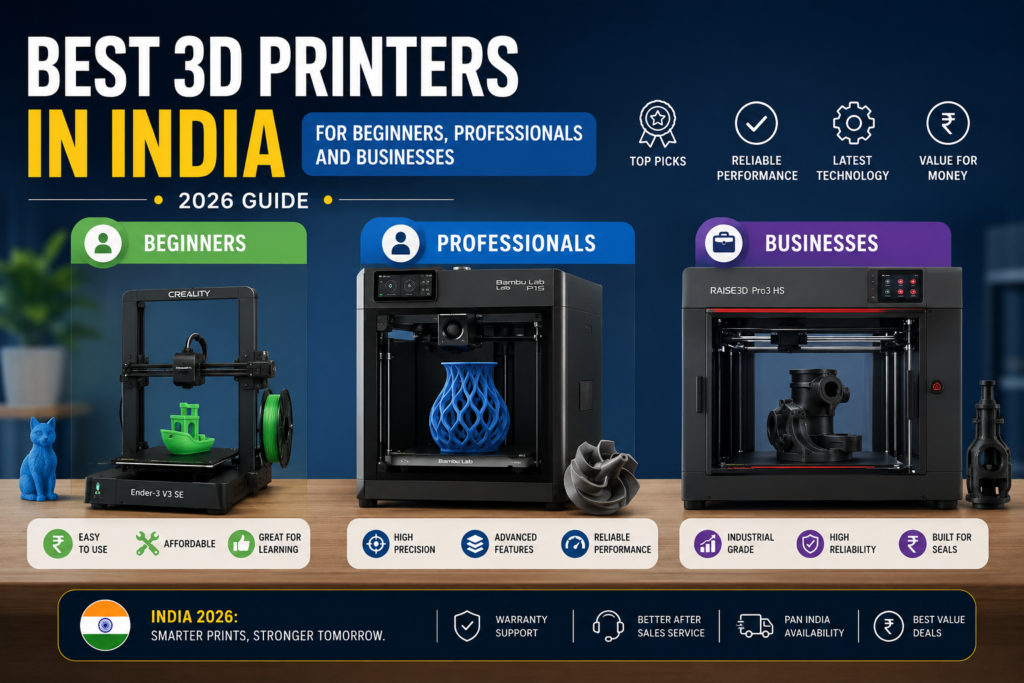
Best 3D Printers for Beginners
If you’re just starting out, you need a machine that is forgiving, easy to set up, and produces decent results without extensive calibration. Auto-levelling beds, a straightforward interface, and good community support are non-negotiable.
Beginners in India should prioritise printers that come partially pre-assembled, support PLA and PETG out of the box, and have active online communities for troubleshooting.
The Kobra X is a well-regarded option in this segment. It features automatic bed levelling, a direct drive extruder, and a build volume suited for most hobby and educational projects. The UI is beginner-friendly, and it handles standard filaments reliably — making it a practical first printer for students, hobbyists, and educators.
What to look for as a beginner:
- Auto-levelling bed (essential for consistent first layers)
- Pre-assembled or semi-assembled design
- PLA/PETG compatibility
- Good community documentation in English and Hindi
- Price range: ₹15,000 – ₹40,000
Best 3D Printers for Professionals
Professional users — engineers, product designers, and R&D teams — need printers that can handle advanced materials, deliver dimensional accuracy, and run reliably for hours without supervision. Rapid Prototyping workflows demand speed and repeatability.
Multi-material capability, enclosed build chambers for ABS and nylon, and high-resolution output matter at this level. Software integration with CAD tools is also a significant factor.
QIDI Tech machines have earned strong credibility among professional Indian users. Their enclosed printers support a wide material range including PA (nylon), carbon fibre composites, and high-temperature filaments. The heated chamber design reduces warping on engineering-grade materials, and print quality is competitive with machines costing significantly more.
For design validation and functional prototyping, look for machines that offer 0.1mm or better layer resolution, dual extrusion for support materials, and repeatable calibration.
Professional buyer checklist:
- Enclosed heated chamber for engineering materials
- Dual extrusion or multi-material support
- Layer resolution of 0.05–0.15mm
- Filament compatibility: ABS, Nylon, TPU, CF composites
- Reliable slicer with professional features
- Price range: ₹60,000 – ₹2,50,000
Best 3D Printers for Businesses and Manufacturing
For businesses, 3D printing is a production tool, not just an experiment. The requirements shift dramatically: you need throughput, material versatility, large build volumes, and the ability to produce end-use parts with consistent quality.
CAD Design Services integration, material certifications, and total cost of ownership (including consumables) become critical decision factors.
Large-format printing is increasingly relevant for manufacturers producing tooling jigs, fixtures, moulds, and large functional components. The Dowell Large Format printer addresses this need with a substantial build volume that allows Indian manufacturers to reduce dependence on outsourced tooling or expensive imported parts.
For resin-based precision work — dental models, jewellery masters, and fine engineering parts — the Photon P1 delivers exceptional detail at a relatively accessible price point. Its mono LCD screen enables faster cure times and a longer screen lifespan.
If you’re evaluating 3D printing as an alternative to CNC machining or injection moulding for short runs, an ROI analysis over 12 months almost always favours bringing the capability in-house. 3D Printing Services can also bridge the gap while you evaluate the right machine for permanent investment.
Business buyer checklist:
- High throughput and low failure rates
- Large build volume (300mm+ in at least one axis)
- Multi-shift reliability
- Post-processing workflow compatibility
- Service contract or local support availability
- Price range: ₹1,50,000 – ₹10,00,000+
FDM vs Resin 3D Printers
Choosing between FDM (Fused Deposition Modelling) and resin (MSLA/DLP) is one of the most common dilemmas for Indian buyers. Here’s a clear comparison:
| Feature | FDM Printers | Resin Printers |
|---|---|---|
| Cost (Machine) | ₹15,000 – ₹5,00,000+ | ₹15,000 – ₹3,00,000+ |
| Material Cost | ₹700 – ₹3,000/kg | ₹2,000 – ₹8,000/litre |
| Print Quality | Good (layer lines visible) | Excellent (near-smooth surface) |
| Detail Resolution | 0.1–0.3mm layer height | 0.025–0.05mm layer height |
| Applications | Functional parts, prototypes, large models | Jewellery, dental, miniatures, precision models |
| Materials | PLA, ABS, PETG, Nylon, TPU, CF composites | Standard resin, ABS-like, castable, flexible |
| Ease of Use | Easier; minimal post-processing | Requires PPE, washing, and UV curing station |
| Build Volume | Up to 1000mm+ (large format) | Typically under 300mm height |
| Best For | Beginners, engineers, manufacturers | Jewellers, dental labs, hobbyists needing fine detail |
Resin Materials selection is particularly important for dental and jewellery applications, where biocompatibility and castability matter.
3D Printer Price Range in India (2026)
Understanding where your budget places you helps set realistic expectations.
Entry-Level (₹10,000 – ₹50,000): Open-frame FDM printers, basic resin printers. Suitable for hobbyists, students, and educators. Limited material support but excellent for learning.
Mid-Range / Professional (₹50,000 – ₹2,50,000): Enclosed FDM machines, prosumer resin printers. Suitable for engineering teams, product designers, and small businesses. Supports a wide range of engineering materials.
Industrial / Large-Format (₹2,50,000 – ₹15,00,000+): High-speed multi-material printers, large-format machines, and specialised systems. Designed for manufacturers, tooling applications, and production environments. Look into Reverse Engineering and Link: 3D Scanning Services as complementary capabilities when deploying at this level.
Import duties, GST (currently 18% on most 3D printers), and shipping costs can add 25–40% to the base international price. Always factor the landed cost when comparing Indian retail prices with overseas listings.
Frequently Asked Questions
1. What is the best 3D printer for beginners in India under ₹30,000? For beginners in India with a budget under ₹30,000, look for an FDM printer with automatic bed levelling and a direct drive extruder. These features significantly reduce calibration headaches. Machines in this range handle PLA and PETG reliably — sufficient for most learning and hobby projects.
2. What is the average 3D printer price in India in 2026? Entry-level FDM printers start around ₹15,000–₹25,000. Professional-grade machines typically fall between ₹60,000 and ₹2,50,000. Industrial and large-format systems can cost ₹3,00,000 to ₹15,00,000 or more, depending on build volume and capability.
3. Is FDM or resin better for an Indian buyer? It depends on your application. FDM is more versatile, cheaper to run, and better for functional parts and large models. Resin offers far superior surface finish and detail — ideal for jewellery masters, dental models, and miniatures. For most beginners and businesses, FDM is the practical starting point.
4. Can I buy a 3D printer for commercial use in India? Yes. Many businesses in India use 3D printers for prototyping, tooling, and end-use production. Commercial buyers should focus on reliability, after-sales support, and total cost of ownership rather than just the purchase price.
5. What materials can Indian 3D printers use? FDM printers in India commonly use PLA, ABS, PETG, TPU, Nylon, and carbon fibre composites. Resin printers use photopolymer resins including standard, ABS-like, castable, and flexible variants. Material availability has improved significantly in India, with multiple domestic and imported options now readily available.
6. Do I need a large-format 3D printer for my manufacturing business? Not necessarily. Large-format printers are valuable for producing jigs, fixtures, moulds, and large structural components. However, if your parts are smaller than 250×250×300mm, a mid-range professional printer will suffice and offer better cost efficiency.
Conclusion: Which 3D Printer Is Right for You?
Here’s a quick recommendation guide based on your profile:
Student / Hobbyist — Start with an FDM printer in the ₹15,000–₹35,000 range with auto-levelling. Focus on learning slicer software and print settings before upgrading.
Educational Institute — Choose a reliable, easy-to-maintain FDM printer with good documentation. Durability and ease of repair matter more than peak performance.
Startup / Product Designer — Invest in an enclosed FDM machine that supports engineering materials. Pair it with professional CAD Design Services for faster design-to-prototype cycles.
Engineering Team / R&D — A dual-extrusion professional FDM printer with a heated chamber gives you the material flexibility needed for functional prototyping and design validation.
Manufacturing Company — Evaluate large-format or high-speed industrial FDM systems with a total cost of ownership mindset. Consider whether in-house printing, outsourced 3D Printing Services, or a hybrid model best fits your production volume.
The Indian 3D printing ecosystem in 2026 is more mature, better supported, and more competitively priced than ever before. Whether you’re printing your first benchy or producing end-use components at scale, there’s a machine built for your exact need — and this guide should give you the clarity to find it.