
For most of 3D printing’s early history in India, the conversation started and ended with desktop machines — compact printers producing parts no bigger than a coffee mug. That era is over. Manufacturers, product studios, and engineering teams across the country are now investing in large format 3D printers capable of producing full-scale prototypes, tooling jigs, architectural models, and end-use industrial components in a single run.
The shift makes sense. Labour and tooling costs are rising. Product cycles are shrinking. And clients expect to see a physical model — not just a render — before signing off on a design. Large-scale 3D printing fills that gap without the lead times and minimums associated with traditional manufacturing.
This guide is written for Indian buyers: engineers, procurement managers, design studio owners, and manufacturing companies evaluating their first or next large format investment. We cover the key technologies, the best machines available in 2026, what to look for before buying, and where to find reliable equipment in India. Browse professional 3D printers to see what’s currently in stock.
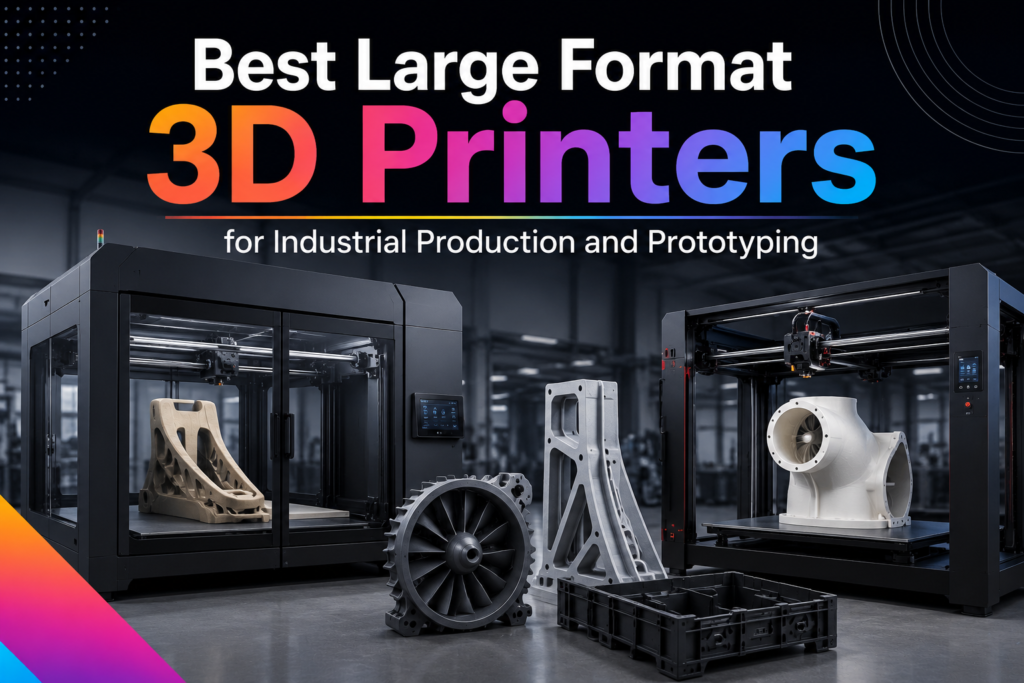
1. What Is a Large Format 3D Printer?
A large format 3D printer — also called a large volume or big-size 3D printer — is generally defined as any machine with a build volume exceeding 300 x 300 x 300 mm. In practice, industrial machines in this category often reach 500 x 500 x 500 mm and beyond, with some specialist systems printing parts measured in metres rather than millimetres.
The defining advantage is obvious: larger build envelopes mean larger single-piece parts. Instead of printing a component in five sections and bonding them together — with all the alignment errors and structural weaknesses that introduces — a large format machine produces it whole. For automotive brackets, medical device housings, architectural façade elements, and aerospace duct prototypes, this is not a nice-to-have. It’s a requirement.
Large format printers are available in FDM, SLA, and SLS technologies, each with different material profiles and surface quality outputs. The right choice depends on your use case, not just your budget.
2. Benefits of Large Format 3D Printing
The case for large format printing in Indian manufacturing is straightforward once you quantify what you’re currently spending on alternatives:
- Single-piece production: No bonding, no alignment, no weak joints. Parts come off the bed structurally continuous.
- Faster iteration cycles: Design changes go from CAD to physical part in hours, not weeks. Critical for product companies under tight launch schedules.
- Tooling replacement: Jigs, fixtures, moulds, and assembly guides can be printed on-demand rather than machined at external vendors.
- Cost-effective at low volumes: No minimum order quantity. Print one part or ten — the economics are the same.
- Material versatility: Industrial FDM machines handle PLA, ABS, PETG, nylon, and carbon fiber filament. SLS systems open up glass-filled nylon and engineering polymers.
For more context on how large format printing fits into a broader manufacturing strategy, visit the 3D printing blog at 3D ProtoFarm.
3. Large Format 3D Printing Technologies
Three core technologies dominate the large format industrial segment. Each has a distinct cost-performance profile:
FDM (Fused Deposition Modelling): The most widely used technology for large format industrial printing. Filament is melted and deposited layer by layer through a nozzle. Build volumes are large, material options are broad, and machines are significantly cheaper than SLA or SLS alternatives. Surface finish is coarser, but for structural prototypes and tooling, this rarely matters. FDM is the default choice for most Indian industrial buyers.
SLA (Stereolithography): Resin-based printing using UV laser or light source. Surface finish is excellent — comparable to injection moulding — making it ideal for presentation models, dental fixtures, and medical device casings. Build volumes are smaller than FDM and material costs are higher, but part accuracy is in a different league.
SLS (Selective Laser Sintering): Powder-based printing using a laser to fuse nylon or glass-filled nylon particles. No support structures required, which means complex geometries with internal cavities are straightforward. SLS is preferred for functional end-use parts and small-batch production runs. Entry cost is high, but per-part economics improve sharply at volume.
Each technology has trade-offs in cost, speed, material compatibility, and surface quality. Our FDM vs SLA vs SLS comparison breaks this down with specs relevant to Indian buyers.
4. Best Large Format 3D Printers for Industrial Production
These machines are evaluated on build volume, material range, reliability under sustained production use, and availability in India:
Creality Ender-5 Max: Build volume of 400 x 400 x 400 mm. One of the most accessible large format FDM machines for Indian buyers. CoreXY motion system for clean high-speed movement, enclosed chamber for ABS and ASA printing, and a heated bed that reaches 110°C. Creality 3D printers are well-supported in India with local spare parts availability.
Raise3D Pro3 Plus: Build volume of 300 x 300 x 605 mm with IDEX (Independent Dual Extruder) capability. Dual nozzle setup allows printing in two materials simultaneously — structural filament and soluble support — for complex geometries. Used widely in automotive, aerospace, and medical device prototyping environments. One of the most reliable professional FDM machines in its class.
Modix BIG-60 V4: Build volume of 600 x 600 x 660 mm. Designed for large industrial parts where single-piece production is non-negotiable. Open-frame design with optional enclosure, self-levelling system, and compatibility with a wide range of engineering filaments. Popular with architecture firms, furniture designers, and automotive Tier-2 suppliers.
Elegoo Saturn 4 Ultra (Large SLA): For buyers who need SLA surface quality at larger build volumes. 218 x 123 x 220 mm resin print area with 12K resolution monochrome LCD. Excellent for high-detail pattern models, jewellery masters, and dental applications where FDM surface quality falls short.
5. Best Large Format Printers for Product Prototyping
Prototyping has different demands from production: faster turnaround, higher dimensional accuracy, and cleaner surface finish matter more than throughput.
Bambu Lab X1 Carbon (Extended): While not purely a large format machine, the X1 Carbon’s 256 x 256 x 256 mm build volume combined with 500 mm/s print speed and multi-material AMS support makes it extremely fast for concept prototypes. Ideal for design studios that need quick iteration. Bambu Lab 3D printers are increasingly available in India and have strong slicer support through Bambu Studio.
Anycubic Photon Mono M7 Pro: Large-format MSLA printer with a 13.5-inch 12K monochrome screen and a build volume of 287 x 163 x 280 mm. Designed for high-detail resin parts at larger scale. Ideal for consumer product casings, medical prototypes, and architectural detail models.
Raise3D E2CF: Carbon fiber-optimized FDM machine with 330 x 240 x 240 mm build volume. The E2CF is engineered specifically for carbon fiber filament and chopped fibre-reinforced nylon — materials that require hardened steel nozzles, active enclosure heating, and precision motion. For industrial functional prototypes where weight-to-strength ratio matters, this is a strong choice.
6. Key Features to Consider Before Buying
Buying a large format 3D printer is a capital expenditure decision. These are the variables that separate a well-matched investment from an expensive mistake:
- Build volume: Measure the largest part you realistically need to print and add 20% margin. Don’t spec for your largest theoretical job — spec for your most common job.
- Enclosure: Open-frame printers struggle with ABS, ASA, and nylon due to warping from ambient temperature variation. If you’re printing anything other than PLA or PETG, an enclosed machine is essential in India’s variable climate.
- Heated bed temperature: PLA needs 60°C, PETG needs 80°C, ABS needs 100–110°C, and engineering filaments may require up to 120°C. Confirm the bed spec matches your material requirements.
- Nozzle material: Brass nozzles wear quickly with carbon fiber and glass-filled filaments. Hardened steel or ruby nozzles are required for abrasive materials.
- Connectivity and software: OctoPrint, proprietary slicer compatibility, remote monitoring, and job queuing become important when the machine is running production jobs overnight.
- After-sales support: For industrial buyers, downtime is expensive. Prioritize suppliers with local service capability and parts availability.
Read our commercial industrial 3D printer guide for a complete evaluation framework for manufacturing buyers.
7. Industries Using Large Format 3D Printers in India
Large format adoption in India is growing fastest in the following sectors:
- Automotive: Dashboard prototypes, bumper assemblies, intake manifold models, and jig fixtures for assembly lines. OEMs and Tier-1 suppliers in Pune, Chennai, and Gurugram are active users.
- Architecture and Real Estate: Scale models of buildings, urban planning layouts, and interior design concept pieces. Firms in Mumbai and Bengaluru have replaced traditional model-making shops with in-house large format printers.
- Defence and Aerospace: Duct prototypes, bracket mockups, and ground support equipment. Carbon fiber and high-temperature nylon printing is in active use at research institutions.
- Consumer Products and FMCG: Packaging design models, product form studies, and in-store display prototypes printed at 1:1 scale for accurate visual assessment before tooling.
- Medical Devices: Surgical guide prototypes, prosthetic socket models, and medical equipment housing mock-ups. SLA machines are preferred for surface quality in this segment.
- Education and R&D: IITs, NITs, and private engineering colleges increasingly invest in large format printers for student projects, research lab fabrication, and design centre operations.
8. Cost of Large Format 3D Printers in India
Pricing varies significantly based on technology, build volume, and brand. Here is a general cost range for Indian buyers in 2026:
- Entry-level large format FDM (300–400 mm build volume): Rs. 40,000 to Rs. 1,20,000. Machines like the Creality Ender-5 Max fall here. Suitable for startups, educational institutions, and small studios.
- Mid-range professional FDM (400–600 mm build volume): Rs. 1,20,000 to Rs. 4,00,000. Covers machines like the Raise3D Pro3 Plus and Bambu Lab’s professional line. Appropriate for product companies and mid-size manufacturers.
- Industrial large format FDM and SLS (600 mm+ build volume): Rs. 4,00,000 to Rs. 15,00,000+. Machines like the Modix BIG-60 and industrial SLS systems. Targeted at large OEMs and contract manufacturing firms running sustained production loads.
These are machine costs only. Budget separately for filament or resin, post-processing tools, spare nozzles, and installation. For production environments, also account for electricity costs — large format machines running 10+ hours per day draw significant power.
9. Why Choose 3D ProtoFarm?
3D ProtoFarm is a dedicated 3D printing equipment and consumables supplier serving buyers across India from its base in Rajkot, Gujarat. For industrial and large format buyers, 3D ProtoFarm offers a curated selection of machines tested and selected for Indian operating conditions — variable power supply, ambient humidity, and the practical constraints of SME manufacturing environments.
The catalogue covers Bambu Lab’s professional and prosumer range, Creality’s wide desktop and semi-industrial lineup, and a growing selection of engineering filaments including carbon fiber, PETG, and nylon-based materials. Pre-sales technical support is available to help buyers match machine capability to their specific use case — not just push the highest-margin unit.
Whether you’re placing your first large format machine or upgrading an existing setup, 3D ProtoFarm provides India-specific pricing, shipping to all major cities, and responsive post-sales support that matters when a production machine goes down.
10. Frequently Asked Questions
What is a large format 3D printer?
A large format 3D printer is any machine with a build volume above 300 x 300 x 300 mm. Industrial machines often reach 500 mm or more per axis, enabling single-piece production of large prototypes, tooling, and structural components.
Which industries use large format 3D printers?
Automotive, architecture, aerospace, consumer products, medical devices, and education are the primary sectors. In India, adoption is especially strong in automotive Tier-1 and Tier-2 suppliers, architecture firms, and engineering college R&D labs.
What build volume is considered large format?
Generally, any build volume above 300 x 300 x 300 mm qualifies. For industrial production use, 500 mm or more per axis is often the working benchmark.
What materials can large format 3D printers use?
FDM-based large format machines support PLA, ABS, PETG, ASA, nylon, TPU, and carbon fiber filament. SLS systems use powder-form nylon and glass-filled nylon. SLA machines use photopolymer resins available in rigid, flexible, and castable variants.
How much does a large format industrial 3D printer cost in India?
Entry-level large format FDM machines start around Rs. 40,000. Mid-range professional systems range from Rs. 1.2 lakh to Rs. 4 lakh. Industrial machines with 600 mm+ build volumes cost Rs. 4 lakh to Rs. 15 lakh or more, depending on technology and brand.
Which large format 3D printer is best for prototyping?
The Bambu Lab X1 Carbon is the top choice for fast concept prototyping where speed and multi-material capability matter. For high-accuracy presentation prototypes, an SLA machine like the Anycubic Photon Mono M7 Pro delivers superior surface quality.
Is FDM the best technology for large-scale printing?
For most industrial applications, yes. FDM offers the largest available build volumes, the widest material range, and the most accessible price point. SLA and SLS are better for specific use cases — fine detail and functional end-use parts respectively — but FDM remains the default for large-scale industrial work.
Where can I buy industrial 3D printers in India?
3D ProtoFarm is a reliable source for industrial and large format 3D printers in India, with a curated catalogue of Bambu Lab and Creality machines plus engineering filaments. For more guidance, explore more 3D printing guides on the 3D ProtoFarm blog.




One thought on “Best Large Format 3D Printers for Industrial Production and Prototyping”
Pingback: The Complete Guide to Choosing the Right 3D Printing Technology: FDM, SLA, SLS & Beyond