A professional 3D printer is no longer a luxury. It is a production tool. Whether you run a startup in Bengaluru, an MSME in Pune, or an R&D lab in Chennai, additive manufacturing is changing how Indian businesses prototype, iterate, and manufacture parts.
Indian companies are adopting professional 3D printers for three clear reasons: lower prototyping costs, faster design cycles, and the push toward local manufacturing under initiatives like Make in India. A part that used to take three weeks to source from overseas can now be printed in-house within hours.
But choosing the right machine matters. Buy the wrong printer and you’ll face material waste, poor output quality, and high running costs. This guide breaks down everything you need to make the right decision for your business.
Types of Professional 3D Printers
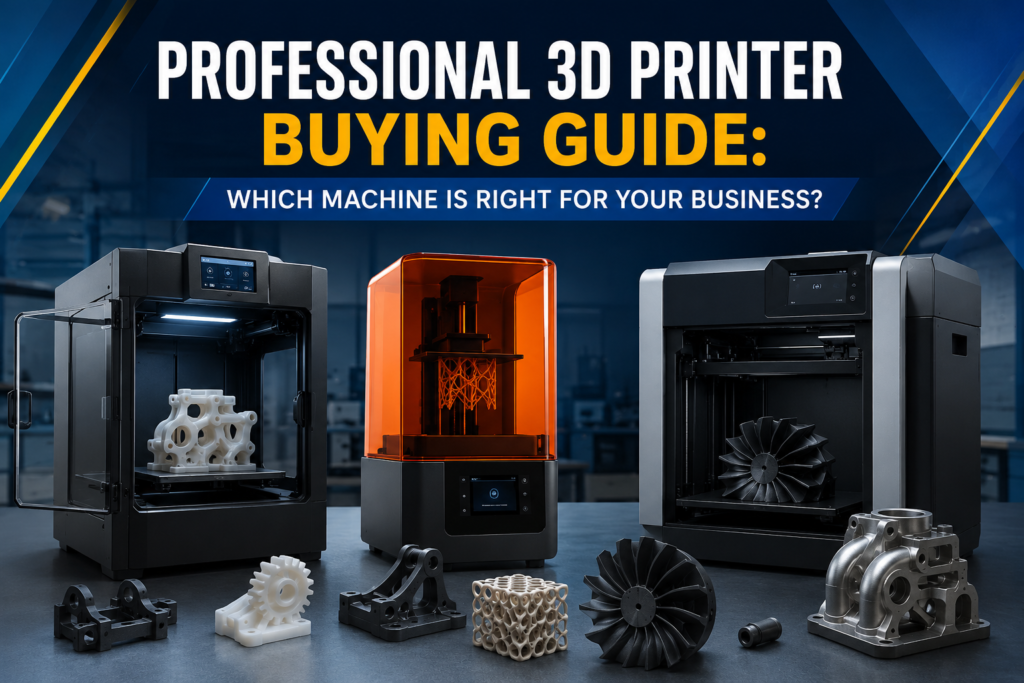
Not all 3D printers work the same way. Each technology has a different process, material set, and ideal use case. Here are the four main types relevant to Indian businesses.
FDM (Fused Deposition Modelling)
FDM printers melt and extrude thermoplastic filament layer by layer. They are the most common type in India and the most affordable. Materials include PLA, ABS, PETG, and engineering-grade filaments like Nylon and PC.
Indian automotive ancillary companies use FDM to print jigs, fixtures, and concept models. Consumer goods companies in Gujarat use them for packaging mockups. If you need functional prototypes at low cost, FDM is the starting point.
SLA / DLP (Resin-Based Printing)
SLA and DLP printers use UV light to cure liquid resin. They produce parts with much higher surface finish and finer detail than FDM. Tolerances can go below 0.05 mm.
Medical device companies in Mumbai and Hyderabad use SLA for surgical guides and dental models. Jewellery manufacturers in Surat use it for casting patterns. If accuracy and surface quality matter, SLA or DLP is the right choice.
For a detailed head-to-head breakdown of these technologies, see this FDM vs SLA vs SLS Comparison before making your final decision.
SLS (Selective Laser Sintering)
SLS uses a laser to sinter powdered nylon or composite material. Parts are strong, functional, and require no support structures. SLS is the go-to technology for industrial prototyping and low-volume production.
Aerospace and defence suppliers in Bengaluru and Pune use SLS for duct assemblies, brackets, and interior components. If you need end-use parts without post-processing, SLS delivers.
Metal 3D Printing
Metal printers use laser powder bed fusion or binder jetting to produce stainless steel, titanium, and aluminium parts. These are expensive machines, typically above ₹50 lakh, and are used by aerospace, defence, and high-end engineering companies. Most Indian MSMEs access metal printing through service bureaus rather than buying in-house.
Professional 3D Printer Buying Guide: Key Factors to Evaluate
Before you put in a purchase order, evaluate these six factors carefully.
- Build Volume: Match the printer’s build volume to your largest expected part size. A small desktop printer may be fine for jewellery but inadequate for automotive door panels.
- Material Compatibility: Check which materials the printer supports. Open-material systems give you vendor flexibility. Closed systems tie you to the OEM’s filament or resin.
- Print Speed: Manufacturers quote maximum speed. Real-world production speed is 30–50% lower. Factor this into your throughput planning.
- Accuracy and Tolerance: FDM typically achieves ±0.2–0.5 mm. SLA and SLS achieve ±0.05–0.1 mm. Match tolerance requirements to your application.
- Maintenance Cost in India: Factor in spare parts availability, service contracts, and downtime. Industrial machines may need trained technicians. Check whether the OEM has a service centre in your city.
- Software Ecosystem: Slicer software, build preparation tools, and file compatibility with your CAD system (SolidWorks, Fusion 360, CATIA) should work without extra plugins or paid licences.
Cost Breakdown: What Does a Professional 3D Printer Cost in India?
Printer prices in India vary enormously depending on technology and build quality. Here is a realistic breakdown.
Entry-Level: ₹2 Lakh – ₹5 Lakh
Desktop FDM and resin printers fall in this range. Suitable for startups, product designers, and students. Running costs are low — filament costs roughly ₹1,500–3,000 per kg. These machines need regular calibration and are not ideal for continuous production.
Mid-Range: ₹5 Lakh – ₹25 Lakh
Professional FDM and SLA machines sit in this bracket. Brands like Bambu Lab, Markforged, and Formlabs offer machines here. These are reliable for regular production cycles and support engineering-grade materials. Ideal for MSMEs and engineering teams with consistent output needs.
Industrial: ₹25 Lakh – ₹1 Crore+
SLS, industrial FDM (Stratasys, HP), and entry-level metal printers fall in this range. These machines are built for production environments. Running costs are higher — SLS powder can cost ₹8,000–15,000 per kg — but per-part costs drop significantly at volume. For a full breakdown of machine options in this segment, see our guide on Industrial 3D Printers for manufacturing companies.
Comparison: Which Professional 3D Printer Fits Your Business?
Here is a practical match between business type and the right printer technology.
- Startup Prototyping: FDM is the right starting point. Low machine cost, widely available materials, and simple operation make it ideal for rapid concept validation.
- Engineering Precision Applications: SLA or DLP printers are better suited. Use them for dental, medical, jewellery, and fine-detail industrial parts.
- Industrial Production and Functional Parts: SLS is the right choice. It produces durable nylon parts with no support removal and consistent mechanical properties.
- High-End Manufacturing: Metal 3D printers are for aerospace, defence, and heavy engineering applications. Most businesses in India should outsource metal printing until volumes justify in-house investment.
Common Mistakes Buyers Make
Many Indian businesses regret their first 3D printer purchase. These are the most common errors.
- Buying on price alone: A cheap machine may produce poor results or break down frequently. Total cost of ownership matters more than sticker price.
- Ignoring material costs: A ₹3 lakh printer with proprietary cartridges that cost ₹5,000 per spool will cost more to run than a ₹6 lakh open-material machine.
- Overestimating print speed: Marketing speed specs are best-case numbers. Plan throughput based on real-world print times, which are significantly longer.
- Skipping post-processing: FDM parts often need sanding, painting, or vapour smoothing. SLA parts need UV curing and IPA washing. Budget for post-processing equipment and time.
When to Choose Outsourcing vs In-House 3D Printing
Buying a printer is not always the right decision. Here is how to decide.
When to Use a 3D Printing Service
If you print fewer than 10–15 jobs per month, outsourcing is almost always cheaper. You avoid capital expenditure, maintenance, and material management. Services also give you access to technologies like SLS and metal printing without the investment.
Businesses that need occasional high-quality prototypes benefit most from Professional 3D Printing Services, which typically offer faster turnaround and wider material options than a single in-house machine.
When to Buy a Machine
Buy in-house when you print daily, need rapid iterations, or have IP sensitivity that prevents sending files outside. If your team runs more than 20 print jobs per month consistently, the machine will typically pay for itself within 12–18 months.
The Hybrid Model
Many Indian companies use an FDM machine in-house for quick concept iterations and outsource SLS or metal jobs to a service bureau. This hybrid model keeps capital costs low while giving access to a broader range of technologies.
Conclusion
Choosing the right professional 3D printer comes down to three questions: What will you print? How often? And what is your budget for both the machine and running costs? FDM suits startups and prototyping at low cost. SLA delivers precision for technical and medical applications. SLS handles industrial production. Metal printing makes sense only at high volume or for specialist applications.
Match your printer type to your actual production needs — not your aspirational ones. Start with the technology that solves today’s problem and scale from there.
If you are not yet ready for an in-house machine, or want to test different technologies before committing to a purchase, Bambu Lab 3D Printers and professional bureau services offer a practical bridge. 3D Protofarm works with startups, MSMEs, and enterprise teams across India to deliver the right output at the right scale — whether you need a single prototype or a production batch.
Frequently Asked Questions
Which 3D printer is best for business in India?
It depends on your use case. For most Indian startups and MSMEs, a professional FDM printer in the ₹5–15 lakh range offers the best balance of cost, material flexibility, and output quality. If you need high accuracy or functional end-use parts, consider SLA or SLS technology respectively.
How much does a professional 3D printer cost in India?
Professional 3D printers in India range from ₹2 lakh for entry-level desktop machines to ₹1 crore or more for industrial SLS and metal systems. Mid-range machines suitable for most businesses cost between ₹5 lakh and ₹25 lakh, excluding GST and installation.
Is 3D printing profitable for startups?
Yes, if used strategically. 3D printing reduces prototyping costs by 60–80% compared to traditional machining and shortens design cycles significantly. Startups that use 3D printing for iterative product development reach market faster and with lower upfront tooling spend.
Which is better — FDM or SLA?
FDM is better for large, functional parts at lower cost. SLA is better for high-detail, smooth-surface parts where accuracy is critical. For most prototyping in Indian businesses, FDM is the right first choice. If you need dental models, surgical guides, or detailed consumer product mockups, SLA wins.
Can 3D printers be used for mass production?
3D printing is not ideal for mass production in the traditional sense. It is most cost-effective for low to mid volumes — typically 1 to 500 units. For higher volumes, injection moulding or CNC machining is more economical. However, 3D printing is increasingly used for mass customisation where each part differs slightly, such as custom orthotics or personalised consumer products.