Introduction to Pellet Extrusion 3D Printing
Indian manufacturing is under constant pressure to cut prototyping time, reduce material costs, and produce end-use parts faster than ever. Pellet extrusion 3D printing has emerged as one of the most practical answers to this challenge, allowing factories to print directly from raw plastic pellets instead of pre-processed filament. For manufacturers evaluating their next investment in additive manufacturing, understanding this technology alongside broader options in our Industrial 3D Printers Guide is a useful starting point before deciding which machine fits a production line.
This article breaks down what pellet extrusion 3D printing is, how it works, how it compares with filament-based printing, and why it is becoming the preferred large-format manufacturing method across Indian industries.
What Is Pellet Extrusion 3D Printing?
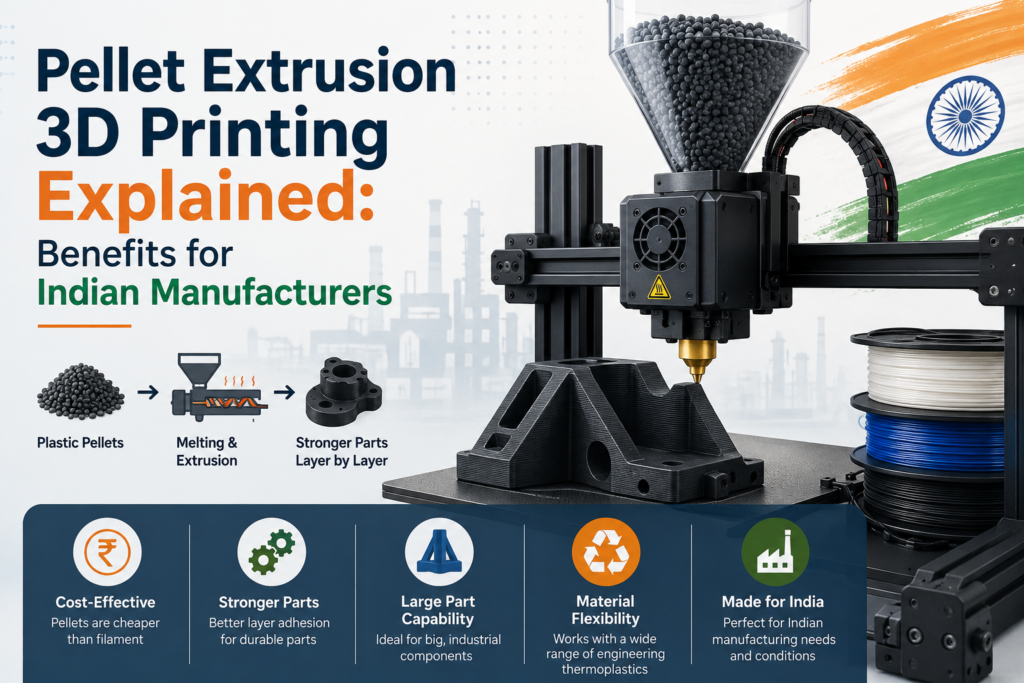
Pellet extrusion 3D printing, sometimes called pellet-fed FGF (Fused Granulate Fabrication) or FPF (Fused Pellet Fabrication), is an additive manufacturing process that builds parts layer by layer using raw plastic pellets rather than spooled filament. The pellets, the same granules used in injection moulding, are fed directly into a heated screw or auger mechanism that melts and extrudes them through a nozzle onto a build platform.
Because pellets skip the extra manufacturing step of being drawn into filament, they are significantly cheaper and available in a wider range of engineering-grade and industrial polymers. This makes pellet extrusion especially attractive for large-format printing, tooling, jigs, fixtures, and functional prototypes where material volume and cost matter as much as precision.
How Pellet Extrusion Technology Works
At the core of a pellet extrusion printer is a screw-based extrusion system, similar in principle to an injection moulding machine but adapted for additive manufacturing. Plastic pellets are gravity-fed or force-fed into a hopper, where a rotating screw pushes them through a heated barrel. As the pellets travel along the screw, they are progressively melted and homogenized before being forced out through a nozzle at a controlled rate.
This screw mechanism allows for much higher throughput than a typical filament extruder, since pellets melt faster and the screw can push larger volumes of material per second. The printer’s control system coordinates extrusion rate with the movement of the print head or gantry, building parts layer by layer just as in filament-based FDM, but at a fraction of the time and material cost for large parts. Many industrial pellet systems also include vacuum-drying hoppers to remove moisture from hygroscopic materials before extrusion, which helps maintain part quality and mechanical strength.
Pellet Extrusion vs Filament 3D Printing
The choice between pellet and filament systems usually comes down to part size, material cost, and production volume. Filament printing offers excellent precision and is well suited to smaller, detail-heavy parts, but filament itself carries a manufacturing premium since raw pellets must be extruded into consistent-diameter strands before they even reach the printer.
Pellet extrusion removes that intermediate step entirely. Manufacturers can print directly from industrial-grade resin pellets, which are typically 50-80% cheaper by weight than equivalent filament, while also gaining access to reinforced and specialty compounds that are rarely available in filament form, such as high-fiber-loaded composites. Throughput is another major differentiator: pellet systems can extrude at several kilograms per hour, making them far better suited to large-format tooling, moulds, and structural prototypes where filament printers would take days.
For a detailed side-by-side cost and performance comparison, see our dedicated breakdown: Pellet 3D Printer vs Filament 3D Printer.
Key Benefits for Indian Manufacturers
For manufacturers in India, where material costs, import duties, and production timelines directly affect competitiveness, pellet extrusion offers several tangible advantages:
- Lower material costs: Industrial pellets are widely available domestically and internationally at a fraction of filament pricing, reducing dependency on costly imported filament spools.
- Faster production cycles: Higher extrusion rates mean large jigs, fixtures, and tooling can be printed in hours instead of days, shortening product development timelines.
- Access to engineering-grade materials: Pellets open the door to materials like glass-filled nylon, carbon-fiber-reinforced polymers, and high-temperature resins that are difficult or expensive to source as filament.
- Reduced dependence on imports: Many manufacturers can source recycled or locally compounded pellets, supporting cost control and sustainability goals simultaneously.
- Scalability for large parts: Automotive tooling, patterns, and large enclosures that would require multiple filament prints can be produced as a single large-format part.
- Better economics at scale: For manufacturers producing recurring batches of tooling or fixtures, the reduced per-kilogram material cost compounds into significant annual savings.
Together, these factors make pellet extrusion particularly relevant for India’s growing automotive, industrial equipment, and contract manufacturing sectors, where cost efficiency and speed-to-part are constant priorities.
Industries Using Pellet Extrusion 3D Printing
Pellet extrusion has found strong adoption across sectors that need large, durable, or functional parts rather than small aesthetic prototypes. Automotive manufacturers use it for jigs, fixtures, and tooling patterns. Aerospace and defense suppliers use it for lightweight composite tooling and mock-ups. Foundries and casting operations use large-format pellet printing to produce sand-casting patterns quickly and affordably, replacing traditional CNC-machined patterns.
Consumer goods and furniture companies also use pellet extrusion for large-scale product prototyping, while architecture and construction firms use it for scaled models and even structural components. A wider look at where industrial additive manufacturing is creating impact can be found in our article on 10 Industries That Need Industrial 3D Printers in 2026, which covers sector-specific use cases in more depth.
Compatible Thermoplastics and Engineering Materials
One of the biggest advantages of pellet extrusion is material flexibility. Common thermoplastics compatible with pellet printers include ABS, PLA, PETG, and polypropylene for general-purpose parts. For more demanding engineering applications, manufacturers can use nylon (PA6, PA12), polycarbonate, and ASA, often with glass or carbon fiber reinforcement for added strength and thermal stability.
High-performance applications may call for materials like PEEK or PEI (Ultem), which offer excellent heat resistance and mechanical strength for aerospace and industrial tooling. Because pellet printers are not limited to pre-extruded filament formulations, manufacturers also have the flexibility to use recycled or regrind pellets, supporting sustainability initiatives without sacrificing material performance. For teams comparing standard filament options alongside pellet-based materials, our 3D Printing Filaments range offers a useful reference point for smaller-scale or detail-focused print jobs.
Cost Savings and ROI Analysis
The return on investment for pellet extrusion systems typically comes from two directions: material savings and time savings. On the material side, pellets can cost a fraction of comparable filament, and buying in bulk from resin suppliers further reduces per-kilogram pricing. For manufacturers running regular batches of tooling, fixtures, or large prototypes, this difference adds up quickly across a production year.
On the time side, faster extrusion rates mean shorter lead times for large parts, which reduces labor hours per part and speeds up product development cycles. When these savings are weighed against the higher upfront cost of pellet printing hardware compared to entry-level filament machines, most manufacturers producing large or recurring parts find that the investment pays back within a reasonable number of production cycles, particularly when replacing outsourced CNC tooling or imported components.
Choosing the Right Pellet Extrusion 3D Printer
Selecting the right machine depends on part size requirements, target materials, and production volume. Manufacturers should evaluate screw design and extrusion consistency, build volume, drying and moisture-control systems for hygroscopic materials, and software compatibility with existing CAD/CAM workflows. Reliability and after-sales support are equally important, since pellet systems are typically deployed in production environments where downtime has a direct cost.
Dowell is one of the established brands offering pellet and large-format extrusion systems suited to Indian manufacturing environments. You can explore machine specifications and configurations in our detailed guide to Dowell 3D Printers in India.
Why Buy from 3D Protofarm?
3D Protofarm works directly with Indian manufacturers to identify, supply, and support the right additive manufacturing hardware for their production needs. Beyond machine sales, the team provides application guidance, material selection support, and after-sales service, helping manufacturers avoid costly trial-and-error when adopting new technology. Our curated range of Industrial 3D Printers includes pellet extrusion systems suited to tooling, prototyping, and end-use part production across industries.
Frequently Asked Questions
Is pellet extrusion 3D printing cheaper than filament printing? Yes, in most cases. Raw pellets cost significantly less per kilogram than filament, and the savings scale with production volume.
What size parts can pellet extrusion printers produce? Pellet systems are commonly used for large-format parts, from tooling and jigs to full-scale patterns, often far larger than typical desktop filament printers can achieve.
Can pellet printers use recycled materials? Many pellet systems can process regrind or recycled pellets, making them a strong fit for manufacturers with sustainability goals.
Do pellet printers require special training to operate? Operators generally need familiarity with screw-based extrusion and material drying requirements, but the learning curve is manageable with proper onboarding and support.
Is pellet extrusion suitable for reverse engineering workflows? When combined with accurate part scanning, pellet extrusion is well suited to reproducing large components. Manufacturers working on reverse engineering projects can pair this with our 3D Scanners for accurate digital capture before printing.
Final Thoughts
Pellet extrusion 3D printing gives Indian manufacturers a practical path to lower material costs, faster large-format production, and access to a broader range of engineering-grade thermoplastics. As industries from automotive to foundry work continue to demand faster tooling turnaround and tighter cost control, pellet-based systems are increasingly becoming a core part of the industrial 3D printing toolkit rather than a niche alternative.
If you’re evaluating whether pellet extrusion is right for your production line, our team can help assess your part requirements, material needs, and budget. Explore our 3D Printing Services to get expert guidance tailored to your manufacturing goals.