Introduction
If you’re scaling up additive manufacturing for production use rather than one-off prototypes, the pellet-versus-filament decision becomes a real budgeting question, not just a technical preference. Both are variants of Fused Deposition Modeling, but they feed raw material into the machine in completely different ways, and that difference cascades into cost, speed, and part quality.
This guide breaks down where each technology saves money, where it costs more, and which one actually makes sense for your production volume. If you’re comparing options as part of a broader search for Industrial 3D Printers, this is one of the first forks in the decision tree you’ll hit.
What Is a Pellet 3D Printer?
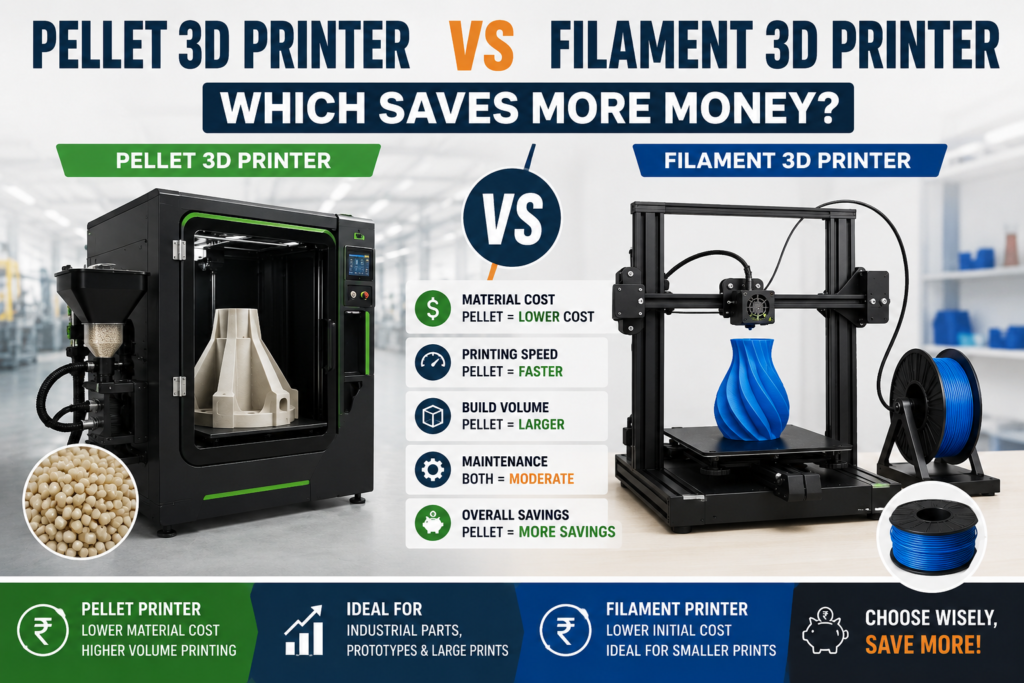
A pellet 3D printer, also called an FGF (Fused Granulate Fabrication) printer, uses raw plastic pellets — the same small granules used in injection molding — as its feedstock. Instead of a spool, the machine has a hopper that feeds pellets into a heated barrel, where a rotating screw melts and pushes the material out through a nozzle.
Because pellets skip the extra manufacturing step of being drawn into filament, they cost a fraction of what filament costs per kilogram, and they open up access to industrial and recycled resins that are rarely sold in filament form at all.
What Is a Filament 3D Printer?
A filament 3D printer is the standard FDM machine most people picture: a spool of pre-extruded plastic filament, typically 1.75 mm or 2.85 mm in diameter, is fed by a gear-driven extruder into a hot end and pushed through a small nozzle. It’s the format used by nearly every desktop and prototyping-grade printer on the market.
How Pellet and Filament 3D Printing Work
The mechanical difference matters more than it sounds. Filament is rigid before it enters the hot end, so an extruder motor can grip it directly and control flow with high precision — this is what enables filament printers’ fine detail and repeatability.
Pellets, by contrast, are loose granules that don’t grip or push against each other. Pellet printers solve this with a screw-driven system: pellets drop into a heated chamber, melt, and get forced out by a turning auger screw. It’s a more mechanically complex system, and controlling fine changes in flow rate is harder than with a rigid filament strand — which is part of why pellet printers tend to produce coarser, faster prints rather than fine detail work.
Cost Comparison: Pellet vs Filament 3D Printers
The cost story splits into two separate questions: what does the machine cost, and what does the material cost over time?
On the machine side, entry-level pellet printers can actually be competitively priced, though industrial-grade pellet systems with larger hoppers and higher-output screws command a premium over comparable desktop filament machines. On the material side, the gap is dramatic and consistent across multiple sources: pellets typically run four to ten times cheaper per kilogram than filament of the same base polymer.
For low-volume or occasional printing, that difference barely registers. For continuous production runs, it becomes the single biggest lever on your cost per part.
Material Cost Analysis
A standard 1 kg spool of PLA filament typically retails in the $11–$25 range depending on brand, quality, and promotions, with specialty and engineering filaments running considerably higher. PLA pellets, by comparison, are commonly available for roughly $2–$8 per kilogram — often described as costing five to ten times less than equivalent filament, since pellets skip the extrusion and spooling steps that add cost to filament manufacturing.
That price advantage compounds with materials that are expensive or simply unavailable in filament form — fiber-reinforced technical polymers, for instance, are far more commonly sold as pellets than as pre-drawn filament. If you’re budgeting for ongoing consumables, it’s worth comparing current listings for 3D Printing Filaments against pellet pricing for the same base polymer before committing to a machine type.
Printing Speed Comparison
Pellet printers generally win on raw throughput. Because a screw-driven pellet extruder can push out significantly more material per hour than a filament nozzle of comparable size, pellet systems are the go-to choice for large, thick-walled parts where volume matters more than fine detail. Filament printers, limited by the diameter of the filament itself, print more slowly but with far greater control over each layer.
Print Quality and Surface Finish
This is where filament printers pull ahead decisively. Smaller nozzle diameters and precise filament-driven extrusion give filament printers a cleaner surface finish and the ability to hold fine geometric detail. Pellet printers, with their larger nozzles and less consistent melt flow, are better suited to large, structural, or functional parts where surface finish is secondary to size and speed.
Build Volume Comparison
Pellet printers are generally built at a larger scale from the outset — the mechanical case for pellet extrusion gets stronger as build volume increases, since the cost savings on material scale directly with the amount of plastic used. Filament printers span a much wider range, from small desktop units to large-format industrial machines, but even large-format filament printers rarely match the sheer throughput of a pellet system printing at a similar size.
Maintenance and Operating Costs
Pellet printers demand more upkeep. The barrel and screw need regular cleaning to prevent material degradation and clogging, and dialing in screw speed, temperature profile, and flow consistency takes real operating experience. Filament printers are comparatively low-maintenance and closer to plug-and-play, which is part of why they remain the default choice for smaller shops and less specialized operators.
Industrial Applications of Pellet 3D Printers
Pellet systems are widely used for furniture prototyping and production, automotive tooling and fixtures, large architectural models, and recycling-driven manufacturing where reclaimed regrind plastic is fed directly into the printer. Anywhere the priority is large volume, low material cost, and moderate finish requirements, pellet printing tends to win.
Industrial Applications of Filament 3D Printers
Filament printers dominate detailed prototyping, functional small-to-medium parts, jigs and fixtures requiring tight tolerances, and end-use components where surface finish and dimensional accuracy matter. As part of a broader manufacturing workflow, filament printers also pair well with outsourced 3D Printing Services when you need finely detailed parts produced without owning every machine type in-house.
Pros and Cons of Pellet 3D Printers
Pros: Dramatically lower material cost, high throughput, access to recycled and specialty industrial resins, ideal for large parts. Cons: Coarser surface finish, higher maintenance, steeper learning curve, larger machine footprint.
Pros and Cons of Filament 3D Printers
Pros: High precision and fine detail, low maintenance, easy to operate, wide range of ready-to-use specialty filaments. Cons: Higher material cost per kilogram, slower deposition rates, less practical for very large parts.
Which Industries Benefit Most from Pellet Printing?
Furniture manufacturing, automotive tooling, large-scale architectural modeling, and any operation built around a circular-economy or recycled-plastic strategy tend to benefit most from pellet printing, since the economics improve as part size and print volume increase.
When Should You Choose a Filament 3D Printer?
Choose filament when the job calls for fine surface detail, tight tolerances, smaller functional parts, or when your team needs a low-maintenance system that multiple operators can run without specialized training. If your production mix is dominated by short-run prototypes or precision components rather than bulk parts, filament is usually the more practical and cost-effective choice overall, since the machine and workflow overhead stays lower.
Pellet vs Filament 3D Printer Comparison Table
| Factor | Pellet 3D Printer | Filament 3D Printer |
|---|---|---|
| Material cost per kg | Low (roughly $2–$8) | Higher (roughly $11–$25+) |
| Print speed / throughput | High | Moderate |
| Surface finish | Coarser | Fine detail |
| Maintenance | Higher | Lower |
| Best for | Large, high-volume parts | Precision, smaller parts |
| Learning curve | Steeper | Beginner-friendly |
Which Saves More Money?
For high-volume, large-format production, pellet printing wins clearly — the material savings alone can offset higher maintenance and a steeper learning curve within a relatively short production run. For low-to-moderate volume work, especially where detail and finish matter, filament printing remains more cost-effective once you account for machine complexity, training time, and maintenance overhead. There isn’t a single universal answer — the right choice depends on your part size, volume, and finish requirements.
Why Buy Industrial 3D Printers from 3D Protofarm?
Choosing between pellet and filament technology isn’t a decision to make from a spec sheet alone — it depends on your actual parts, materials, and production goals. Working with an established supplier means getting machine recommendations based on your real workflow, genuine equipment with proper warranty support, and access to complementary capabilities like reverse engineering with 3D Scanners if you need to digitise existing tooling or components before scaling up production.
Frequently Asked Questions
Is pellet 3D printing always cheaper than filament? Only at volume. The material cost per kilogram is far lower, but higher machine complexity and maintenance mean pellet printing needs a reasonable production volume to pay off its added overhead.
Can pellet printers achieve the same detail as filament printers? Generally no. Larger nozzles and less consistent melt flow make pellet printers better suited to large, structural parts rather than fine-detail work.
Can I use recycled plastic in a pellet printer? Yes — this is one of pellet printing’s biggest advantages, since regrind and reclaimed plastics can often be fed directly into the system.
Do pellet printers need special training to operate? Generally more than filament printers. Tuning screw speed, temperature, and flow consistency takes hands-on experience that filament printers largely automate away.
Is filament printing being replaced by pellet printing? No — they serve different needs. Filament remains the standard for precision and small-to-medium parts, while pellet systems are gaining ground specifically in large-volume, large-format production.
Final Verdict
Pellet printers save the most money at scale, thanks to a material cost advantage that can run five to ten times lower than filament. Filament printers save money in a different way — through lower maintenance, easier operation, and better suitability for precision parts where reprints and failed runs cost more than the material itself. The right answer depends less on which technology is “better” and more on matching the machine to your part size, volume, and finish requirements.