Not long ago, 3D printing was considered a novelty — a tool for making small plastic trinkets or one-off academic models. Today, it’s producing jet engine brackets for Airbus, patient-specific surgical implants, and load-bearing construction components. The future of 3D printing isn’t a distant speculation; it’s unfolding on factory floors and R&D labs right now.
According to a 2025 market report by Mordor Intelligence, the global additive manufacturing market is projected to reach USD 101.8 billion by 2030, growing at a CAGR of over 20% from 2025. For Indian manufacturers, product designers, and startup founders, this represents one of the most significant industrial shifts of the decade.
This article unpacks the 3D printing trends that matter most — the technologies gaining traction, the industries being transformed, the challenges holding back adoption, and what the 2026–2030 window looks like for businesses willing to move early.
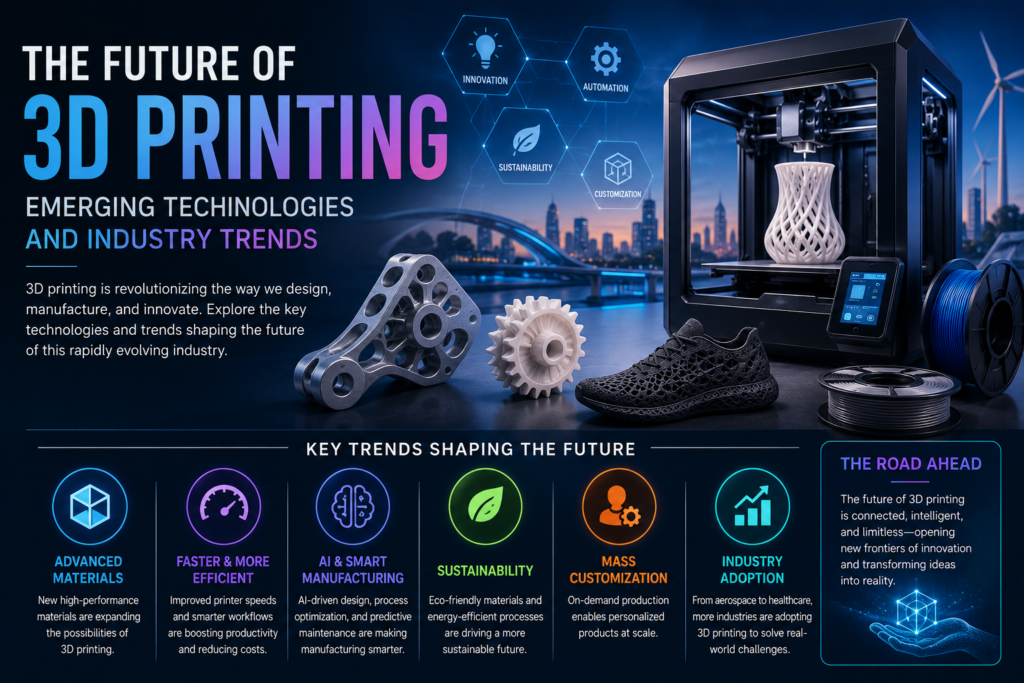
The Current State of the Global 3D Printing Industry
Additive manufacturing has moved decisively from prototyping into production. While rapid prototyping remains a high-volume use case, end-use part production now accounts for a growing share of revenue across the sector.
The Americas still lead in market share, but Asia-Pacific — particularly India, China, and South Korea — is growing fastest. India’s additive manufacturing market, valued at approximately USD 1.3 billion in 2024, is expected to more than double by 2029 as industrial adoption accelerates and government-backed digital manufacturing initiatives take hold.
Adoption is no longer limited to aerospace and automotive. Healthcare, consumer electronics, defense, and construction are all scaling up their reliance on industrial 3D printing for complex, low-volume production — exactly the scenarios where traditional manufacturing struggles.
Emerging 3D Printing Technologies Worth Watching
The real story behind additive manufacturing’s growth isn’t one technology — it’s a convergence of several innovations arriving at the same time.
AI-Powered Print Optimization
Artificial intelligence is being layered into every stage of the print process. Machine learning models now monitor layer deposition in real time, flag structural anomalies before they become defects, and adjust print parameters on the fly. When paired with generative design — where algorithms generate geometry optimised for strength, weight, and material usage — the results are components that no human engineer would have designed intuitively, yet outperform traditional parts on almost every metric.
Companies like Autodesk and nTopology have already integrated generative design into commercial workflows. Expect this to become standard practice in aerospace, automotive, and medical device engineering by 2028.
Multi-Material and Metal Additive Manufacturing
Single-material printing is no longer the ceiling. Multi-material printers can now deposit rigid and flexible polymers in a single build, enabling functional assemblies without secondary bonding. Metal 3D printing — using technologies like selective laser melting (SLM), electron beam melting (EBM), and binder jetting — is scaling up rapidly in aerospace and medical devices, where titanium and Inconel parts are printed to near-net shape, eliminating weeks of CNC machining.
Desktop Metal’s Production System and GE Additive’s ArcamQ10plus are examples of machines pushing metal AM into volume production. In India, DRDO and HAL have both invested in metal additive capabilities for indigenous defense components.
Bioprinting and Healthcare Applications
Bioprinting — the deposition of living cells to create tissue-like structures — remains one of the most watched frontiers. While fully functional printed organs are still years away, significant milestones have been reached: printed skin grafts for burn patients, cartilage scaffolds for orthopaedic surgery, and vascularised tissue models for drug testing are all in clinical or commercial use.
In India, institutions like IIT Hyderabad and the Sree Chitra Tirunal Institute are actively researching bioprinted tissue constructs, with medical-grade 3D printing finding immediate application in custom orthotics, surgical guides, and dental prosthetics.
Large-Scale Construction Printing
Construction 3D printing has crossed from experiment to commercial deployment. Firms in Europe, China, and the Middle East are printing two and three-storey structures using concrete extrusion systems. India’s construction sector — under pressure to deliver affordable housing at scale — is beginning to evaluate these systems seriously, with pilot projects underway in Maharashtra and Tamil Nadu.
Smart Materials and 4D Printing
4D printing adds time as a design variable: printed objects made from smart materials change their shape or properties in response to heat, moisture, or electric stimulus. Applications range from self-assembling medical stents to adaptive aerospace components. While 4D printing remains largely in research phases, the materials science underpinning it is maturing quickly.
Industry Trends Shaping the Future of Additive Manufacturing
Distributed Manufacturing and On-Demand Production
One of the most consequential shifts is the move toward distributed manufacturing — producing components where they’re needed, rather than shipping from a central facility. A network of 3D Printing Services India providers, accessible via digital platforms, can serve as a distributed production layer for companies that don’t want the capital cost of in-house printers.
On-demand production eliminates minimum order quantities and reduces lead times from weeks to days. For Indian startups developing hardware products, this fundamentally changes the economics of early-stage prototyping and pre-production validation.
Supply Chain Transformation and Digital Inventory
The COVID-19 pandemic exposed the fragility of globally extended supply chains. Additive manufacturing offers a structural fix: instead of holding physical inventory of low-velocity spare parts, manufacturers can hold digital files and print on demand. Airbus and Siemens have already moved in this direction for MRO (maintenance, repair, and overhaul) components. Indian manufacturers in automotive and heavy engineering would benefit significantly from this approach.
Sustainability and Waste Reduction
Traditional subtractive manufacturing removes material to achieve a shape — generating significant waste. Sustainable manufacturing through additive processes deposits material only where needed, reducing material waste by up to 90% in some metal applications. Closed-loop polymer recycling, where support material and failed prints are reprocessed into new feedstock, is also gaining traction across Manufacturing Solutions providers.
Mass Customisation at Scale
The economics of 3D printing don’t penalise variation. Producing 500 identical parts costs roughly the same as producing 500 slightly different ones. This enables mass customisation — truly individualised products at production volumes — in sectors like consumer healthcare, footwear, dental, and eyewear. Adidas’s Futurecraft 4D lattice midsole and Invisalign’s personalised dental aligners are two of the most commercially successful examples.
Industry Applications: Where Additive Manufacturing Is Taking Hold
Aerospace and Defence
This remains the highest-value application vertical. The ability to produce complex, lightweight components in high-performance materials — with full traceability — makes metal AM indispensable. NASA prints rocket engine injectors; Boeing produces structural cabin components additively; India’s DRDO is printing UAV airframe parts. The sector’s demand for custom, low-volume, flight-critical parts is almost a perfect use-case match for additive methods.
Automotive
Automotive OEMs use Rapid Prototyping Services extensively for design iteration, tooling, and jig fabrication. The electric vehicle transition is accelerating this further, as EV architectures require frequent structural and thermal management redesigns. Companies like Ford and BMW have installed high-capacity polymer and metal printers directly on assembly lines for end-use parts.
Healthcare and Medical Devices
Patient-specific implants, surgical planning models, and medical device housings are well-established applications. The product prototype development cycle for medical devices has been compressed from 18 months to under 6 in some cases, enabling faster regulatory submissions and faster access for patients. In India, the combination of a large patient population, growing private healthcare sector, and government push for medical device localisation makes this one of the most promising growth areas.
Consumer Products and Retail
For consumer product companies, Product Design Services powered by additive manufacturing allow aggressive design iteration without tooling investment. Footwear, eyewear, electronics accessories, and sporting goods brands are using AM to compress concept-to-shelf timelines significantly.
Construction
As mentioned above, construction printing is moving from pilot to commercial project. The immediate near-term opportunity in India is prefabricated modular components — walls, panels, drainage elements — that can be printed off-site and assembled quickly, addressing both cost and speed constraints in affordable housing.
Challenges and Honest Considerations
Any balanced view of additive manufacturing’s future must acknowledge the friction points.
- Material limitations: The palette of printable materials, while growing, is still narrower than conventional manufacturing. High-performance polymer composites, ceramics, and multi-phase alloys remain difficult to print reliably at scale.
- Production scalability: Most AM systems are batch processes. Achieving the throughput of injection moulding or die casting for high-volume parts remains a significant engineering challenge.
- Cost factors: For high volumes of geometrically simple parts, traditional methods still win on cost per unit. AM’s economics favour complexity and low volume — understanding this boundary is critical for sound investment decisions.
- Skills gap: Operating and maintaining industrial AM systems, and designing effectively for additive processes (DfAM), requires specialist knowledge. India faces a notable shortage of trained AM engineers, though this is improving through IIT programmes and industry training initiatives.
- Regulatory and certification: In regulated industries (aerospace, medical, defence), qualification and certification of additively manufactured parts requires substantial testing and documentation. Frameworks are maturing but remain demanding.
Future Outlook: 2026 to 2030
Several trajectories look particularly strong over the next four years.
AI-Driven Manufacturing Closes the Quality Gap
In-process monitoring powered by machine vision and AI will make AM quality control more reliable and auditable. This directly addresses one of the key objections to AM in regulated industries — inconsistent part-to-part quality. By 2028, AI-supervised printing is expected to be standard on industrial-grade systems.
Smart Factories and Industry 4.0 Integration
Additive manufacturing is a natural fit within digital manufacturing ecosystems. As Indian manufacturers adopt Industry 4.0 infrastructure — connected machines, digital twins, cloud-based process control — AM printers will integrate as just another production node in a responsive, data-driven factory.
Localised Production Becomes a Competitive Strategy
For Indian businesses, the convergence of Custom Prototyping capability with domestic Product Prototype Development services means international-quality product development without international supply chain exposure. By 2030, India could be a significant exporter of additively manufactured precision components, particularly in aerospace, defence, and medical devices.
Growth of Metal 3D Printing
Metal AM is forecast to be the fastest-growing segment of the additive market through 2030. Binder jetting — which is faster and cheaper than laser powder bed fusion — is gaining commercial acceptance and will bring metal printing economics within reach of mid-sized manufacturers, not just defence and aerospace primes.
At 3DProtoFarm, we’ve worked with product teams across India’s manufacturing, healthcare, and consumer goods sectors to turn ambitious design concepts into validated physical prototypes — faster and with less capital risk than traditional methods allow. If you’re evaluating additive manufacturing for your next product development cycle, the right time to start is now, not after your competitors do.
Frequently Asked Questions
1. What is the difference between 3D printing and additive manufacturing?
The terms are often used interchangeably, though ‘additive manufacturing’ is the broader, more technically precise term covering all processes that build parts layer by layer from digital files. ‘3D printing’ originally referred specifically to polymer inkjet processes but has become the popular shorthand for the entire category. In industrial contexts, ‘additive manufacturing’ is preferred.
2. Which industries benefit most from 3D printing today?
Aerospace and defence, healthcare and medical devices, and automotive currently generate the largest commercial returns from additive manufacturing, owing to their tolerance for higher per-part costs in exchange for geometric complexity, customisation, and reduced lead times. Consumer products and construction are growing fast from a smaller base.
3. Is 3D printing cost-effective for mass production?
Generally not for high-volume, geometrically simple parts — traditional methods win there on per-unit cost. Additive manufacturing is most cost-effective for low-to-medium volumes, highly complex geometries, customised or patient-specific parts, and scenarios where tooling investment would otherwise be required. The break-even volumes are shifting upward as machine speeds and material costs improve.
4. How is AI being used in 3D printing?
AI is being applied across several dimensions: generative design (producing optimised geometries from performance targets), in-process quality monitoring (detecting print defects in real time), print parameter optimisation (reducing trial runs), and predictive maintenance for printer hardware. The combined effect is higher first-time-right rates and lower total production cost.
5. What should Indian startups and manufacturers know before investing in 3D printing?
Start with a clear use-case definition — know whether you need prototyping speed, end-use production, tooling support, or all three. Evaluate whether in-house investment or working with an external service provider makes more financial sense at your volumes. Prioritise design-for-additive training for your engineering team, as DfAM knowledge significantly affects the economics. And pilot with real production use cases before committing to capital equipment.
Conclusion: Act on the Shift Before It Acts on You
The future of 3D printing is not a single moment of arrival — it’s an ongoing series of capability expansions, each one making additive manufacturing more capable, more affordable, and more difficult to ignore. From AI-optimised generative designs to distributed production networks and metal AM entering volume production, the industry is compounding its advantages year on year.
For Indian startups, product designers, and manufacturers, the question is no longer whether additive manufacturing will matter to your industry. It already does. The practical question is whether you move early — accessing the speed, flexibility, and cost advantages now — or spend the next few years catching up. Industrial 3D Printing services are more accessible and more capable than ever. The infrastructure exists. The expertise is available.
The only thing left is the decision to start. Talk to our team at 3DProtoFarm to explore how additive manufacturing can accelerate your next product development cycle.