If you need prints with ultra-smooth surfaces, sub-50-micron detail, and dimensional accuracy tight enough for snap-fit assemblies or dental aligners, resin 3D printing is in a different league from FDM. The technology has matured dramatically in recent years. What used to cost ₹3–5 lakh and require a dedicated technician now ships for under ₹30,000 and sets itself up automatically.
This guide cuts through the noise. It covers the best resin printers available in 2026 across three professional segments — engineering prototyping, dental and clinical applications, and product design — along with the material science, resolution fundamentals, and cost framework you need to make the right call for your specific use case.
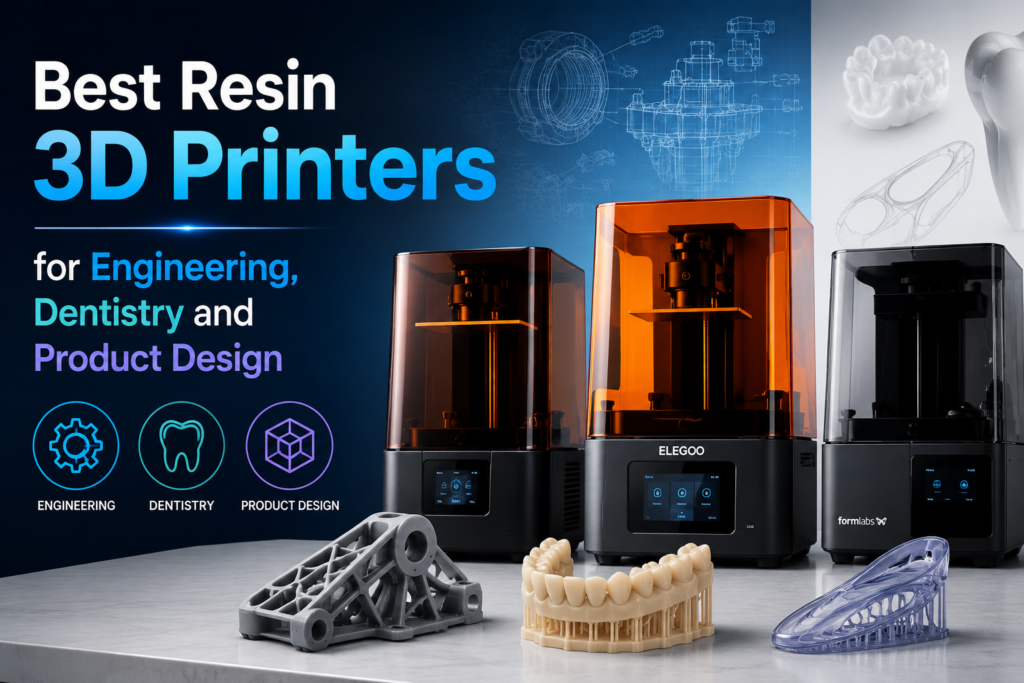
What Is a Resin 3D Printer?
A resin 3D printer uses UV light to cure liquid photopolymer resin into solid layers, building objects from the bottom up one layer at a time. The three most common variants are:
SLA (Stereolithography) — A laser traces each layer point-by-point in the resin vat. This produces the finest feature resolution and smoothest surfaces but is slow and expensive. Formlabs’ Form series is the most recognised desktop SLA line.
DLP (Digital Light Processing) — A digital projector flashes an entire layer at once, curing all points simultaneously. Faster than SLA for small build areas, with resolution determined by the projector’s pixel density. Common in dental and jewellery applications.
MSLA / LCD (Masked Stereolithography) — Uses a monochrome LCD screen as a photomask between the UV backlight and the resin. The entire layer cures at once, similar to DLP, but at a much lower cost. The dominant technology in 2026 for desktop and prosumer printers. Elegoo, Anycubic, and Phrozen all use MSLA.
For most engineering, dental, and product design applications in India, high-end MSLA and professional SLA are the two categories worth evaluating.
Why Resin 3D Printing Is Preferred for High-Precision Applications
The core advantage is resolution. FDM printers lay down molten plastic in lines typically 0.4–0.8mm wide; even at their finest, they produce visible layer lines and rounded edges. Resin printers cure layers as thin as 25–50 microns with XY pixel sizes between 18 and 50 microns on modern machines. The result is surface quality that rivals injection moulding at the visual level.
For engineering prototyping, this matters when:
- You need accurate fits between mating parts (tolerances ±0.1–0.2mm are routinely achievable)
- The prototype will be shown to stakeholders and first impressions of surface quality matter
- You are validating fine features — threads, snap-fits, thin walls — that FDM simply cannot render cleanly
For dental applications, dimensional accuracy isn’t cosmetic — it directly determines clinical fit. A crown that is even 0.2mm off requires remake. Dental DLP and MSLA printers operating at 33–50 micron XY resolution can routinely hit the ±25 μm tolerance that clinical workflows demand.
If your team is currently outsourcing precision models, an in-house resin printer can dramatically compress turnaround times. Our SLA 3D Printing Service is available for teams that need high-volume or large-format resin output beyond what a desktop machine can handle.
Key Factors to Consider Before Buying a Resin 3D Printer
XY Resolution — The pixel size of the LCD or projector. Smaller is better. For dental and jewellery work, aim for ≤35 microns. For engineering prototypes, 50 microns is generally sufficient.
Build Volume — Larger build plates let you print bigger single parts or batch smaller ones. For dental, a 130×80mm plate is usually adequate. Engineering and product design teams often want 200×120mm or larger.
Technology Type — MSLA is the value choice. Professional SLA (Formlabs) costs more but delivers superior reliability, a closed-loop material ecosystem, and audit-trail features for regulated environments.
Resin Ecosystem — Closed systems (Formlabs, SprintRay) cost more per litre but come with validated settings and FDA-cleared or biocompatible options. Open systems work with any 405nm resin, giving you flexibility and lower material costs.
Post-Processing Requirements — Every resin printer needs a wash station (IPA or dedicated wash liquid) and a UV curing unit. Budget for these; they add ₹8,000–₹25,000 depending on the tier.
Indian Market Availability — Check that spare LCD screens, FEP/nFEP films, and resins are actually stocked in India before committing. Elegoo and Anycubic have established supply chains here. Formlabs operates through ARK Infosolutions as its authorised distributor.
Best Resin 3D Printers for Engineering Applications
Engineering teams need printers that combine good build volume, reliable layer adhesion, engineering-grade resin compatibility, and — at the professional tier — software workflows that support documentation and repeatability.
Formlabs Form 4 — Professional Benchmark
The Form 4 is the reference machine for professional resin 3D printing in 2026. It uses Formlabs’ Low Force Display (LFD) print engine, which reduces peel forces during layer separation, resulting in a print success rate that Formlabs reports at 99%. Print speeds reach up to 100mm/hour, and most jobs complete in under two hours.
Key specs: 200×125×210mm build volume, 50-micron XY resolution, compatible with 38+ Formlabs resins including Tough 2000, Rigid 10K, and High Temp resins. The PreForm slicer and Formlabs Dashboard cloud platform make print management and material tracking straightforward for team environments. In India, the Form 4 is available through Phillips Additive and ARK Infosolutions.
Best for: Engineering teams prototyping functional components, jigs and fixtures, low-volume production parts, or any application requiring FDA-cleared or biocompatible materials and audit-trail repeatability.
Limitations: Expensive (US $4,069 standalone; Indian pricing on request from distributors). Proprietary resin ecosystem adds ongoing cost unless you unlock the Open Material Mode add-on (~$875).
Elegoo Saturn 4 Ultra — Mid-Range Value Pick
The Saturn 4 Ultra is the most capable mid-range resin printer available in India in 2026. It features a 10-inch 12K monochrome LCD with a 218×123×220mm build volume, ACF (Anti-Cloudiness Film) for faster layer separation and fewer failures, a heated resin vat, and AI-based print failure detection via an integrated camera.
The tilt-release mechanism on the vat and build plate dramatically reduces peel force compared to earlier flat-peel MSLA machines, which translates to more reliable prints on large surface-area layers — a common failure point in engineering work. It is priced around US $399 (approximately ₹33,000–₹38,000 in India at current exchange rates), and 3dprotofarm.in stocks the machine directly from its Rajkot warehouse.
Best for: Engineering startups, product studios, and educational institutions needing large-format resin output without a professional-grade budget. Excellent for prototyping structural brackets, housings, and mechanical assemblies.
Limitations: Open resin ecosystem means you manage your own exposure profiles; no dashboard for remote fleet management. Replacement LCD screens are a recurring cost, though widely available.
Elegoo Mars 5 Ultra — Desktop Engineering Precision
For teams that need maximum detail in a compact format, the Mars 5 Ultra offers 18×18-micron XY resolution — among the finest on any consumer resin printer — in a desktop footprint. Build volume is smaller (143×90×165mm), but the pixel density makes it the right tool for fine-featured mechanical parts, thin-wall components, and intricate assemblies.
Best for: Mechanism prototyping, connector housings, medical device models, and any part where sub-20-micron XY precision matters more than build size.
Our Rapid Prototyping Services are available if you need complex assemblies, multi-material outputs, or production volumes that go beyond what a single in-house machine can deliver.
Best Resin 3D Printers for Dental Models and Aligners
Dental applications have more demanding requirements than most engineering work. Accuracy must be consistent batch-to-batch, not just print-to-print. Materials must be biocompatible. And workflows must accommodate the high throughput of a busy dental lab — often 20–50 models per day.
Formlabs Form 4B — Clinical Standard
The Form 4B is the dental-specific variant of the Form 4. It is compatible with 15 biocompatible Formlabs resins, including FDA-cleared materials for surgical guides, dental models, and temporary crowns. Print speed reaches 100mm/hour, and the build volume is 200×125×210mm — large enough to batch multiple aligners or models in a single run.
What separates the Form 4B from consumer MSLA machines for dental use is the combination of validated material profiles, a documented print success rate, and Formlabs’ cloud dashboard which creates repeatable production conditions. For regulated dental environments where material traceability is required, this matters significantly.
Best for: Dental labs producing surgical guides, splints, temporary crowns, and orthodontic models at clinical quality with traceability requirements.
Flashforge Focus Ultra — Mid-Range Dental Specialist
The Focus Ultra is engineered specifically for dental production. It uses a 9.25-inch 6K monochrome LCD to achieve 33-micron XY resolution, with a build volume of 197×122×180mm. Print speeds range from 10–50mm/hour, and it features an industrial-grade Z-axis rail and a quick-removal pin on the resin tank for faster changeovers. It is compatible with a wide range of third-party dental resins operating at 405nm.
At its price point (considerably lower than Formlabs), it suits dental labs in India that need clinical-grade dimensional accuracy without the full cost of the Formlabs ecosystem.
Best for: Clinics and labs producing crowns, bridges, orthodontic models, retainers, and surgical guides at high volume where open resin compatibility is important.
Phrozen Sonic XL 4K Plus — Accessible Dental Entry Point
Phrozen designed the Sonic XL 4K Plus specifically for dental workflows. Its lower 4K resolution compared to the 14K+ panels on newer machines is a deliberate choice: dental workflows prioritise dimensional accuracy and validated exposure profiles over raw pixel count, and 4K calibration is extremely well-understood for crown and bridge applications.
Phrozen’s dental resin lineup — including Wax-like Dental Green for casting and Dental Model Burgundy for study models — is well-developed and more affordable per litre than Formlabs’ FDA-cleared options. This makes it the practical entry point for dental clinics in India that are transitioning from plaster models to digital workflows.
Best for: Clinics taking their first steps into in-house dental printing, labs that need reliable aligner models at lower per-print cost, and practices where a single operator manages the printer.
Best Resin 3D Printers for Product Design and Prototyping
Product designers use resin printing at two distinct stages: concept validation (where speed and surface aesthetics matter) and functional testing (where mechanical properties matter). The right printer depends on where in that cycle you are.
Formlabs Form 4 — Client-Ready Prototypes
Product development teams use the Form 4 to produce parts that look client-ready straight off the printer. The combination of 50-micron XY resolution, LFD print technology, and Formlabs’ wide colour and material range (including Clear, Grey, and Black resins in standard and high-temp variants) means prototypes arrive with minimal post-processing before a client presentation.
For consumer product design where stakeholder approval hinges on visual impression, the Form 4’s surface quality advantage over MSLA machines is material. It consistently outperforms mid-range MSLA printers in edge sharpness and surface uniformity.
Elegoo Saturn 4 Ultra — Volume and Speed
For product design studios running multiple design iterations per week, the Saturn 4 Ultra’s large build plate and fast print cycles make it the throughput choice. You can nest four to six prototype parts on a single build plate and run overnight, arriving in the morning to a full batch.
The ACF film and tilt mechanism on the Saturn 4 Ultra mean that large-area prints — common in product design, where housing shells and panels are typical outputs — succeed reliably rather than delaminating mid-print as they often did on older flat-peel MSLA machines.
Anycubic Photon Mono M7 Pro — Fast Iteration at Mid Range
The M7 Pro is positioned as the fastest printer in the mid-range segment for production work. With Anycubic’s LighTurbo 2.0 light source and a 9.6-inch panel, it balances build volume (196×122×260mm, notably tall) with reliable throughput. The 260mm Z height is useful for tall consumer product prototypes — bottles, enclosures, and handle-heavy objects — that other mid-range machines would need to print in sections.
Best for: Product designers who iterate on tall or ergonomic forms and need reliable overnight batch printing.
For teams that need help translating a design brief into a printable prototype strategy, our Product Design and Development service covers the full workflow from CAD to finished model.
Resin vs FDM: Which Technology Is Right for You?
The choice is rarely binary in a professional setting — most studios run both — but the decision logic is clear.
Choose resin when:
- You need surfaces smooth enough for direct photography or client review
- You are validating tight tolerances (≤0.2mm) on mating parts
- The output is dental, medical, or jewellery grade
- Part size fits within ~200×120mm and 200mm Z
Choose FDM when:
- Part size exceeds resin build volumes
- You need structural, load-bearing strength in the prototype itself
- Material cost per kg matters (FDM filament costs ₹800–₹2,500/kg vs ₹1,500–₹4,000/kg for quality resin)
- The application requires PETG, ASA, or engineering-grade filaments for thermal or UV resistance
For projects that fall outside both desktop technologies, our FDM 3D Printing Service handles large-format and engineering-grade FDM output.
Understanding Print Resolution, Accuracy and Surface Finish
Resolution in resin printing has two axes:
XY Resolution — Determined by the pixel size of the LCD or projector. In 2026, ranges from ~18 microns (Mars 5 Ultra, 8K panel) to ~50 microns (Formlabs Form 4). For reference, a human hair is approximately 70 microns in diameter. Below 35 microns, fine surface features like engraved text and micro-lattice structures become clearly defined.
Z Resolution (Layer Height) — User-selectable, typically 25–100 microns. Finer layers improve surface finish on curved surfaces and reduce visible layer stepping, but increase print time proportionally. For engineering and dental work, 50 microns is the standard starting point; for master patterns and jewellery, 25–35 microns is common.
Dimensional Accuracy — Different from resolution. The Form 4 specifies dimensional tolerance of ±0.15% in XY. For a 100mm part, that is ±0.15mm. MSLA machines running dialled-in exposure profiles can approach ±0.1–0.2mm for well-calibrated prints. Dental applications typically target ±25–50 microns for clinical fit.
Surface Finish — Even at identical resolution, surface finish varies with the print technology, resin formulation, and support placement strategy. LFD (Formlabs) and tilt-release MSLA (Saturn 4 Ultra, Mars 5 Ultra) generally outperform standard flat-peel MSLA on large surface areas due to lower peel stress during layer separation.
Our Industrial 3D Printing Solutions are available for applications requiring tolerances and surface specifications beyond desktop resin capabilities.
Material Options for Engineering and Dental Applications
The resin market in 2026 covers a wide spectrum of mechanical and clinical properties. Key categories relevant to professional users:
Standard/General Purpose — ABS-like tensile strength (~45–60 MPa), low cost, wide community of tested exposure profiles. Good for visual models and concept prototypes. Not suitable for functional mechanical stress testing.
Engineering Resins — Formulated for specific mechanical requirements. Elegoo ABS-Like Pro and Siraya Tech Blu target impact resistance and some flexibility. Formlabs Tough 2000 (tensile strength ~46 MPa, elongation at break 25%) and Rigid 10K (glass-filled, 10,000 MPa flexural modulus) cover functional and structurally demanding engineering work respectively.
High-Temperature Resins — Formlabs High Temp and Anycubic High Clear offer heat deflection temperatures above 200°C, suitable for under-hood automotive validation and heat-exposed jigs and fixtures.
Dental Resins — A distinct category with biocompatibility and clinical property requirements. Key sub-types:
- Model resins — High dimensional stability, low shrinkage, for orthodontic working models and surgical guides
- Casting resins — Wax-based, low-ash burnout, for dental casting patterns
- Temporary crown resins — Biocompatible, stain-resistant, for in-mouth placement
Brands commonly used in Indian dental labs include Phrozen Dental, Jamghe, Antinsky (compatible with most 405nm LCD machines), and Formlabs’ FDA-cleared dental range for Form 4B users.
For applications requiring SLS nylon or composite materials that go beyond resin properties, our SLS 3D Printing Service offers an alternative route to engineering-grade parts.
Common Challenges of Resin 3D Printing
Resin handling and safety — Uncured resin is a skin irritant and potential sensitiser. Nitrile gloves, adequate ventilation, and a UV-safe work environment are non-negotiable. In Indian summer conditions (35–45°C), resin storage below 30°C away from sunlight is essential to prevent premature degradation.
Post-processing overhead — Every print needs washing (IPA or dedicated wash solution) and UV curing before use. Budget 30–60 minutes of post-processing per build. Enclosed wash-and-cure stations (Elegoo Mercury, Formlabs Wash & Cure) reduce this significantly and pay for themselves quickly in time savings.
LCD screen lifespan — Monochrome LCD screens in modern MSLA printers are rated for 2,000–4,000 hours of UV exposure. At moderate use (2–3 hours/day), that is 2–4 years. Replacement screens for Elegoo and Anycubic are available in India for ₹3,000–₹8,000.
Print failures — Flat-peel MSLA machines have a 60–90% print success rate on large-area layers without careful tuning. Tilt-release mechanisms (Saturn 4 Ultra, Mars 5 Ultra) and ACF film reduce this significantly. Formlabs Form 4 operates at a reported 99% success rate. For production environments, print success rate directly affects throughput and material waste.
Resin waste from failed prints — Cured resin fragments in the vat contaminate subsequent prints. Build in regular vat filtering as part of workflow maintenance.
Maintenance and Post-Processing Requirements
A professional resin printing setup involves three workstations: the printer itself, a washing station, and a UV curing station.
Washing — Parts must be washed in IPA (99% concentration recommended; 70% IPA contains too much water and leaves residue) or a dedicated wash solution like Elegoo PC-6 or Formlabs IPA Replacement for 5–10 minutes, agitated or ultrasonically. IPA at 90%+ concentration is available from chemical suppliers and online marketplaces across India.
Curing — Post-wash parts need UV curing to fully cross-link the resin, stabilising mechanical properties and eliminating surface tackiness. Dedicated UV curing chambers (Elegoo Mercury Cure, Phrozen Cure Mega) provide even exposure and temperature-controlled curing for consistent results. Avoid direct sunlight curing for anything dimensionally critical — uneven heating causes warping.
Regular printer maintenance:
- FEP/nFEP/ACF film replacement every 20–50 large builds (or when cloudiness appears); cost ₹500–₹2,000 per film
- Vat filtering after every build and full vat clean weekly for active use
- Build plate re-levelling check monthly
- IPA waste disposal — cured IPA residue by sunlight exposure before disposal; check local guidelines
Cost Analysis: Entry-Level vs Professional Resin Printers
| Tier | Representative Machine | Printer Cost (India) | Resin Cost | Target User |
|---|---|---|---|---|
| Entry MSLA | Elegoo Mars 5 Ultra | ₹20,000–₹28,000 | ₹1,200–₹1,800/kg | Hobbyist, student, small studio |
| Mid-Range MSLA | Elegoo Saturn 4 Ultra | ₹33,000–₹42,000 | ₹1,200–₹2,500/kg | Engineering startup, design studio |
| Professional SLA | Formlabs Form 4 | ₹3.5–₹4.5 lakh (estimate) | ₹5,000–₹12,000/kg | Enterprise engineering, regulated dental |
| Dental Specialist | Flashforge Focus Ultra | ₹1.2–₹2 lakh (estimate) | ₹3,000–₹8,000/kg (dental grade) | Dental lab, clinic |
Note: Formlabs and dental specialist printer pricing in India varies by distributor and configuration. Contact Phillips Additive or ARK Infosolutions for current INR pricing on the Form 4 and Form 4B.
The real cost comparison is not just hardware — it is the fully-loaded cost per good print, including:
- Resin consumed (including failed prints)
- Wash solution and IPA
- Consumables (FEP film, replacement LCDs)
- Post-processing time
- Support removal and finishing labour
At low to moderate volumes, a mid-range MSLA machine has the lowest cost per print. At high volumes with repeatability requirements, the lower failure rate and lower labour overhead of the Form 4 often close the total cost gap significantly.
Future Trends in Resin 3D Printing Technology
16K resolution panels — The Elegoo Saturn 4 Ultra 16K is entering the market in Q3 2026 at approximately US $849, offering 20×26 micron XY resolution at large-format build size. This approaches SLA-level feature quality at MSLA pricing.
AI-assisted failure detection — Integrated cameras with print-monitoring AI (as on the Saturn 4 Ultra and M7 Pro) are becoming standard on mid-range machines, reducing material waste from undetected failures in overnight runs.
Automated resin management — Smart resin management systems (two-way pumps, automatic fill and drain, batch tracking) are moving down from professional to mid-range printers, reducing the labour overhead of large-volume resin printing.
Engineering and biocompatible materials expansion — The resin material library is expanding significantly. ABS-like materials now reach tensile strengths of 70–84 MPa, closing the gap with injection-moulded ABS. Dental resin certification pipelines are shortening as more manufacturers seek FDA and CE clearance.
Faster print speeds — Print speeds of 50–100mm/hour, once exclusive to Formlabs’ platform, are appearing on MSLA machines. The bottleneck is shifting from print time to post-processing time.
Final Recommendations
For engineering teams on a budget: The Elegoo Saturn 4 Ultra is the best-value machine in the Indian market for serious professional use. Its combination of large build volume, 12K resolution, tilt-release mechanism, and heating vat delivers reliable results at a price point accessible to startups and SMEs.
For regulated or client-facing professional environments: The Formlabs Form 4 remains the benchmark. Its print success rate, material ecosystem, and workflow software are meaningfully differentiated from MSLA alternatives for teams where failed prints, material traceability, and repeatable output quality are business-critical.
For dental labs entering in-house printing: The Phrozen Sonic XL 4K Plus is the accessible starting point, with a purpose-built dental resin ecosystem. Labs that need clinical accuracy with a clear upgrade path should evaluate the Flashforge Focus Ultra or Formlabs Form 4B depending on volume and traceability requirements.
For product design studios: Run the Saturn 4 Ultra for iteration and overnight batch work. If client presentation quality drives your studio’s decisions, the Form 4 produces visually superior results that reduce finishing time before presentations.
If your project requirements exceed what a desktop machine can deliver — in build volume, material specification, or production throughput — our Custom Manufacturing Services cover the full range of professional resin, SLS, and FDM output for Indian engineering and design teams.
Frequently Asked Questions
Which resin 3D printer is best for engineering prototypes? The Formlabs Form 4 for professional and regulated applications; the Elegoo Saturn 4 Ultra for mid-range engineering work requiring large build volume and high throughput. For desktop precision, the Elegoo Mars 5 Ultra’s 18-micron XY resolution handles intricate mechanical details extremely well.
Are resin 3D printers suitable for dental applications? Yes. Purpose-built dental printers from Formlabs (Form 4B), Flashforge (Focus Ultra), and Phrozen (Sonic XL 4K Plus) are routinely used in dental labs and clinics for surgical guides, orthodontic models, temporary crowns, and aligner fabrication. The key requirements are 33–50 micron XY resolution, dimensional stability under ±50 microns, and biocompatible or dental-certified resin compatibility.
What is the difference between SLA, DLP and LCD resin printers? SLA uses a UV laser tracing each layer point-by-point — the highest resolution, slowest, and most expensive. DLP uses a digital projector to flash entire layers — faster, common in dental. LCD (MSLA) uses a monochrome LCD screen as a photomask with a UV backlight — the most cost-effective, and the dominant technology for desktop and prosumer machines in 2026.
How accurate are modern resin 3D printers? Mid-range MSLA machines (Saturn 4 Ultra, Mars 5 Ultra) achieve dimensional tolerances of ±0.1–0.2mm with proper calibration and exposure tuning. The Formlabs Form 4 specifies ±0.15% XY tolerance (±0.15mm on a 100mm part). Dental-specific DLP printers like the HeyGears UltraCraft ChairSide Pro achieve ±25 μm accuracy for clinical applications.
What materials can be used in professional resin printers? Standard and ABS-like resins for visual models, engineering resins (Tough, Rigid, High Temp) for functional prototypes, castable resins for investment casting patterns, flexible and elastic resins for seals and living hinges, and dental/biocompatible resins for clinical applications. Open-platform printers accept any 405nm photopolymer resin; closed platforms (Formlabs) use validated proprietary resins with optional open material mode.
Are resin 3D printers expensive to maintain? Ongoing costs include resin (~₹1,200–₹8,000/kg depending on grade), IPA or wash solution, FEP/nFEP film replacement (₹500–₹2,000 every 20–50 builds), and LCD screen replacement (₹3,000–₹8,000 every 2–4 years at moderate use). Professional SLA printers (Formlabs) have higher material costs but lower failure rates, which reduces net material waste.
Is resin printing better than FDM for product design? For surface finish, fine detail, and visual prototype quality — yes, resin is significantly better. For structural functional testing, large-scale parts, or cost-sensitive volume output — FDM is often the better choice. Most product design studios run both technologies, using resin for client-facing prototypes and FDM for structural validation and large mockups.
How do I choose the right resin 3D printer for my business? Start with the output requirement: what does the finished print need to do? If it needs to meet clinical or regulated material standards, start with Formlabs Form 4 or Form 4B. If you need large build volume at accessible cost, the Saturn 4 Ultra is the mid-range benchmark. If budget is tight and print size is small, the Mars 5 Ultra offers excellent value. Factor in the total cost of ownership — resin, consumables, post-processing equipment, and failure rate — not just the printer price.