Anycubic Photon P1 vs Elegoo Saturn 4 Ultra 16K: Which Resin 3D Printer Is Better? (2026 Comparison)
Resin 3D printing has moved well beyond hobbyist basements in 2026. Miniature painters want crisper faces on 32mm models, jewelry designers need masters accurate enough for direct casting, dental labs need dimensionally trustworthy models, and engineers want prototypes that hold tolerance. That demand keeps pushing screen resolution, mechanical precision, and workflow automation forward every year.
Two machines currently dominate that conversation among serious hobbyists and small studios: the Anycubic Photon P1 and the Elegoo Saturn 4 Ultra 16K. Both are MSLA 3D printers built for high-resolution resin printing, but they take noticeably different approaches to get there. This Anycubic Photon P1 vs Elegoo Saturn 4 Ultra 16K comparison breaks down design, resolution, speed, materials, and running costs so you can decide which one fits your workflow.
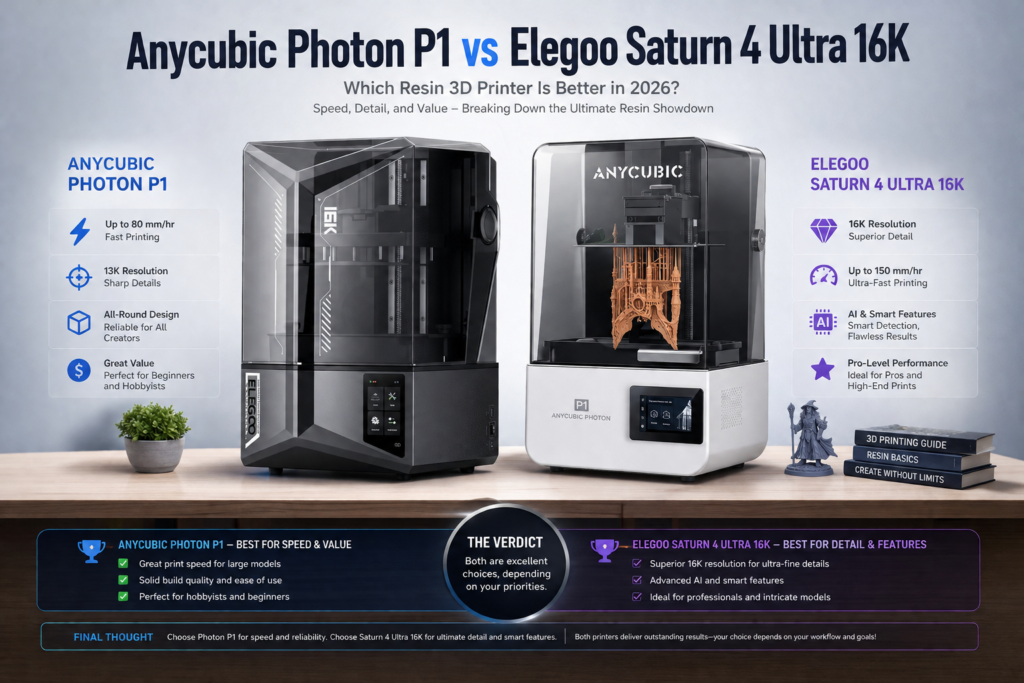
Quick Comparison Table
| Feature | Anycubic Photon P1 | Elegoo Saturn 4 Ultra 16K |
|---|---|---|
| LCD Resolution | 10.1″ 14K mono LCD, 16.8 × 24.8 μm XY | 10″ 16K mono LCD, 14 × 19 μm XY |
| Build Volume | 223 × 126 × 230 mm (6.5L) | 211.68 × 118.37 × 220 mm |
| Print Speed | Standard-speed workflow, ball-screw driven | Up to 150 mm/h |
| Light Source | LighTurbo 4.0 COB array | COB light source with Fresnel lens |
| Auto Leveling | Industrial ball-screw Z-axis, ±0.01mm repeatability | Smart mechanical leveling sensors |
| Resin Tank | Smart heated tank, up to 40°C, dual-vat capable | Heated VAT, keeps resin at 30°C |
| Connectivity | USB, Wi-Fi | USB, Wi-Fi, OTA updates |
| Camera | Not standard | Built-in AI camera with live monitoring |
| Air Filtration | Not built-in | Not built-in |
| Operating System | Photon Workshop / Chitubox compatible | EL3D-4.0 / Chitubox compatible |
| Best For | Dual-material work, engineering resins, jewelry | High-speed batch printing, dental, miniatures |
Design & Build Quality
The Anycubic Photon P1 leans into “industrial-grade” language, and the hardware backs it up. Its Z-axis runs on a stability ball screw rated for roughly ±0.01mm repeatability across more than a thousand print cycles, and the build plate carries a flatness tolerance most consumer machines don’t bother mentioning.
The Elegoo Saturn 4 Ultra 16K keeps the familiar flip-lid Saturn design proven across several generations. It’s a touch less exotic mechanically, but the touchscreen interface is responsive and the heated tank plus AI camera give it a genuinely premium feel. For a resin 3D printer India buyers can set up and trust within an afternoon, the Saturn 4 Ultra 16K’s polish is a real advantage in this Anycubic Photon P1 vs Elegoo Saturn 4 Ultra 16K matchup.
Print Resolution & Quality
This is where the debate gets genuinely close. The Photon P1 uses a 14K screen delivering 16.8 × 24.8 μm XY resolution, while the Saturn 4 Ultra 16K’s 16K panel pushes down to 14 × 19 μm — a technical win for Elegoo on paper.
In practice, both machines produce results that are difficult to fault for tabletop miniatures, jewelry masters, dental models, and engineering prototypes. Fine facial details on 28-32mm miniatures look nearly identical once properly dialed in; the finer pixel pitch on the Saturn 4 Ultra 16K becomes more noticeable on intricate jewelry filigree, while the Photon P1’s mechanical stability shows its value on taller, dimensionally sensitive engineering parts. Supports release cleanly on both machines when tuned correctly.
Print Speed Comparison
Elegoo has the clear edge here. The Saturn 4 Ultra 16K is rated for print speeds up to 150 mm/h thanks to its Tilt Release mechanism, which lifts one edge of the tank to peel layers with far less resistance than a straight vertical pull.
The Photon P1 doesn’t chase headline speed numbers the same way. Its Wave Release Technology reduces peel force significantly and improves resin economy, but Anycubic prioritized repeatability and curing efficiency over raw throughput. For quiet, low-stress printing rather than shaving minutes off each cycle, the P1’s approach still holds up well.
Build Volume
Both printers occupy a similar footprint, but the Photon P1’s 223 × 126 × 230 mm volume is slightly larger, and its optional dual-plate configuration lets you split the vat for two simultaneous small-model runs. The Saturn 4 Ultra 16K’s 211.68 × 118.37 × 220 mm volume stays comfortable for full dental arches, mid-size sculptures, or batches of smaller items.
For commercial print farms running larger single pieces or split dual-material jobs, the Photon P1’s extra depth gives it a practical edge; for small-scale miniature or jewelry batches, either machine handles the job well.
Auto Leveling & User Experience
The Saturn 4 Ultra 16K is arguably friendlier for a first-time resin printer owner. Its smart mechanical sensors handle leveling, residue detection protects the LCD, and alarms for resin shortage or leveling failure catch mistakes early. Maintenance stays simple thanks to the quick-release, non-slip tray design.
The Photon P1’s ball-screw Z-axis needs more careful initial setup, but once calibrated it holds that calibration exceptionally well over time. Beginners chasing a fast, foolproof first print will likely prefer the Saturn 4 Ultra 16K; users planning heavy day-to-day use will appreciate the P1’s long-term mechanical stability.
Material Compatibility
Material support is nearly identical across the Anycubic Photon P1 vs Elegoo Saturn 4 Ultra 16K matchup:
| Material | Photon P1 | Saturn 4 Ultra 16K | Applications |
|---|---|---|---|
| Standard Resin | Yes | Yes | General-purpose models |
| ABS-like Resin | Yes | Yes | Durable functional parts |
| Tough Resin | Yes | Yes | Snap-fit prototypes, mechanisms |
| Flexible Resin | Yes | Yes | Gaskets, wearable components |
| High Temp Resin | Yes (up to 8000cps viscosity) | Yes | Injection mold masters |
| Dental Resin | Yes | Yes | Dental models, aligners |
| Castable Resin | Yes | Yes | Jewelry casting |
| Water Washable Resin | Yes | Yes | Low-odor hobby printing |
The Photon P1’s headline advantage is viscosity tolerance: its smart heated tank supports resins up to roughly 8000cps, opening the door to thicker engineering-grade materials. The Saturn 4 Ultra 16K’s 30°C tank heating similarly improves flow and layer adhesion for standard and dental resins.
Software & Ecosystem
Both printers fit comfortably into a standard resin printing workflow. The Photon P1 pairs with Anycubic’s Photon Workshop and is also Chitubox and Lychee Slicer compatible. The Saturn 4 Ultra 16K runs on Elegoo’s EL3D-4.0 firmware, works natively with Chitubox, and supports OTA updates plus remote monitoring through its Wi-Fi module and AI camera — an advantage the Photon P1 doesn’t match out of the box.
Running Costs
Resin consumption is comparable for standard prints on both machines, though the Photon P1’s Wave Release Technology is rated to cut resin waste by 20-30%. FEP/release-film replacement and LCD lifespan are similar across both printers. Electricity draw is modest either way, and neither includes built-in air filtration, so a ventilated space is worth budgeting for regardless of which resin 3D printer you pick.
Pros & Cons: Anycubic Photon P1 vs Elegoo Saturn 4 Ultra 16K
Anycubic Photon P1
Pros
- Industrial-grade ball-screw Z-axis with excellent long-term repeatability
- Dual-vat, dual-material/dual-color printing option (via add-on kit)
- Handles high-viscosity engineering resins up to 8000cps
- Slightly larger build volume
Cons
- No built-in camera for remote monitoring
- Steeper initial calibration curve
- Dual-material kit is a separate purchase
Elegoo Saturn 4 Ultra 16K
Pros
- Finer 16K screen resolution for ultra-fine detail
- Genuinely fast print speeds up to 150 mm/h
- Built-in AI camera and smart sensors for a beginner-friendly experience
- Heated tank and Tilt Release Technology reduce failed prints
Cons
- Slightly smaller build volume than the Photon P1
- No native dual-material printing capability
- Long-term mechanical wear data is still emerging since it’s a newer release
Which Resin Printer Should You Buy?
When you break down Anycubic Photon P1 vs Elegoo Saturn 4 Ultra 16K by use case, the right pick becomes clearer:
- Beginners: The Saturn 4 Ultra 16K’s guided setup, smart sensors, and camera monitoring make the learning curve gentler.
- Miniature creators: Either printer delivers exceptional detail; the Saturn 4 Ultra 16K’s finer pixel pitch gives it a slight edge on very small features.
- Jewelry businesses: The Photon P1’s high-viscosity resin compatibility suits castable and wax-like jewelry resins particularly well.
- Dental labs: Both machines print accurate dental models; the Saturn 4 Ultra 16K’s speed shortens turnaround on daily case volume.
- Product designers & engineers: The Photon P1’s mechanical stability and dual-material option support functional prototyping workflows better.
- Small businesses & professional print farms: The Saturn 4 Ultra 16K’s throughput advantage matters most at scale, while the Photon P1’s dual-vat option adds flexibility for mixed batch jobs.
If you’d like a broader shortlist beyond just these two, our resin 3D printers for engineering, dentistry, and product design guide covers more options across budgets.
Frequently Asked Questions
1. Which is better, Anycubic Photon P1 or Saturn 4 Ultra 16K? In the Anycubic Photon P1 vs Elegoo Saturn 4 Ultra 16K matchup, neither is universally “better” — the Photon P1 wins on mechanical stability, build volume, and dual-material printing, while the Saturn 4 Ultra 16K wins on resolution, speed, and beginner-friendly automation. Your choice should come down to what you print most often.
2. Is the Photon P1 good for beginners? Yes, though it rewards patience during initial calibration. Its ball-screw Z-axis holds its setting well once dialed in.
3. Which printer offers better print quality? Both excel at high-detail 3D printing. The Saturn 4 Ultra 16K has a finer XY resolution; the Photon P1’s mechanical precision keeps quality consistent across long runs.
4. Which has a larger build volume? The Photon P1, at 223 × 126 × 230 mm versus the Saturn 4 Ultra 16K’s 211.68 × 118.37 × 220 mm.
5. Can both print dental resin? Yes. Both machines produce dimensionally accurate dental models suitable for lab workflows.
6. Which printer is faster? The Saturn 4 Ultra 16K, rated up to 150 mm/h thanks to its Tilt Release mechanism.
7. What software do they support? The Photon P1 works with Photon Workshop, Chitubox, and Lychee Slicer. The Saturn 4 Ultra 16K runs on EL3D-4.0 and is natively supported in Chitubox.
8. How much does resin printing cost? Ongoing costs mainly come down to resin, periodic FEP/release-film replacement, and eventual LCD replacement — broadly similar on both machines.
9. Which printer is better for commercial use? For high-volume batch production, the Saturn 4 Ultra 16K’s speed wins. For mixed-material prototyping, the Photon P1’s dual-vat capability adds flexibility.
10. Where can I buy a genuine Anycubic Photon P1 or Elegoo Saturn 4 Ultra 16K in India? You can find genuine, warranty-backed units at 3D Printer Store India, including the Anycubic Photon P1 and the Elegoo Saturn 4 Ultra 16K.
Conclusion
There’s no single winner in the Anycubic Photon P1 vs Elegoo Saturn 4 Ultra 16K comparison — only the right fit for your specific work. If you value mechanical durability, larger build volume, and the flexibility of dual-material printing, the Photon P1 is the stronger long-term investment. If raw speed, ultra-fine 16K resolution, and beginner-friendly automation matter more, the Saturn 4 Ultra 16K is hard to beat.
Whichever machine fits your workflow, pair it with genuine UV resin, a reliable wash & cure machine, and proper accessories to get consistent results from day one. Explore our full range of professional resin printers, materials, and resin 3D printing services, and browse our FDM vs SLA vs SLS comparison if you’re still weighing technologies. Our team at 3DProtoFarm is happy to help you pick the right high-resolution resin printing setup for your goals.