Introduction
Investing in an industrial 3D printer is no longer a niche decision reserved for R&D labs — it’s a core manufacturing choice that affects tooling costs, production speed, and product quality on the factory floor. With dozens of technologies, brands, and price points on the market, choosing the wrong machine can mean wasted capital, mismatched materials, and stalled production lines. Before making a purchase decision, it helps to first understand the landscape of available options, which our Industrial 3D Printers Guide covers in detail.
This article walks through the key factors Indian manufacturers should evaluate before buying an industrial 3D printer, from technology type and material compatibility to total cost of ownership and vendor support.
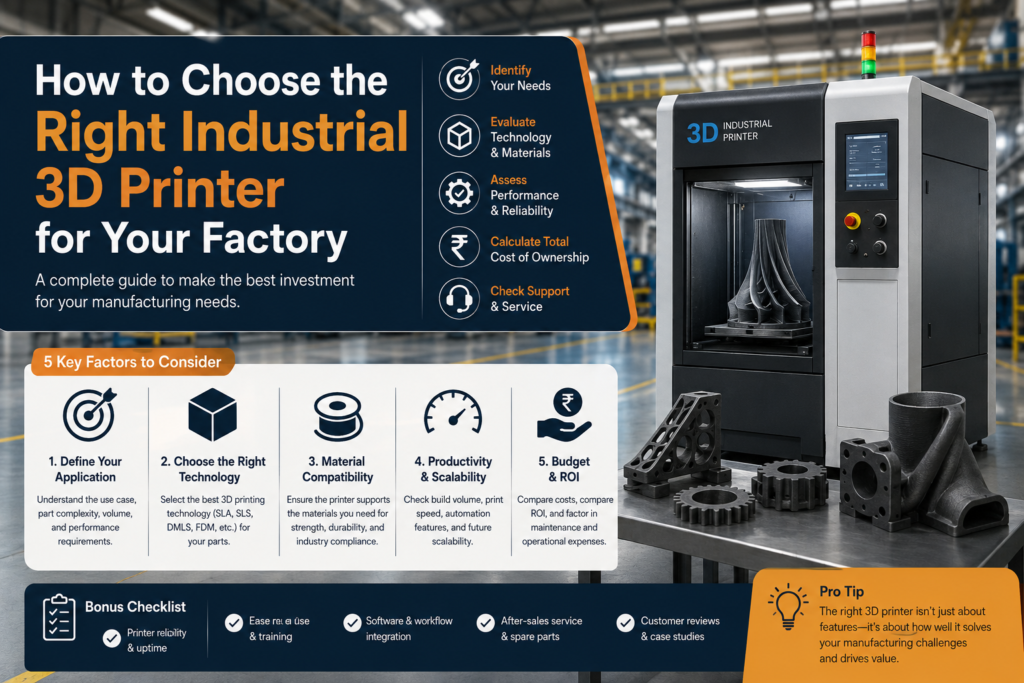
Why Choosing the Right Industrial 3D Printer Matters
An industrial 3D printer is a long-term production asset, not a one-time purchase. The right machine can shorten prototyping cycles, eliminate outsourced tooling costs, and enable in-house production of end-use parts. The wrong machine, on the other hand, can lock a factory into limited materials, slow throughput, or expensive maintenance contracts that erode any cost savings additive manufacturing was supposed to deliver.
Because industrial printers represent a significant capital investment, the selection process needs to be treated with the same rigor as choosing a CNC machine or injection moulding press — matched carefully to the parts, materials, and volumes a factory actually needs to produce.
Understand Your Manufacturing Requirements
Before comparing machines, manufacturers need clarity on what they’re actually trying to produce. This means asking: Are the parts prototypes, jigs and fixtures, or end-use production components? What part sizes and volumes are typical? What tolerances and surface finishes are required? And how frequently will the printer be used — daily production runs or occasional prototyping?
The answers to these questions shape every other decision in the buying process. A factory producing large tooling patterns has very different needs from one producing small, high-precision functional prototypes, and no single printer technology serves both equally well.
Compare Industrial 3D Printing Technologies
Industrial 3D printing spans several distinct technologies, each suited to different applications. Fused Deposition Modeling (FDM) remains the most widely used method for functional prototypes and tooling due to its affordability and material range. Stereolithography (SLA) and Digital Light Processing (DLP) offer higher resolution and smoother surface finishes, making them suitable for detailed prototypes and casting patterns. Selective Laser Sintering (SLS) produces strong, isotropic parts without support structures, ideal for complex geometries and low-volume production.
For manufacturers needing large-format parts at high throughput and lower material cost, pellet extrusion has become an increasingly popular option, since it prints directly from raw plastic pellets instead of pre-processed filament. Our article on Pellet Extrusion 3D Printing Explained breaks down how this technology works and where it fits into a factory’s production strategy.
Consider Build Volume and Print Speed
Build volume determines the maximum part size a printer can produce in a single run, and it directly affects whether large components need to be printed in sections and assembled afterward. Manufacturers producing sizeable jigs, fixtures, or patterns should prioritize machines with generous build chambers to avoid the added labor and potential weak points introduced by multi-part assembly.
Print speed is equally important for production environments, where machine downtime and long print queues translate directly into delayed output. Screw-based and pellet-fed systems typically offer significantly higher throughput than standard filament extruders, which matters most when a factory needs to produce large or repeat parts on a tight schedule.
Material Compatibility and Engineering Plastics
A printer is only as useful as the materials it can process. Factories should evaluate whether a machine supports the specific engineering plastics their applications demand — such as ABS, nylon, polycarbonate, PETG, or fiber-reinforced composites — rather than being limited to a narrow set of proprietary materials.
Open material systems give manufacturers more flexibility and cost control, since they aren’t locked into a single supplier’s pricing. For teams building a broader material strategy, our 3D Printing Filaments range offers a reference point for standard and engineering-grade options suited to different applications and printer types.
Accuracy, Repeatability, and Surface Finish
Different applications demand different levels of precision. A tooling jig may tolerate looser tolerances than a functional prototype destined for fit-testing against production assemblies. Manufacturers should look closely at a printer’s dimensional accuracy specifications, layer resolution, and repeatability across multiple print runs, since inconsistent output can undermine confidence in using 3D-printed parts for anything beyond visual models.
Surface finish also matters for parts that will be used directly, painted, or bonded to other components. Technologies like SLA and DLP typically offer smoother out-of-the-box finishes than FDM or pellet extrusion, though post-processing can close much of that gap for functional applications where cosmetic finish is secondary to strength and cost.
Automation and Smart Manufacturing Features
As factories move toward Industry 4.0 workflows, automation features are becoming a meaningful differentiator between printers. Capabilities like remote monitoring, automated material feeding, closed-loop process control, and integration with factory MES (Manufacturing Execution Systems) reduce the manual oversight a printer requires and help maintain consistent quality across long production runs.
For factories running multiple machines or multiple shifts, features like automatic bed leveling, filament or pellet run-out detection, and networked print queue management can meaningfully reduce downtime and operator workload, improving overall equipment effectiveness.
Total Cost of Ownership (TCO)
The purchase price of an industrial 3D printer is only one part of the cost equation. A full TCO analysis should account for material costs per part, energy consumption, maintenance and spare parts, software licensing, and the labor required for operation and post-processing.
Machines with lower upfront costs sometimes carry higher ongoing material or maintenance expenses, while more expensive systems may pay for themselves faster through material savings and reduced downtime. For manufacturers weighing pellet-based systems against traditional filament printers, our detailed comparison, Pellet 3D Printer vs Filament 3D Printer, offers a clear breakdown of where the real savings come from over a machine’s operating life.
Choosing the Right Industrial 3D Printer Brand
Brand reputation matters as much as specifications on a data sheet. Manufacturers should evaluate a brand’s track record for reliability, the availability of spare parts and consumables in India, and the responsiveness of local technical support. A printer that performs well in a demo but has no local service network can quickly become a liability once it’s running production parts on a factory floor.
It’s also worth considering how established a brand is across different industries, since machines with proven use cases across 10 Industries That Need Industrial 3D Printers in 2026 tend to have more mature support ecosystems and a broader base of documented applications to learn from.
Questions to Ask Before Buying
Before finalizing a purchase, manufacturers should ask suppliers a set of direct questions: What is the expected lifespan of key components, and what do replacements cost? What lead time can be expected for spare parts and service visits in India? Is training included, and how long does it take an operator to become proficient? What materials are officially supported, and are third-party materials permitted without voiding warranty? And finally, what does a realistic payback period look like based on current production volumes?
Getting clear, specific answers to these questions — rather than general marketing claims — is often the difference between a printer that integrates smoothly into production and one that sits underused after the first few months.
Why Buy from 3D Protofarm?
3D Protofarm helps Indian manufacturers navigate exactly these decisions, offering guidance on technology selection, material compatibility, and total cost of ownership before a purchase is made. Beyond the sale, the team provides installation support, operator training, and ongoing service, ensuring machines stay productive rather than becoming underused assets. Manufacturers can explore the full range of Industrial 3D Printers available, spanning multiple technologies and price points suited to different production needs.
Frequently Asked Questions
What is the most important factor when choosing an industrial 3D printer? There isn’t a single universal factor — the right choice depends on matching build volume, material compatibility, and speed to the specific parts a factory needs to produce.
Is a more expensive printer always a better investment? Not necessarily. A higher price tag doesn’t guarantee lower total cost of ownership; material costs, maintenance, and uptime often matter more over the machine’s lifespan.
Can one printer handle both prototyping and production parts? Some machines are versatile enough for both, but factories with high-volume production needs often benefit from dedicated machines optimized for either prototyping precision or production throughput.
How important is local vendor support in India? Very important. Downtime on a production machine is costly, and having local access to spare parts, service technicians, and training significantly reduces the risk of extended downtime.
Do I need a 3D scanner alongside a 3D printer? For manufacturers working on reverse engineering, part replication, or quality inspection, pairing a printer with reliable digitization hardware is essential. Our 3D Scanners range supports these workflows alongside industrial printing.
Final Thoughts
Choosing the right industrial 3D printer is a decision that shapes production efficiency, material costs, and part quality for years to come. By clearly defining manufacturing requirements, comparing technologies objectively, and evaluating total cost of ownership rather than just sticker price, factories can avoid costly missteps and select a machine that genuinely fits their production goals.
If you’re evaluating options for your factory, our team can help assess your specific requirements and recommend the right fit. Explore our 3D Printing Services to get started with expert guidance tailored to your manufacturing needs.