Introduction
Additive manufacturing has quietly crossed a threshold. What used to be a prototyping tool sitting in a corner of the design office is now a production asset that shows up on the same balance sheet as CNC machines and injection molds. Analysts covering the sector describe 2026 as the year the industry stops counting how many printers it sold and starts counting how many industrial parts those printers actually produced, with utilization and measurable ROI becoming the real benchmarks.
That shift matters if you’re deciding whether Industrial 3D Printers belong in your own operation. Below are ten industries where the case for owning or outsourcing industrial-grade 3D printing has become hard to ignore in 2026.
Why Industrial 3D Printing Is Growing in 2026
Two forces are driving the acceleration. First, supply chain uncertainty and geopolitical pressure have pushed manufacturers toward localized, on-demand production instead of relying on long, fragile supply lines for spare parts and tooling. Second, the technology itself has matured: printers are faster, materials are more capable, and software increasingly automates the design and process-optimization work that used to require specialist expertise. Together, these forces are moving 3D printing from an occasional prototyping tool into an embedded part of mainstream manufacturing, with end-use parts, tooling, and spares treated as planned production items rather than exceptions.
Benefits of Industrial 3D Printers for Manufacturing
- Faster design iteration and shorter time-to-market
- On-demand production that reduces inventory and warehousing costs
- Ability to produce complex geometries that traditional machining can’t achieve
- Localized spare-parts production, reducing dependency on long supply chains
- Lower tooling costs for low-to-mid volume production runs
- Support for lightweighting and material consolidation in finished parts
Industry #1: Automotive Manufacturing
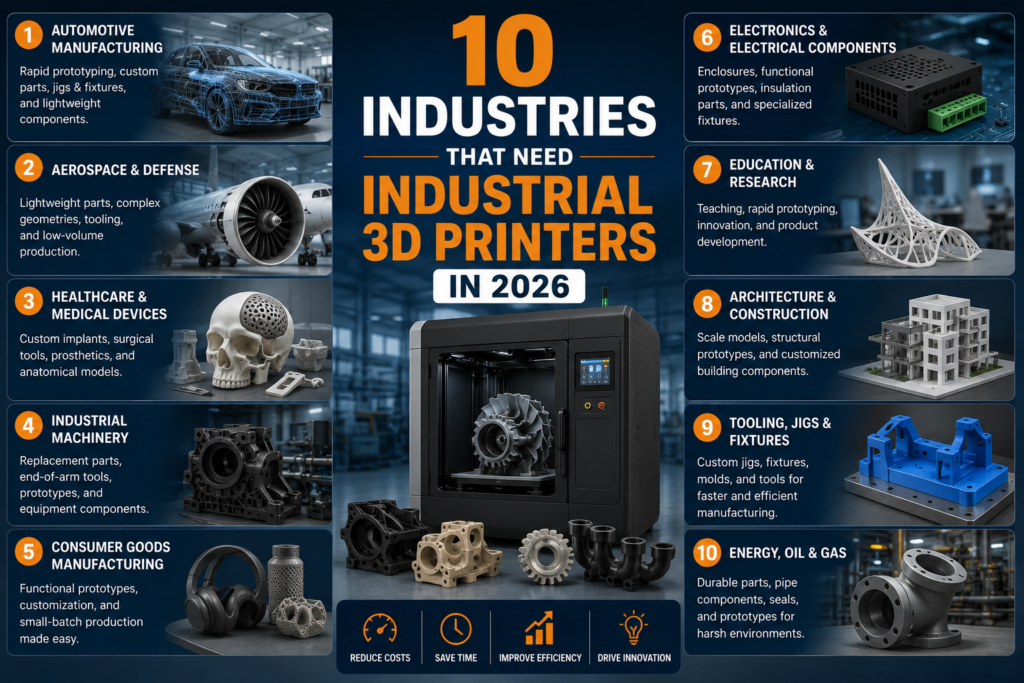
Automotive remains one of the largest users of industrial 3D printing, spanning production tooling, jigs, fixtures, and end-use interior components. The shift toward electric vehicles has accelerated this further, since EV manufacturers need rapid prototyping cycles that legacy automakers historically didn’t require, and several major automakers now maintain in-house additive manufacturing centers.
Industry #2: Aerospace & Defense
Aerospace and defense are moving beyond structural parts toward functional, high-performance printed components — parts offering fire resistance, electromagnetic shielding, and lightweight multifunctionality. In defense specifically, additive manufacturing helps extend the service life of existing equipment by enabling local, on-demand production of optimized spare parts rather than waiting on traditional supply chains.
Industry #3: Healthcare & Medical Devices
Healthcare is scaling its use of 3D printing rapidly for personalized implants, orthopedic components, and patient-specific devices, supported by advances in speed, accuracy, and multi-material processing. A large part of this workflow starts with capturing a patient’s or existing part’s exact geometry — which is where reverse engineering comes in. Using 3D Scanners to digitise anatomy or existing components allows manufacturers to design custom-fit devices before printing them, shortening the path from measurement to finished product.
Industry #4: Industrial Machinery
Machine builders and maintenance teams increasingly print replacement parts, custom brackets, and low-volume components on demand, rather than keeping large spare-parts inventories or waiting on long-lead-time machined replacements. This is one of the clearest cost-saving applications of industrial 3D printing, since it converts a warehousing problem into a print-on-demand one.
Industry #5: Consumer Goods Manufacturing
For complex parts with annual volumes in the low thousands, 3D printing has proven more cost-effective than injection molding in several sectors, including consumer electronics and premium home appliances. This has enabled a shift toward zero-inventory, on-demand production models where products are manufactured strictly as orders come in rather than produced in bulk ahead of demand.
Industry #6: Electronics & Electrical Components
Consumer electronics manufacturers are relying increasingly on additive manufacturing for compact, high-precision components as material choices expand and material costs continue to decline. Custom enclosures, connector housings, and low-volume electrical component production are all areas where 3D printing now competes directly with traditional tooling-based manufacturing.
Industry #7: Education & Research
Universities and technical institutes use industrial-grade printers to teach additive manufacturing at a scale closer to actual production, rather than desktop-scale demonstrations. As printers become more user-friendly and AI-assisted design tools lower the skill barrier to entry, education is becoming a meaningful pipeline for building the workforce that industrial manufacturers will need to run these systems at scale.
Industry #8: Architecture & Construction
Architectural firms use large-format printing for detailed scale models and design mock-ups that would be slow and expensive to build by hand. Beyond models, construction-adjacent applications — printed formwork, custom fixtures, and structural components — are a growing niche as large-format FDM and pellet systems become more accessible.
Industry #9: Tooling, Jigs & Fixtures
This is arguably the single most common industrial use case across every sector on this list. Manufacturing workflows increasingly treat 3D-printed jigs, fixtures, and production tooling as a normal part of the process rather than a novelty, since printed tooling can be produced faster and cheaper than machined equivalents for many applications. Manufacturers sourcing this capability without owning every printer type in-house often turn to outsourced 3D Printing Services to get tooling produced quickly without capital investment in new equipment.
Industry #10: Energy & Oil & Gas
Energy, mining, and infrastructure sectors are turning to localized, on-demand production as a way to build supply chain resilience, particularly for remote or hard-to-reach operations where waiting weeks for a replacement part isn’t practical. Wire-based metal additive manufacturing is also growing in this space, valued for material efficiency and suitability for large structural components.
Key Features to Look for in an Industrial 3D Printer
- Build volume matched to your largest regularly produced part
- Nozzle and bed temperature range suited to your material mix — engineering polymers need higher-temperature configurations
- Print speed appropriate to your production throughput needs
- Multi-material or dual-extrusion capability, increasingly relevant as multi-material printing becomes standard for parts needing integrated seals or variable stiffness
- Reliability features like auto-leveling, filament sensors, and power-loss recovery
- Material compatibility, since your printer is only as useful as the range of 3D Printing Filaments it can reliably process
How to Choose the Right Industrial 3D Printer
Start with your part requirements, not the spec sheet. Map out your typical part sizes, the materials you need to print in, your required throughput, and whether finish quality or raw speed matters more for your application. From there, narrow down the field of 3D Printers that actually fit those requirements rather than chasing the largest or fastest machine available. It’s also worth deciding early whether you need an in-house machine at all, or whether outsourcing production makes more sense for your current volume — that decision alone can save a significant capital outlay if your part volumes don’t yet justify owning equipment.
Why Buy Industrial 3D Printers from 3D Protofarm?
Choosing the right industrial 3D printer is as much about matching a machine to your actual production needs as it is about the machine itself. Working with an established supplier means getting guidance based on your real parts and materials, genuine equipment with proper warranty support, and access to complementary capabilities — from reverse engineering to contract printing — so you’re not locked into a single in-house solution before you’ve validated your production volume.
Frequently Asked Questions
Is industrial 3D printing only useful for prototyping? No — 2026 marks a clear shift toward end-use parts, spare parts, tooling, and fixtures being produced additively as planned production items, not just prototypes.
Which industries are adopting 3D printing fastest right now? Automotive, aerospace, defense, and healthcare are leading adoption, driven by supply chain resilience needs and advances in high-performance materials.
Do small manufacturers need industrial-grade printers, or can desktop machines work? It depends on part size, material requirements, and volume. Many smaller operations start with outsourced printing services before investing in industrial equipment once volume justifies it.
What materials are most in demand for industrial 3D printing in 2026? High-performance thermoplastics like PEEK and PEKK are seeing rising adoption in aerospace and medical applications, alongside continued growth in engineering-grade FDM materials like ABS, nylon, and reinforced composites.
Is 3D printing more cost-effective than traditional manufacturing? For complex parts at low-to-mid volumes, 3D printing has proven more cost-effective than processes like injection molding in several sectors — though at very high volumes, traditional manufacturing still tends to win on unit cost.
Final Thoughts
The common thread across all ten industries is the same: 3D printing is no longer a novelty sitting alongside traditional manufacturing — it’s becoming a planned, measurable part of it. Whether you’re producing tooling, prototypes, or end-use parts, the industries that will benefit most in 2026 are the ones that treat additive manufacturing as a production tool with its own ROI, not an experiment to revisit later.