When it’s time to turn a design into a physical part, businesses often land on two very different paths: rapid prototyping through 3D printing, or CNC machining. Both can produce accurate, functional parts, but they get there in completely different ways — and the right choice depends heavily on your project’s goals, timeline, and budget.
Choosing the wrong method can mean paying more than necessary, waiting longer than you need to, or ending up with a part that doesn’t perform the way your application requires. This guide breaks down how rapid prototyping and CNC machining actually compare, so you can make the right call for your next product development cycle.
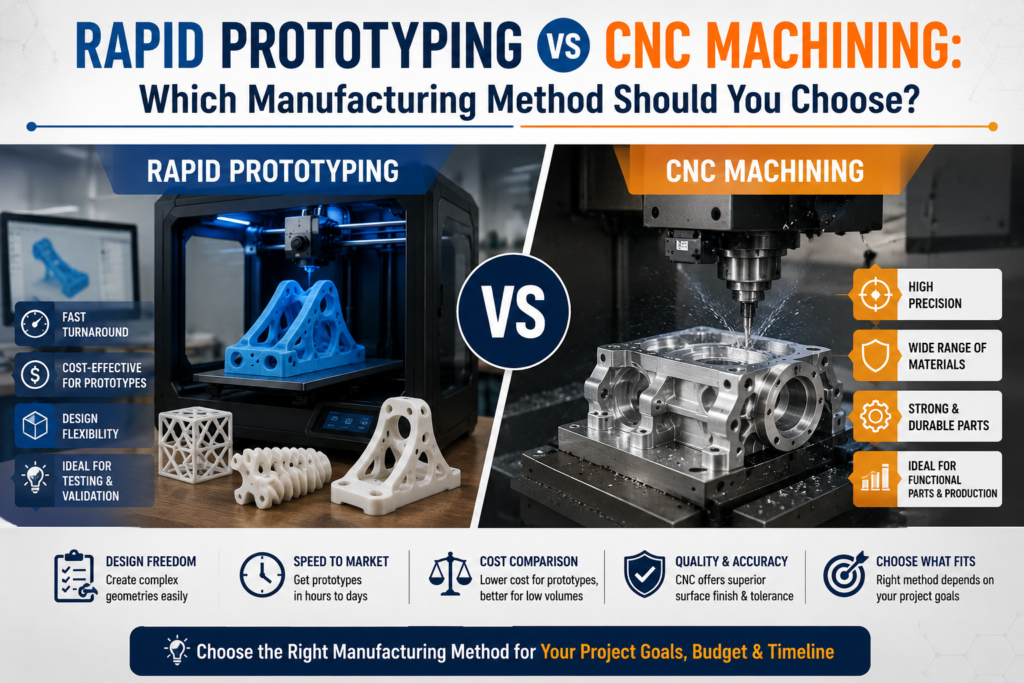
Rapid Prototyping vs CNC Machining: Understanding the Basics
Rapid prototyping, most commonly done through 3D printing, is an additive process. Parts are built layer by layer directly from a digital CAD file, with material added only where the design requires it. This makes it possible to produce complex geometries, internal structures, and organic shapes that would be difficult or impossible to machine conventionally.
CNC machining, by contrast, is a subtractive process. A block of raw material — typically metal or plastic — is cut, drilled, and milled away using computer-controlled tools until the final part shape remains. It’s a mature, highly precise manufacturing method that has been the backbone of prototype manufacturing and production machining for decades.
Both approaches start from the same place: a CAD design. If you want a deeper look at how a digital file becomes a finished part through 3D printing specifically, our guide on From CAD to Finished Part: Understanding the Complete 3D Printing Process walks through that entire workflow step by step.
Key Differences Between Rapid Prototyping and CNC Machining
Design Complexity
Rapid prototyping through 3D printing excels at complex geometries — internal channels, lattice structures, and organic curves that would require multiple setups or specialized tooling on a CNC machine. Because material is added rather than removed, there’s far more design freedom.
CNC machining, on the other hand, is limited by tool access. Certain internal features, undercuts, or deep cavities may be difficult or impossible to reach with a cutting tool, which can force design compromises that 3D printing doesn’t require.
Surface Finish and Tolerances
CNC machining generally produces tighter tolerances and smoother surface finishes straight off the machine, which matters for precision-fit assemblies or parts with strict dimensional requirements. Rapid prototyping can achieve fine detail and smooth finishes too, particularly with resin-based processes, but tolerances typically aren’t as tight as machined parts without additional post-processing.
Material Options
CNC machining works with a wide range of production-grade metals and plastics, making it a strong choice when your final part needs to closely match the mechanical properties of the intended production material. 3D printing material options have expanded significantly, with engineering-grade plastics, resins, and composites now available — browse the current range of Materials to see what’s suited to your application.
Speed for Iteration
This is where rapid prototyping tends to have a clear edge. Because there’s no tooling setup required, design changes can go from file to printed part in hours, not days. This makes 3D printing especially valuable during early-stage product development, when a design might go through several iterations before it’s finalized.
When to Choose Rapid Prototyping or CNC Machining
Choose rapid prototyping when:
- You’re in the early stages of product development and need to test form, fit, or function quickly
- Your design includes complex internal geometries or lattice structures
- You need a low-cost way to iterate through multiple design versions
- You’re producing a small batch of parts and tooling costs aren’t justified
- Your application doesn’t require production-grade mechanical properties
Choose CNC machining when:
- Your part needs tight tolerances or a specific surface finish straight off the machine
- You need the part in a production-grade metal or engineering plastic
- The design is relatively simple to machine and doesn’t rely on complex internal features
- You’re producing a part that needs to closely match final production material properties
- Strength, wear resistance, or thermal performance are critical to the part’s function
In many real-world projects, businesses actually use both methods at different stages — 3D printing for early concept validation and CNC machining for later-stage functional testing or short production runs. Choosing between additive manufacturing and machining isn’t always an either-or decision; it often comes down to matching the right method to the right stage of your project.
If you’re still deciding which 3D printing process fits your prototyping needs, our comparison of FDM vs SLA vs SLS: Complete 2026 Comparison can help you narrow down the right technology once you’ve settled on additive manufacturing.
Cost, Lead Time & Material Comparison
Cost
For low-volume prototyping, 3D printing is typically the more cost-effective option. There’s no tooling investment required, and material is only used where the design calls for it. CNC machining costs more upfront due to tooling, setup, and material waste from the subtractive process — but that cost can even out or become more economical at higher production volumes, where machining speed and consistency start to pay off.
Lead Time
Rapid prototyping lives up to its name here. Print jobs can often be completed and delivered within a day or two, depending on part size and complexity. CNC machining typically involves longer lead times due to setup, tool changes, and multi-axis programming, especially for complex parts.
Material Properties
If your prototype needs to closely simulate the mechanical properties of a final production part — particularly for metal components — CNC machining generally delivers more predictable, production-representative results. 3D printing materials have narrowed this gap considerably, especially with industrial-grade printers capable of producing strong, functional parts. Explore the current lineup of 3D Printers used for industrial-grade prototyping and short-run production to see what’s achievable with today’s additive manufacturing technology.
Volume Considerations
3D printing scales well for low to medium volumes without the tooling costs that come with machining. For high-volume production runs, CNC machining — or in some cases injection molding — tends to become more economical over time. Understanding where your project sits on this volume curve is key to choosing the right method, and our Commercial Guide to Industrial 3D Printers for Manufacturing Companies covers this in more detail for teams evaluating equipment for scaling production.
Why Choose 3D Proto Farm for Prototype Manufacturing
Deciding between rapid prototyping and CNC machining doesn’t have to be a guessing game. 3D Proto Farm works with businesses to identify the right manufacturing method for each stage of product development, backed by a wide range of printing technologies, an extensive material library, and industrial-grade equipment built for both prototyping and short-run production.
Whether you need a same-week prototype to validate a design or a production-representative part for functional testing, 3D Proto Farm’s team can help you choose the approach that fits your timeline, budget, and performance requirements. Explore 3D Proto Farm’s services to find the right manufacturing path for your next project. For a deeper understanding of how a design becomes a finished part, revisit our guide on how to select the right 3D printing service for your business.