India’s manufacturing sector is in the middle of a quiet transformation. Product development cycles that once stretched across months are now being compressed into weeks, and a big reason for this shift is industrial 3D printing. From automotive component makers in Pune to electronics startups in Bengaluru, Indian businesses are rethinking how they build prototypes and produce parts.
This change matters because the manufacturing method a business chooses directly affects its budget, its speed to market, and its ability to scale. Picking the wrong approach can mean lakhs of rupees lost on tooling that never gets used, or weeks wasted waiting on a mold when a 3D-printed part could have done the job overnight.
This guide breaks down industrial 3D printing and traditional manufacturing across cost, speed, scalability, and real-world use cases — so Indian founders, designers, and engineering teams can make an informed call for their next project.
What Is Industrial 3D Printing?
Industrial 3D printing, also called additive manufacturing, builds physical parts layer by layer directly from a digital design file. Instead of cutting away material from a solid block (as in subtractive processes) or forcing molten material into a mold, a 3D printer deposits or fuses material only where it’s needed.
This layer-by-layer approach is why additive manufacturing produces far less material waste and why design changes can be made almost instantly — there’s no mold to modify, just a CAD file to update.
Common Industrial 3D Printing Technologies
- FDM (Fused Deposition Modeling): Extrudes thermoplastic filament layer by layer. Cost-effective and widely used for functional prototypes and jigs.
- SLA (Stereolithography): Uses a laser to cure liquid resin, producing highly detailed, smooth-surfaced parts ideal for design validation and medical models.
- SLS (Selective Laser Sintering): Fuses powdered material (often nylon) with a laser, producing strong, durable parts without support structures — useful for functional end-use components.
A detailed breakdown of these technologies is available in this FDM vs SLA vs SLS Comparison.
Industrial Applications in India
Indian manufacturers are using these technologies for tooling jigs and fixtures, functional prototypes, customized medical devices, automotive components, and short-run consumer products. The growing accessibility of Industrial 3D Printers has made this technology viable even for small and mid-sized businesses, not just large OEMs.
What Is Traditional Manufacturing?
Traditional manufacturing covers a set of well-established production methods that have powered industry for over a century. These processes are typically subtractive or formative, relying on tooling, molds, or dies to shape material.
Injection Molding
Molten plastic is injected into a precision-machined steel or aluminum mold. It’s extremely efficient for high-volume production but requires significant upfront mold investment, often ₹3,00,000 to ₹15,00,000 or more depending on part complexity.
CNC Machining
A subtractive process where computer-controlled cutting tools remove material from a solid block (metal or plastic) to create the final part. It offers excellent precision and is common for metal components, but tooling and setup time add to lead time.
Casting and Fabrication
Includes sand casting, die casting, and sheet metal fabrication — commonly used for larger or structural components in automotive, industrial equipment, and construction-related manufacturing.
Common Use Cases
Traditional manufacturing dominates where volumes are high and part designs are finalized — think automotive body panels, consumer electronics housings produced in the lakhs, and standardized industrial hardware.
Industrial 3D Printing vs Traditional Manufacturing: Key Differences
| Parameter | Industrial 3D Printing | Traditional Manufacturing |
|---|---|---|
| Initial Cost | Low to moderate | High (tooling-dependent) |
| Tooling Cost | None | ₹3,00,000+ per mold/die |
| Production Speed | Fast for low volumes | Slow setup, fast once running |
| Design Flexibility | Very high | Limited once tooling is made |
| Customization | Excellent, part-by-part | Difficult and costly |
| Material Waste | Minimal | Higher (especially CNC) |
| Scalability | Best for low-to-mid volume | Best for high volume |
| Lead Time | Hours to days | Weeks to months (tooling) |
| Prototype Development | Ideal | Expensive and slow |
| Low Volume Production | Cost-effective | Often uneconomical |
| Mass Production | Higher per-unit cost at scale | Lowest per-unit cost at scale |
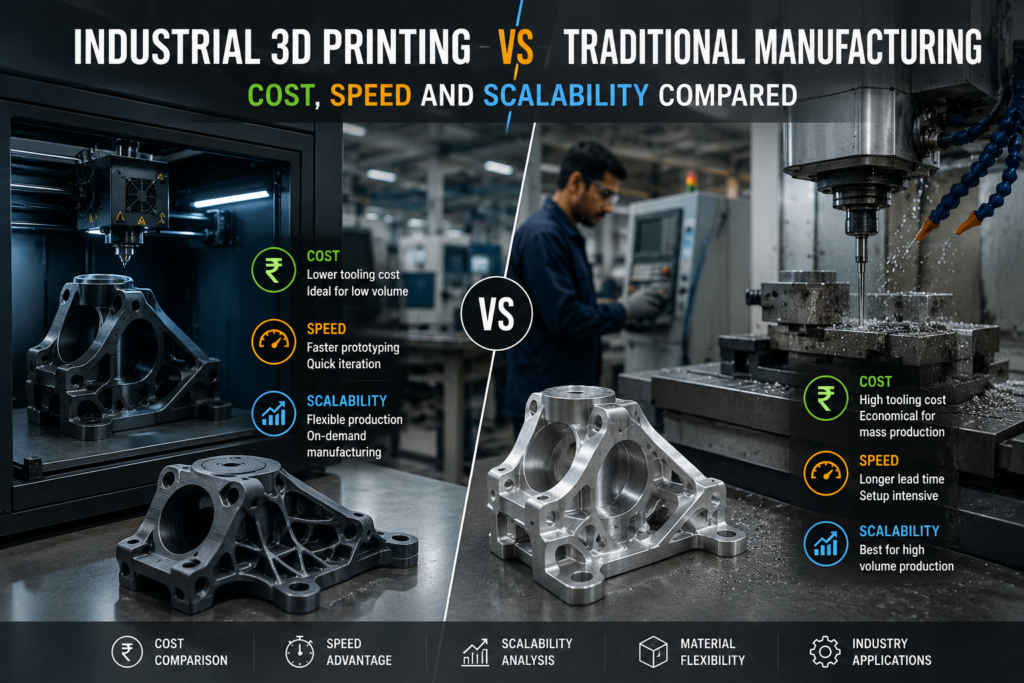
Cost Comparison
Cost is usually the deciding factor for Indian businesses, especially startups and MSMEs working with tight budgets.
Tooling and mold costs are the biggest expense in traditional manufacturing. A single injection mold can run into several lakhs, and that cost is sunk the moment a design needs revision. Industrial 3D printing eliminates this entirely — there’s no tool to scrap when a design changes.
Prototype costs also differ sharply. A single CNC-machined or injection-molded prototype can cost tens of thousands of rupees once setup and material are factored in, whereas a 3D-printed prototype of similar complexity often costs a fraction of that.
Production costs favor traditional manufacturing once volumes climb into the thousands of units, since the mold cost gets spread across more parts, lowering the per-unit price. This is why most Indian engineering teams treat the two methods as complementary rather than competing — using Rapid Prototyping Services early, then moving to traditional methods at scale.
For startups specifically, the absence of tooling cost means capital can go toward product iteration and testing instead of being locked into a mold before the design is even validated.
Speed Comparison
Traditional manufacturing timelines are dominated by tooling lead time. Designing and machining an injection mold in India typically takes 4 to 8 weeks before a single part can be produced. Any design change after that point means revising or remaking the mold.
Industrial 3D printing collapses this timeline dramatically. A prototype can be printed and in hand within hours, and design revisions can be tested the same day. This rapid iteration cycle is one of the biggest reasons Indian product teams are turning to Professional 3D Printing Services during early development stages.
For businesses racing to launch ahead of competitors, this speed advantage often translates directly into a faster time-to-market — sometimes shaving months off a product’s development cycle.
Scalability Comparison
Scalability is where the two approaches diverge most clearly.
Low-volume manufacturing (a few units to a few hundred) almost always favors 3D printing, since there’s no tooling cost to amortize.
Mid-volume production (hundreds to a few thousand units) is a gray zone — the right choice depends on part complexity, material requirements, and how finalized the design is.
High-volume production (tens of thousands of units and beyond) is where traditional manufacturing, particularly injection molding, becomes far more economical on a per-unit basis. Once a design is locked and demand is consistent, traditional manufacturing becomes the financially sound choice.
Real-World Indian Industry Examples
Automotive: Indian auto component suppliers use 3D printing for jigs, fixtures, and prototype parts before committing to die-casting for mass production.
Medical devices: Customized surgical guides and prosthetic components are increasingly 3D printed in India, where patient-specific geometry makes traditional tooling impractical.
Consumer products: D2C brands use 3D printing to test packaging and product housings before locking designs for injection molding runs.
Industrial equipment: Spare parts for legacy machinery are often 3D printed on demand, avoiding the cost of remaking obsolete molds.
Electronics startups: Hardware startups rely on 3D Printing Services India to validate enclosure designs through multiple iterations before any tooling investment is made.
When Should You Choose Industrial 3D Printing?
- Rapid prototyping during product design
- Functional testing before finalizing a design
- Customized or patient-specific products
- On-demand spare parts production
- Small production batches (typically under a few hundred units)
Product Prototype Development using additive manufacturing is particularly well suited to industries where design iteration matters more than per-unit cost.
When Should You Choose Traditional Manufacturing?
- Large-scale, high-volume production runs
- Standardized products with finalized designs
- Consistent, high-demand market requirements
- Projects where the lowest possible unit cost is the priority
Hybrid Manufacturing Approach
Many Indian manufacturers don’t choose one method exclusively — they combine both. The typical hybrid workflow starts with 3D printing for prototype development and design validation, where multiple iterations can be tested quickly and cheaply. Once the design is finalized and demand justifies higher volumes, production shifts to traditional manufacturing methods like injection molding or CNC machining for cost-efficient mass production.
This hybrid strategy is gaining traction across Indian industries because it captures the best of both worlds: the speed and flexibility of additive manufacturing during development, and the low per-unit economics of traditional manufacturing at scale. Businesses exploring desktop-to-industrial workflows often start with accessible platforms like Bambu Lab 3D Printers before scaling to industrial-grade equipment.
Conclusion
Choosing between industrial 3D printing and traditional manufacturing isn’t about picking a “better” technology — it’s about matching the method to your project’s volume, budget, and timeline. 3D printing wins on speed, design flexibility, and low-volume economics, with no tooling cost standing between an idea and a physical part. Traditional manufacturing wins on per-unit cost once production volumes climb into the thousands.
Before committing to either path, evaluate your expected production volume, available budget, and how soon you need to reach the market. For most Indian businesses moving from concept to finished product, starting with 3D printing for prototyping and validation — then transitioning to traditional manufacturing for scale — offers the most practical balance of cost and speed. Teams looking to move faster on product development can explore working with 3D Protofarm to bring designs from concept to functional prototype without the wait or expense of traditional tooling.
Frequently Asked Questions
1. Is industrial 3D printing cheaper than traditional manufacturing? For low volumes and prototypes, yes — industrial 3D printing avoids tooling costs entirely. For high-volume production, traditional manufacturing usually becomes cheaper per unit once mold costs are spread across thousands of parts.
2. How much does an injection mold cost in India? Depending on size and complexity, injection molds in India typically range from ₹3,00,000 to ₹15,00,000 or more, not including design and setup time.
3. Can industrial 3D printing be used for final production parts, not just prototypes? Yes. Technologies like SLS produce durable, functional parts suitable for end use, especially for low-volume or customized production runs.
4. What production volume makes traditional manufacturing more economical? This varies by part complexity, but traditional manufacturing generally becomes cost-effective once volumes reach the thousands of units, where tooling costs are spread thin enough to lower per-unit pricing.
5. Which Indian industries are adopting additive manufacturing the fastest? Automotive, medical devices, electronics, and industrial equipment sectors are among the fastest adopters, primarily for prototyping, jigs and fixtures, and customized or low-volume parts.