3D printing helps Indian startups accelerate product development by enabling rapid, low-cost physical prototypes within hours or days — replacing weeks of traditional manufacturing. Startups can iterate faster, validate designs early, reduce tooling expenses, and present investor-ready prototypes without committing to large production runs.
India’s startup ecosystem is growing faster than ever. With over 1,40,000 registered startups as of 2025, the pressure to build, validate, and ship products quickly has never been more intense. Whether it’s a Bengaluru-based EV company or a MedTech innovator in Pune, the race to market demands smarter, faster ways to develop hardware products.
That’s where 3D printing has become a genuine game-changer.
Over the past few years, product prototype development using additive manufacturing has moved from being a niche tool to a mainstream strategy for Indian hardware startups. The ability to turn a CAD design into a physical model overnight — and then iterate again the next morning — is reshaping how Indian founders build products.
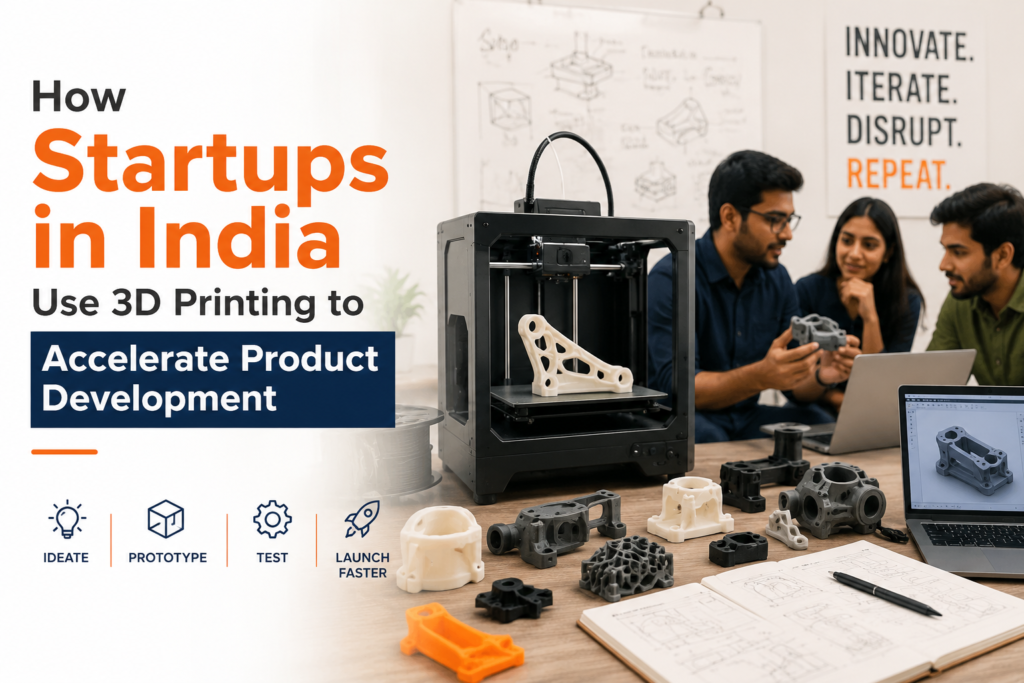
Why Speed Matters in Modern Product Development
In today’s competitive market, being second is often the same as being invisible.
Indian startups face a unique set of pressures. Investor cycles are shorter. Consumer expectations are higher. And global competition means that a startup in Chennai is not just competing with a rival in Mumbai — it’s competing with product teams in Shenzhen and Silicon Valley.
Speed of iteration directly impacts survival.
A startup that can run ten prototype cycles in two months will almost always outperform one that manages three. Early prototyping lets you find fatal design flaws before spending millions on tooling. It lets you test usability with real users, not hypothetical ones. And it gives founders credible proof-of-concept when pitching to investors.
Reducing time-to-market from 18 months to 6 months is no longer exceptional — it’s expected. The startups achieving this consistently are the ones using rapid prototyping as a core part of their product development workflow.
What Is Product Prototype Development?
Product prototype development is the process of creating physical or digital representations of a product concept — before committing to full-scale manufacturing.
A prototype is not just a model. It is a hypothesis made tangible. It answers the question: does this design actually work?
Prototypes range from low-fidelity mockups (foam, cardboard, rough 3D prints) to high-fidelity functional units that closely mimic the final product in appearance and behaviour. In between, teams build multiple iterations — each one refining geometry, materials, mechanisms, or user experience.
For hardware startups, this process is the backbone of product innovation. Unlike software, where a patch can be pushed in minutes, physical products require deliberate, hands-on validation. Getting a component’s wall thickness wrong, or miscalculating a snap-fit tolerance, can delay an entire product launch by months.
That’s why the quality and speed of the prototype development process directly determines whether a startup succeeds or stalls.
How 3D Printing Transforms Product Prototype Development
Traditional manufacturing methods — CNC machining, injection moulding, sheet metal fabrication — are powerful but slow and expensive for early-stage product work.
3D printing flips this equation.
Faster iterations: A design change that might take two weeks with a traditional vendor can be reprinted overnight. Startups can run three or four design cycles per week, not per month.
Design flexibility: Complex internal geometries, organic shapes, integrated features — these are trivially achievable in 3D printing and prohibitively expensive in traditional machining. Startups aren’t forced to compromise their design to fit manufacturing constraints.
Low-volume production: Need five functional units for investor demos or user trials? 3D printing handles that without any setup cost penalty. You pay only for what you print.
Reduced tooling costs: Injection mould tooling for a single component can cost anywhere from ₹2 lakh to ₹20 lakh. For early prototypes, this cost is entirely unnecessary. 3D printing eliminates it.
Improved product testing: Functional prototypes produced via FDM, SLA, or SLS allow real stress testing, fit checks, and assembly validation — not just visual evaluation.
Better investor demonstrations: A physical, functional prototype converts investor conversations. It removes ambiguity. It builds confidence. Founders who walk into a pitch with a working model in hand consistently report better engagement and faster funding decisions.
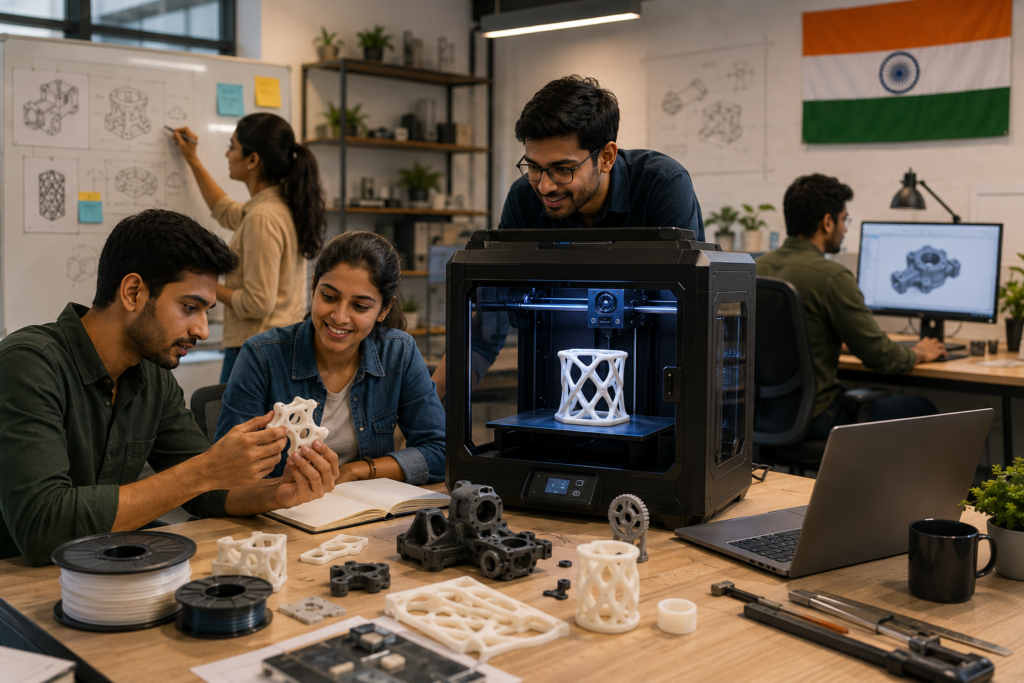
Key Benefits of Rapid Prototyping Services for Indian Startups
| Factor | Traditional Prototyping | Rapid Prototyping |
|---|---|---|
| Development Time | 4–12 weeks | 1–5 days |
| Cost | ₹50,000–₹5,00,000+ | ₹2,000–₹50,000 |
| Design Changes | Expensive, slow, vendor-dependent | Fast, in-house or same-week turnaround |
| Risk | High — errors discovered late | Low — errors found early in iterations |
| Product Validation | Often skipped due to cost | Continuous and affordable |
| Market Readiness | Delayed by 6–18 months | Accelerated by 50–70% |
Rapid prototyping services give Indian startups an asymmetric advantage — doing more testing for less money than their traditionally-built competitors.
Industries Where Indian Startups Are Using 3D Printing
EV and Mobility Startups
India’s electric vehicle sector has exploded. Startups developing two-wheelers, three-wheelers, battery management systems, and EV components are using 3D printing to prototype enclosures, mounting brackets, cooling channels, and structural assemblies.
Companies in Bangalore, Pune, and Hyderabad are using selective laser sintering (SLS) and FDM printing to test thermal performance and mechanical fit before committing to metal casting or injection moulding. For a sector where battery safety and component reliability are non-negotiable, the ability to iterate quickly in the lab before going to the factory is critical.
Healthcare and MedTech
MedTech startups are among the most active users of 3D printing for prototyping in India in 2025–2026. From wearable health monitors and surgical guides to custom orthotics and diagnostic equipment housings, the applications are expanding rapidly.
Biocompatible-grade resins and sterilisable polymers available through advanced 3D printing services in India are enabling MedTech founders to prototype devices that closely mimic final production specifications — helping them navigate regulatory validation faster.
Consumer Electronics
India’s consumer electronics startup landscape — smartwatches, audio devices, smart home products, personal care gadgets — demands aesthetically polished prototypes for user testing and retail pitch decks.
High-resolution SLA and MJF prints allow consumer electronics founders to test form factor, ergonomics, button feel, and display bezels long before tooling is created. The visual and tactile quality of modern 3D printed prototypes rivals injection-moulded parts in many applications.
Industrial Equipment
Industrial hardware startups building machinery, tools, jigs, fixtures, and automation components rely on 3D printing to test assembly sequences, validate ergonomics for operators, and prototype custom pneumatic or hydraulic fittings.
The ability to print functional, load-bearing components in engineering-grade materials like PETG, Nylon, and Carbon Fibre composites has made 3D printing a serious production-support tool, not just a visual prototyping one.
IoT and Smart Devices
India’s IoT startup boom — smart meters, agricultural sensors, industrial monitoring systems, connected safety devices — involves enclosure design, PCB housing, antenna placement, and connector layouts that all require physical prototyping.
3D printing allows IoT founders to create custom enclosures that fit their PCBs perfectly, test IP ratings with printed gaskets, and validate antenna clearances — without waiting for custom-fabricated parts.
How 3D Printing Services India Reduce Startup Costs
The financial case for 3D printing in product development is compelling for Indian startups working with limited seed or angel capital.
Eliminating mould costs: Every mould avoided in the prototype phase preserves ₹3–20 lakh for actual product development, marketing, or hiring.
Small batch production: 3D printing has no minimum order quantity. Ten units cost ten times one unit — unlike injection moulding, where setup costs make small batches prohibitively expensive.
Faster testing cycles: Faster prototyping means faster decisions. Fewer weeks of uncertainty means lower burn rate during development.
Reduced material waste: Additive manufacturing by definition adds material only where needed. Subtractive processes like CNC machining can waste 60–90% of raw material in complex geometries.
Lower redesign expenses: When design changes are cheap and fast to implement, startups find and fix problems earlier — when they’re still inexpensive. Late-stage redesigns after tooling is committed can cost 10–100x more than early-iteration changes.
Explore the wide range of printing materials available for prototyping — from engineering polymers to flexible resins — to understand how material choice affects cost, performance, and iteration speed.
From Idea to Market: Typical Startup Product Development Workflow
Here is how Indian hardware startups typically move from concept to manufacturing-ready product using 3D printing:
- Concept Creation — Define product requirements, user needs, and core technical constraints. Sketch or whiteboard the design intent.
- CAD Design — Build 3D digital models using tools like Fusion 360, SolidWorks, or Onshape. Export as STL or STEP files for printing.
- Prototype Printing — Submit files to a rapid prototyping partner. Choose materials and process based on what you need to validate: appearance, fit, function, or stress performance.
- Functional Testing — Assemble the prototype. Test fit and form. Run stress, thermal, or usability tests depending on the product category.
- Design Improvements — Document what failed or underperformed. Update the CAD model. Reprint and repeat. Most hardware startups run 3–8 iterations before a final design is locked.
- Final Validation — The last prototype cycle produces a near-production unit. This version is used for regulatory submissions, investor pitches, and manufacturing partner discussions.
- Manufacturing Readiness — With a validated design in hand, startups can now approach tooling vendors, contract manufacturers, and supply chain partners with confidence.
This workflow — executed well — is what separates startups that successfully launch products from those that stay stuck in development limbo.
Common Mistakes Startups Make During Product Prototype Development
Even well-funded startups make avoidable mistakes in their prototyping process. Here are the most common ones:
Skipping validation — Founders who are convinced their design is correct skip user or functional testing. This is expensive. A ₹5,000 prototype that reveals a fatal flaw saves the ₹15 lakh tooling investment that would have locked in the mistake.
Over-engineering designs — Early-stage prototypes don’t need to be perfect. Adding unnecessary complexity to prototypes wastes time and delays learning. Build the minimum version that answers the specific question being tested.
Choosing wrong materials — A prototype printed in PLA tells you little about how a final ABS or PC component will behave under stress or heat. Matching prototype materials to expected production materials is critical for functional testing validity.
Delaying prototype testing — Many founders wait too long before putting a prototype in front of real users. The sooner you get physical feedback, the less expensive the corrections become.
Ignoring manufacturability — Designing a beautiful prototype that cannot be manufactured at scale is a trap. Every iteration should move toward designs that are viable in production processes — injection moulding, die casting, or sheet metal fabrication.
Choosing the Right Rapid Prototyping Partner in India
The quality of your prototyping partner significantly affects the quality of your product development process.
Technology capabilities: Look for partners offering multiple processes — FDM, SLA, SLS, MJF, PolyJet — not just a single technology. Different design requirements call for different processes.
Material options: Your partner should offer a broad range of materials including engineering polymers, flexible resins, high-temperature materials, and biocompatible grades where needed. Review the full materials catalogue before selecting a vendor.
Turnaround time: In hardware development, days matter. Reliable 24–72 hour turnaround is the benchmark for competitive rapid prototyping services.
Engineering support: The best partners do more than print files. They flag design issues, suggest material alternatives, and support design-for-manufacturing decisions that save money downstream.
Quality standards: Dimensional accuracy, surface finish consistency, and part repeatability all matter for functional testing. Ask for tolerance specifications and part quality benchmarks.
Scalability: Your prototyping partner should be able to grow with you — from 1-unit prototypes to 50-unit pilot batches to production support.
3D Proto Farm is built specifically for Indian startups, product designers, and hardware teams. With a comprehensive range of prototyping services covering multiple technologies and materials, rapid turnaround, and engineering-oriented support, it’s a strong partner for teams serious about accelerating their product development cycle.
Conclusion
India’s hardware startup wave is real, and the teams winning in it are the ones iterating faster, validating earlier, and spending smarter. Product prototype development powered by 3D printing is the single most accessible tool available to Indian founders for compressing development timelines and reducing technical risk.
The data is clear, the use cases are proven, and the infrastructure is now available across India. Whether you are building an EV component, a smart device, a medical instrument, or an industrial tool — your next prototype is closer and more affordable than you might think.
Frequently Asked Questions
What is product prototype development? Product prototype development is the process of creating physical or functional models of a product design before committing to full-scale manufacturing. It allows teams to test, validate, and refine their design through multiple iterations.
How much does a startup prototype cost in India? Depending on complexity, size, and material, a single 3D printed prototype in India typically costs between ₹2,000 and ₹50,000. Functional multi-part assemblies may cost more. This compares favourably to traditional prototyping methods that can run ₹50,000 to several lakhs.
Why do startups use rapid prototyping services? Startups use rapid prototyping services to reduce development time, validate product designs with real physical models, demonstrate concepts to investors, and identify design flaws early — before expensive tooling or manufacturing commitments are made.
Which industries benefit most from 3D printing? In India, the industries deriving the most value from 3D printing in 2025–2026 include EV and mobility, healthcare and MedTech, consumer electronics, industrial equipment, and IoT/smart devices.
How long does 3D printing take for a prototype? Most standard prototypes are completed within 24 to 72 hours depending on size, geometry, and process. Complex parts using SLS or multi-material printing may take 3–5 days. This is dramatically faster than traditional fabrication methods.
Where can startups find 3D printing services in India? Startups can access professional rapid prototyping and 3D printing services through platforms like 3D Proto Farm, which offers multiple printing technologies, engineering-grade materials, and fast turnaround for hardware product teams across India.