Modern businesses operate in an environment where speed, precision, and cost-efficiency define competitive advantage. Across industries, teams are under pressure to move faster — from concept to prototype, from prototype to product — without ballooning R&D budgets. Professional 3D printing has emerged as a transformative solution to this challenge, enabling companies to design, iterate, and manufacture with unprecedented agility.
At the forefront of this shift are Bambu Lab 3D printers — a new generation of high-speed, intelligent machines built specifically to meet the demands of commercial and industrial users. Whether you are a startup accelerating product development or an established manufacturer optimizing production workflows, Bambu Lab 3D printers deliver the performance, reliability, and automation that modern business applications require.
This article explores how Bambu Lab 3D printers are redefining professional 3D printing, the key business applications they enable, and how organizations across industries are leveraging them for rapid production and sustainable growth.
Why Businesses Are Adopting Professional 3D Printing
The adoption of professional 3D printing in business settings has accelerated dramatically over the past few years. What was once a niche technology reserved for specialized labs is now a mainstream tool reshaping how companies design, test, and produce goods. Several key drivers explain this rapid uptake:
- Faster product development: Traditional manufacturing processes require tooling and lengthy lead times. 3D printing allows teams to go from digital design to physical object in hours, dramatically compressing development cycles.
- Reduced prototyping costs: Outsourcing prototype manufacturing is expensive and time-consuming. In-house printing with a commercial 3D printer eliminates those costs and gives teams full control over iterations.
- Custom manufacturing: Businesses can produce bespoke parts, components, and products on demand without minimum order quantities or retooling costs.
- On-demand production: Rather than maintaining large inventories, companies can print parts as needed, reducing warehousing expenses and minimizing waste.
- Competitive advantages: Faster go-to-market cycles, lower development costs, and the ability to iterate rapidly give businesses a decisive edge over competitors relying on traditional manufacturing.
Industrial analysts project that the global 3D printing market will exceed $44 billion by 2028, underscoring just how central additive manufacturing has become to modern business strategy.
Bambu Lab 3D Printers: A New Standard for Commercial 3D Printing
When it comes to commercial 3D printing, not all machines are created equal. Many desktop printers were designed for hobbyists, lacking the speed, reliability, and workflow integration that professional environments demand. Bambu Lab changed this equation.
Engineered for performance, Bambu Lab 3D printers set a new benchmark for what commercial 3D printing hardware can deliver. Key capabilities include:
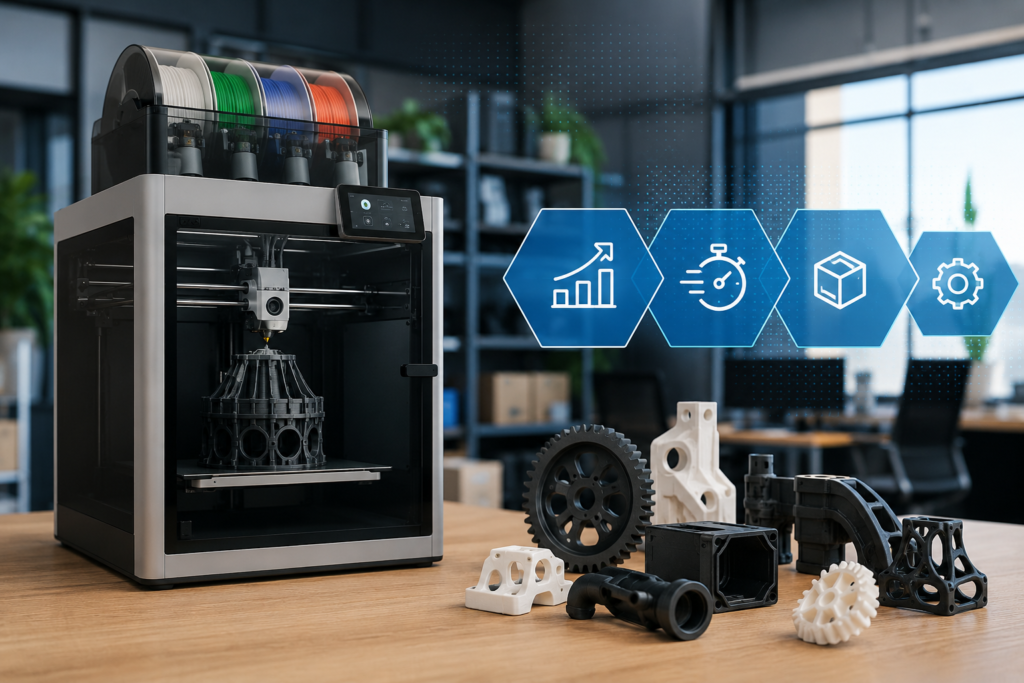
- High-speed printing capabilities: Bambu Lab printers operate at speeds up to 500 mm/s, making them among the fastest desktop-class machines available. This directly translates to shorter wait times and higher throughput for business users.
- Advanced automation: Features like automatic bed leveling, vibration compensation, and AI-powered flow calibration eliminate manual adjustments, saving time and reducing failed prints.
- Multi-material printing: The AMS (Automatic Material System) enables printing with up to 16 materials or colors in a single job, opening possibilities for complex assemblies and multi-component prototypes.
- Reliability for business environments: Bambu Lab machines are engineered for consistent performance over extended print runs, a critical requirement for teams that cannot afford unexpected downtime.
- User-friendly workflow: Intuitive slicing software, remote monitoring via mobile app, and seamless cloud integration allow teams to manage print queues and monitor jobs without constant hands-on supervision.
These capabilities collectively make Bambu Lab one of the most compelling platforms for organizations looking to bring professional-grade additive manufacturing in-house.
Key Business Applications of Bambu Lab 3D Printers
The versatility of Bambu Lab 3D printers makes them applicable across a wide range of professional use cases. Below are the primary business applications driving adoption:
Rapid Prototyping
Product teams use Bambu Lab printers to produce functional prototypes within hours of finalizing a design. An electronics firm, for example, can print enclosure concepts in the morning, review them with stakeholders by midday, and iterate on a revised version by end of day — a cycle that previously took weeks with outsourced tooling.
Functional Testing
Beyond visual models, Bambu Lab printers produce parts suitable for mechanical and thermal testing. Engineering teams print brackets, housings, and connectors using engineering-grade materials to validate performance before committing to mass production tooling.
Manufacturing Jigs and Fixtures
On the factory floor, custom jigs and fixtures are essential for maintaining precision during assembly. Companies print these tools in-house on demand, eliminating supplier lead times and allowing fixtures to be customized for each product variant without additional cost.
Product Customization
Consumer products companies leverage Bambu Lab’s multi-material capabilities to produce customized product variants for individual clients or limited-edition runs. This is particularly valuable in industries like medical devices, where patient-specific geometries are required.
Educational and Research Projects
Universities, research labs, and corporate R&D departments use Bambu Lab 3D printers to rapidly produce experimental components, teaching aids, and research models. The combination of speed and material versatility supports iterative academic workflows.
Small-Batch Production
For startups and small manufacturers, Bambu Lab printers provide a viable path to small-batch production without the capital investment of traditional manufacturing equipment. Runs of dozens to hundreds of parts are economically feasible, bridging the gap between prototyping and full-scale production.
How Bambu Lab Accelerates Rapid Production
Rapid production is not simply about fast print speeds — it is about end-to-end workflow efficiency. Bambu Lab addresses every stage of the production pipeline:
- Fast print speeds: At up to 500 mm/s, Bambu Lab printers complete jobs that would take competitors many hours in a fraction of the time, directly increasing throughput per machine.
- Reduced downtime: Automated calibration, self-diagnostic systems, and AI error detection minimize failed prints and unplanned stops. Production lines built around Bambu Lab printers achieve consistently high uptime.
- Automation features: From filament loading to bed leveling, automation reduces manual intervention, allowing small teams to manage multiple printers simultaneously without dedicated operator oversight.
- Multi-color and multi-material capabilities: The AMS allows complex, multi-component assemblies to print in a single job rather than requiring multiple separate runs, cutting total production time significantly.
- Efficient workflow management: Bambu Studio software integrates with cloud storage and supports batch job queuing, enabling production managers to plan, schedule, and monitor jobs across printer fleets from a centralized interface.
A consumer electronics startup, for instance, reported reducing their prototyping cycle from 10 days to under 48 hours after deploying a fleet of Bambu Lab X1 Carbon printers, enabling them to compress a 6-month product development cycle to under 3 months.
Industries Benefiting from Commercial 3D Printing
Commercial 3D printing with platforms like Bambu Lab is creating value across virtually every major industry:
- Manufacturing: Producers use 3D printing for tooling, jig production, and low-volume part manufacturing, reducing lead times and enabling agile production lines.
- Automotive: Design teams prototype components, produce custom interior parts, and fabricate testing fixtures. Tier-1 suppliers use in-house printing to reduce dependency on external tooling vendors.
- Consumer Products: Brands produce concept models, packaging prototypes, and limited-run product variants without minimum order requirements.
- Healthcare: Medical device companies print patient-specific anatomical models, surgical guides, and device housings. Regulatory-compliant materials enable functional device prototyping.
- Education: Institutions create teaching aids, research models, and student project components while developing hands-on familiarity with advanced manufacturing technology.
- Engineering: Structural and mechanical engineers use printed parts to validate designs before committing to expensive CNC machining or injection molding.
- Electronics: PCB enclosure prototypes, cable management components, and custom mounting brackets are routinely produced in-house, accelerating hardware development cycles.
Choosing the Right Professional 3D Printer for Your Business
Selecting the right machine is a strategic decision that will shape your production capabilities for years. When evaluating professional 3D printing hardware, businesses should consider the following factors:
- Production volume: Assess your expected weekly print hours. Higher-volume operations benefit from faster machines with larger build volumes, while lower-volume teams may prioritize versatility over raw throughput.
- Material requirements: Confirm the printer supports the materials your applications require — whether standard PLA/PETG, engineering grades like ABS and PC, or flexible TPU.
- Print quality: Layer resolution and surface finish requirements vary by application. Evaluate sample prints from shortlisted machines using materials relevant to your use case.
- Ease of use: Consider how much technical expertise your team has. Highly automated platforms like Bambu Lab reduce the learning curve and minimize operator dependency.
- Scalability: Can you expand capacity by adding printers to a networked fleet? Platforms with robust fleet management capabilities grow with your business without adding proportional management overhead.
- ROI: Model the total cost of ownership including hardware, consumables, maintenance, and operator time against the value of reduced lead times and outsourcing costs.
Explore the full range of available 3D Printers to compare models suited to different production requirements and budgets.
Beyond Hardware: The Importance of Expert 3D Printing Support
Acquiring the right hardware is only the first step. Many organizations underestimate the importance of implementation support in achieving optimal results from their 3D printing investment. Expert guidance across the following areas can make the difference between a machine that sits underutilized and one that transforms your production capabilities:
- Consultation: An experienced partner helps you identify the right hardware configuration, build volume, and material profile for your specific application requirements.
- Material selection: With hundreds of filament options available, selecting the right material for each application — balancing strength, flexibility, heat resistance, and cost — requires specialized knowledge.
- Training: Ensuring your team is proficient with slicing software, print settings optimization, and routine maintenance prevents costly mistakes and maximizes equipment utilization.
- Maintenance: Scheduled maintenance and prompt troubleshooting support minimize downtime and extend the service life of your hardware investment.
- Workflow optimization: As your print volume grows, an expert partner can help you design efficient print queuing strategies, automate repetitive tasks, and integrate 3D printing into your broader manufacturing workflow.
Discover how professional 3D Printing Services can support your organization from initial setup through ongoing production optimization.
Future of Business Manufacturing with Bambu Lab 3D Printers
The trajectory of additive manufacturing points toward an increasingly central role in the global production economy. Several emerging trends will shape how Bambu Lab and commercial 3D printing more broadly evolve over the coming years:
- Digital manufacturing: As design software, simulation tools, and printing hardware become more deeply integrated, the path from digital model to physical part will become near-instantaneous, enabling true on-demand manufacturing at scale.
- Smart factories: Bambu Lab printers, with their cloud connectivity and remote monitoring capabilities, are natural fit for Industry 4.0 smart factory environments where production equipment communicates autonomously to optimize workflow.
- Distributed production: Rather than centralizing manufacturing in large facilities, companies will increasingly deploy distributed networks of printers closer to end users, reducing shipping costs and enabling regional customization.
- AI-assisted workflows: Artificial intelligence will play a growing role in automatic print setting optimization, predictive maintenance, and quality inspection, further reducing the operator expertise required to achieve professional results.
- Sustainability: 3D printing produces significantly less material waste than subtractive manufacturing methods, and the ability to print on demand reduces overproduction and inventory waste — aligning with corporate sustainability commitments.
For businesses that invest in platforms like Bambu Lab today, they are not merely acquiring a tool — they are positioning themselves at the leading edge of a manufacturing transformation that will reshape competitive dynamics across industries over the coming decade.
Conclusion
Bambu Lab 3D printers represent a genuine step-change in what professional and commercial 3D printing can deliver. With industry-leading print speeds, sophisticated automation, multi-material capabilities, and a user-friendly workflow, they address the real-world demands of business environments where time, consistency, and output quality directly impact competitiveness.
From rapid prototyping and functional testing to small-batch production and on-demand part manufacturing, Bambu Lab 3D printers enable businesses across manufacturing, engineering, healthcare, education, and consumer products to innovate faster and operate more efficiently.
Whether you are evaluating your first commercial 3D printer or expanding an existing fleet, the combination of Bambu Lab hardware and expert implementation support provides a powerful foundation for building an advanced, future-ready manufacturing capability. Explore how Bambu Lab 3D printers can accelerate your business’s production and innovation goals — and take the next step toward smarter, faster manufacturing.
Frequently Asked Questions
1. Why are Bambu Lab 3D printers popular for businesses?
Bambu Lab 3D printers combine high-speed printing (up to 500 mm/s), advanced automation features, multi-material support, and intuitive software — a combination that directly addresses the reliability, throughput, and workflow requirements of professional environments. Their low failure rate and minimal manual calibration needs make them practical for teams without dedicated print operators.
2. Can Bambu Lab printers be used for commercial production?
Yes. Bambu Lab printers are increasingly used for small-batch commercial production runs, particularly for startups and SMEs that require cost-effective manufacturing of dozens to hundreds of parts. Their consistent output quality and high uptime make them suitable for production applications, not just prototyping.
3. What industries benefit most from professional 3D printing?
Manufacturing, automotive, healthcare, electronics, consumer products, engineering, and education are among the most active adopters. Any industry that requires custom components, rapid iteration, or low-volume production can benefit from professional 3D printing capabilities.
4. How does rapid prototyping reduce development costs?
Rapid prototyping eliminates or reduces the need to outsource physical model production to external vendors, which involves tooling fees, shipping costs, and long lead times. By producing prototypes in-house in hours rather than weeks, teams can validate designs earlier, catch errors before they become expensive, and accelerate the overall development timeline.
5. Are Bambu Lab printers suitable for engineering materials?
Select Bambu Lab models — particularly the X1 Carbon — support engineering-grade materials including ABS, ASA, PA (nylon), PC (polycarbonate), and carbon fiber composites. The enclosed build chamber and active temperature management required for these materials are built into the hardware design.
6. What is the difference between hobby and commercial 3D printing?
Hobby printing prioritizes affordability and accessibility. Commercial 3D printing demands higher throughput, consistent quality, reliable uptime, support for advanced materials, and integration into professional workflows. Commercial platforms like Bambu Lab are engineered specifically to meet these elevated requirements, with automation and software features that are largely absent from hobby-grade hardware.
7. How can businesses scale production using 3D printers?
Scaling typically involves deploying multiple printers operating in parallel, managed via centralized fleet management software. Platforms like Bambu Lab support cloud-based print queue management, enabling small teams to coordinate production across multiple machines efficiently. As volume grows, additional printers can be added to the fleet without proportionally increasing management overhead.
8. What should companies consider before investing in a professional 3D printer?
Key considerations include expected production volume, material requirements for your applications, build volume needs, print quality standards, available technical expertise within your team, integration with existing design and production workflows, and total cost of ownership including hardware, consumables, and maintenance. Consulting with an experienced 3D printing solutions provider before purchasing is strongly recommended to ensure hardware selection aligns with your specific operational requirements.